
Horseshoe Crab Barge
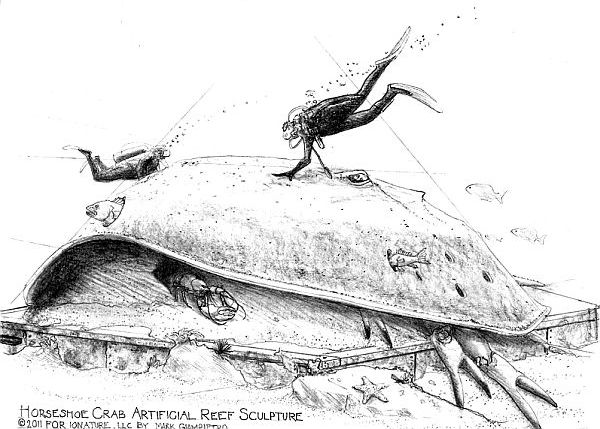
- Type:
- artificial reef, barge
- Specs:
- ( 40 x 50 ft )
- Sponsor:
- Chris Wojcik
- Sunk:
- Thursday August 30, 2012 - Axel Carlson Artificial Reef
- GPS:
- 40°01.700' -73°59.300'
- Depth:
- 80 ft
Horseshoe Crab Sculpture Destroyed
Artist Chris Wojcik's sculpture shattered as support strap breaks during the sinking process
By Karen Wall
Asbury Park Press
The snap of a support strap was all it took to end Chris Wojcik's dream of placing a giant sculpture on the Axel Carlson Reef.
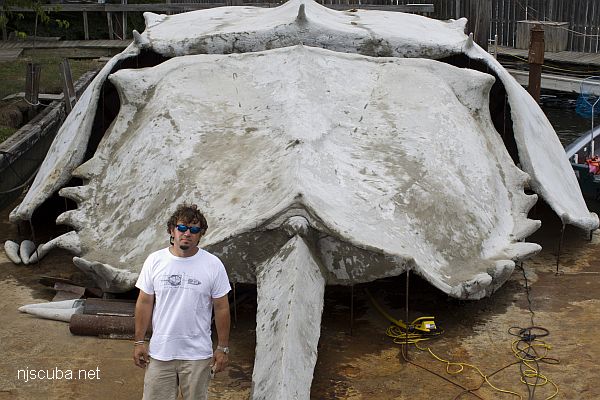
The 47-foot sculpture of a horseshoe crab -- representing more than a year's worth of work to construct it and raise funds -- lies in pieces in 80 feet of water, according to Hugh Carberry, director of the state's Artificial Reef Program through the Division of Fish and Wildlife.
"It was basically my worst nightmare coming true, " Wojcik, of Point Borough, said Thursday evening when he finally returned home after spending a few more hours at the reef site trying to assess the damage.
The sculpture was welded onto a pair of 50-foot deck barges, and the 50-ton assembly was towed out to the reef site Thursday morning. Once there, Carberry said the barges were slowly filled with water and a pair of bridles -- one under the head of the crab, the other under the tail end -- were put in place.
As it neared the point of being ready to sink, Carberry said, the bridles were attached to a crane operated by DonJon Marine, an experienced heavy marine moving company. As they began to lower the crab to the bottom, Carberry said, the bridle under the tail section snapped and the barges sank.
Instead of simply hitting the bottom, however, Carberry said that during the descent, the crab separated from the barges and it hit bottom first and broke. The deck barges then landed on top of the pieces, breaking them further, he said.
"It's a heartbreaker, " Wojcik said. The sculpture was expected to be listed in the Guinness Book of Records as the world's largest underwater sculpture. "It's a very discouraging situation."
Carberry said he and the crew from the reef program ran side-scan sonar over the area almost immediately and he said at first they could see the barges sitting right side up but not the crab. Side-scan sonar is projected out from the sides of a boat, instead of straight down, and has been used in mapping ocean wreckage for several years.
Carberry said DonJon had divers on the crane and sent them down to confirm the sonar findings.
"The way it (the bridling) was designed, it should have worked, " Carberry said.
Carberry said the pieces of the crab and the barges will still make good habitat because they provide structure. Wojcik had welded steel piping onto the deck of the barge that will make good habitat for lobsters, and the pieces of concrete -- made from the same material the state uses to create reef balls -- will still attract all kinds of life.
"It'll still make a nice reef, " he said, "but we would have liked to have seen it (whole) on the bottom."
Carberry said that when Wojcik approached him initially with the concept, he thought it was a really neat idea.
"I thought it was really unique, " Carberry said, noting that Florida has some sculptures as part of its reef system. But the magnitude of the one Wojcik constructed surprised and impressed him.

"I had no idea it would be that big, " Carberry said.
The sculpture had taken Wojcik and two friends six weeks to construct. A steel rebar skeleton was built, and the concrete that made up its body was poured in a single pour over the frame and shaped into place.
The sinking took several months to accomplish as Wojcik had to raise the funds to pay for it, then set all the arrangements in place with the state and the crane operator. Among those who supported the effort were the Hudson River Fishermen's Association, and the Ann E Clark Foundation, which has been a significant supporter of projects on New Jersey's artificial reefs.
After the crab was inspected by the Coast Guard and the EPA and approved for sinking, Wojcik had to wait for cooperative weather. A planned July 25 sinking was scrapped when storms made the conditions unsafe.
When Wednesday arrived and the weather looked good for Thursday, the crab was moved from its home behind the Shipwreck Grill in Brielle, under the Route 35 and railroad bridges that span the Manasquan River to a dock behind the Shrimp Box in Point Pleasant Beach. Early Thursday morning final riggings were attached and the crab began its journey to the reef, passing through Manasquan Inlet to cheers from supporters and in sight of the curious who had heard about it or seen its construction in progress.
Hannah and Cameron Teza, 8 and 10 years old, dragged their father, John, to the inlet just as the sun rose to see it make its departure. Hannah had seen it when it was just being framed, and Cameron had seen the completed sculpture.
"I got home from a business trip last night and my wife told me they wanted to see it, " Teza said.
As it moved along behind a TowBoat US boat, Wojcik could be seen on the barge, checking tie-lines and making sure everything was OK. He waved to the onlookers then went back to his work.
Out at the reef, Wojcik's wife, Caryn, other family members, and a number of folks who helped pay for the construction and the sinking of the sculpture, watched the progress from the deck of Capt. Bob Pennington's Sea Devil.
The wait was a long one as first Wojcik and Carberry walked around the perimeter of the sculpture, then were joined by the crew from DonJon. Coverings were removed from holes on the sides and hoses inserted to pump seawater into the interior of the barges. The sinking slowed when an air pocket developed at the head end of the barges and crewmen from the crane deck had to cut an additional hole in the side to let the air escape.
As water began washing over the deck, you could hear the anticipation rising for what was expected to be a slow descent. But the snap of the bridle caused a collective gasp, and the instant recognition among all that the result might be bad.
Wojcik, who had been watching and filming from a Zodiac, approached the Sea Devil to assure his family that he was OK.
"Somebody didn't calculate right, " he said, then turned and headed back toward the site where the crab disappeared beneath the surface.
Thursday evening, Wojcik was trying to find some positives, but the devastation of the day was unquestionably his primary emotion.
"All the material will still make good habitat, " he said. "It'll be a little better for lobster than for blackfish, because it will be flat like a dinner plate, " while blackfish prefer nooks and crannies to hide in.
Wojcik, who had previously talked about possibly doing other sculptures, wasn't sure what his next step would be.
"I have to sort this out first, " he said.
The sculpture actually hit the bottom first, and the barge landed on top of it upside-down. I don't think it could have turned out any worse. It wouldn't have lasted long anyway.
Artificial Reef Sites, Artificial Reefs, Axel Carlson Artificial Reef, Barges, New Jersey Artificial Reef Sites, New Jersey Artificial Reefs,
Axel Carlson Artificial Reef
- "small old wreck"
- Austin
- Barbara Ann
- Bay King
- big barge
- Brooklyn
- Manasquan Inlet Buoy
- Captain Bill
- Carrabassett
- Caterina.D
- Colleen
- crab barge
- Delaware
- Ed Schmidiger
- Glory Wreck
- Hail Mary
- Harbor Charlie
- Hillman III
- Jim Lynch
- Manasquan Inlet
- McGinty
- Megan Sue
- Middle Barge
- MRMTC 8
- MRMTC 9
- OWD III
- Patrick McHugh
- Riggy
- Rump
- Shark River Inlet
- Snug Harbor
- Swensen
2.0 Nautical Miles off Mantoloking, 5.19 sq miles
Depth: 65-80 ft [download]
More: Axel Carlson Artificial Reef ...
Manasquan Chart
- Barge #10
- 120 Wreck
- 3 Sisters
- Ambrose Buoy
- A Street - Shark River
- Across
- Adele
- Ajace
- Alex Mac
- Allenhurst Jetty
- Anastasia
- Antioch
- Arnoff
- Arundo
- Asfalto
- Aurora
- Ayuruoca
- BA Wreck
- Shark River - Back Bay
- Balaena
- Bald Eagle
- Barnegat Inlet
- BD1738
- USS Benson
- Beth Dee Bob
- Blue Boy
- Bonanza
- Brick barge
- Bronx Queen
- Brunette
- Cecilia M Dunlap
- Cornelius Grinnell
- Catherine Jackson
- Chauncy Jerome
- Caddo
- Cadet
- Capt Smitty
- Catamount
- Charlemagne Tower
- Chaparra
- Chesapeake
- Choapa
- clam boat
- Continent
- crane barge
- Creole
- Daghestan
- Delaware
- drydock
- Dryland
- dump
- Duncan
- Edmund Phinney
- Elberon Rocks
- Emerald / USS Hibiscus
- Eureka
- Francis A Perkins
- William R Farrell
- FF Clain
- Finance
- Fort Victoria
- Gassoon
- German
- Lady Gertrude
- GL78
- Glen II
- Glory Wreck
- I.P. Goulandris
- Granite Wreck
- Great Isaac
- Gulftrade (stern)
- Gulftrade (bow)
- Gypsy
- Horseshoe Cove
- Alexander Hamilton
- Hankins (Big)
- Hankins (Offshore)
- Hankins 3
- Happy Days
- Cornelius Hargraves
- Harry Rush
- Harvey's Schooner
- Thomas Hebert
- Ida K
- Immaculata
- Inshore barge/tug
- Irene/Truro
- Irma C
- John Minturn
- Jack I
- Joan La Rie III
- Klondike Rocks
- Lizzie H. Brayton
- Lana Carol
- Larsen
- Lavallette Wreck
- Leon Walter
- Lillian
- Lizzie D
- Long Branch locomotives
- Logwood
- H.W. Long
- Macedonia
- Mahogany
- Malta
- Manasquan Inlet
- Marion
- Maurice Tracy
- Mediator
- Meta
- Middle Barge
- Mistletoe
- R.C. Mohawk
- Mohawk
- Manasquan Wreck
- Nautilus
- Navesink River
- Northeast Sailor
- New Reef
- New Deal
- New Era
- NW Barges
- Olsen
- HMS Pentland Firth
- Park City
- Peerless
- Persephone
- Long Branch Pier Rubble
- Pinta
- Pliny
- Plymouth
- Pocopson
- Remedios Pascual
- Ruth Shaw
- Ramos
- Ranger
- Reliable
- Relief Lightship
- Rickseckers
- Ridge Schooner
- Riggy
- Rjukan
- Rockaway Belle
- Roy's barge
- RP Resor
- Manasquan River Railroad Bridge
- Rudder Wreck - Pocono
- Rump
- Rusland / Adonis
- Scotland Buoy
- San Saba
- Sandy Hook Pilot Boat
- SC-60
- Sea Girt Inlet
- Sea Girt Wreck
- Sea Hag
- Seaside Crane Barge
- Shark River Inlet
- Shrewsbury Rocks
- Simala
- Spring Lake Sailor
- Steel Wreck
- Stolt Dagali
- Sumner
- Southwest Mohawk
- Sylvanus
- Tampa III
- Thurmond
- Tolten
- Train Wheel
- Troop Carrier
- USS Turner
- AWOIS 8087
- AWOIS 8097
- u11
- AWOIS 7509
- AWOIS 7932
- AWOIS 9768
- AWOIS 12966/11422
- AWOIS 1609
- AWOIS 8084
- AWOIS 7940
- AWOIS 7938
- AWOIS 8076
- AWOIS 4600
- AWOIS 8075
- Valerie E
- Vega
- Vivian
- Vizcaya
- Warrior
- Western World
- Edward W Winslow
- Yankee (G+D)
- Yellow Flag
- ZPG-3W
More: Manasquan Dive Sites Chart ...
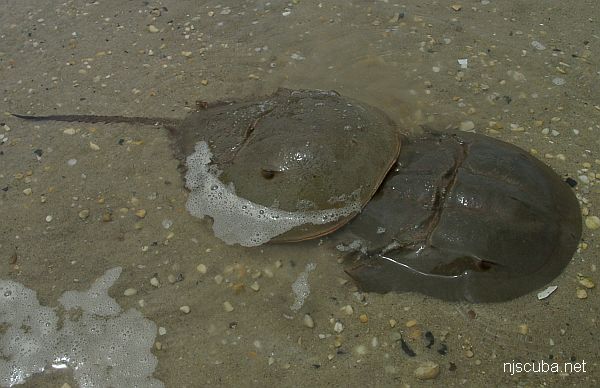
Horseshoe Crabs Limulus polyphemus are extremely common in the rivers and bays of this area. They are actually more closely related to spiders than to the other crustaceans on this page. In fact, technically they are not crustaceans at all. Despite their fierce-looking array of claws and spines, they are completely harmless.
They are also completely inedible - not even the native Indians would eat them except in the direst emergency. They are nonetheless threatened by man since vast numbers are collected commercially for fertilizer, bait, and other uses. Horseshoe Crabs are found from the water's edge down to 75 feet.
More: Atlantic Horseshoe Crab ...



Questions or Inquiries?
Just want to say Hello? Sign the .