
Immaculata
- Type:
- shipwreck, barge
- Depth:
- 95 ft
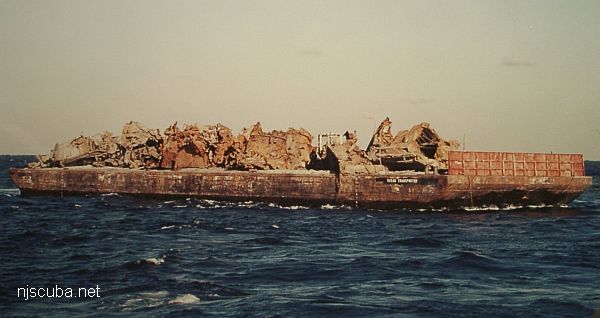
This wreck seems to be one or more wooden barges, possibly garbage barges from the 1920s. There is an anchor in one spot near a machinery pile, and in other spots, the old walls rise perhaps 10 ft off the bottom. But otherwise, everything is pretty broken down. This forms many hiding holes for lobster and rock crabs, and there is one in almost every hole, and some quite large. The Sea Bass are also good-sized. Yellowish natural sponges and bottles are easy to find.
This area is marked on many charts as the "Acid Grounds" because it was once used as a dumping ground for industrial waste. That was a while ago, however, and the environment certainly looks healthy enough today. Visibility this far out can be very good, but the bottom stirs up easily into an impenetrable cloud of silt, and there is little current to carry it away.
AWOIS 7790
Questions or Inquiries?
Just want to say Hello? Sign the .