Logwood

Logwood
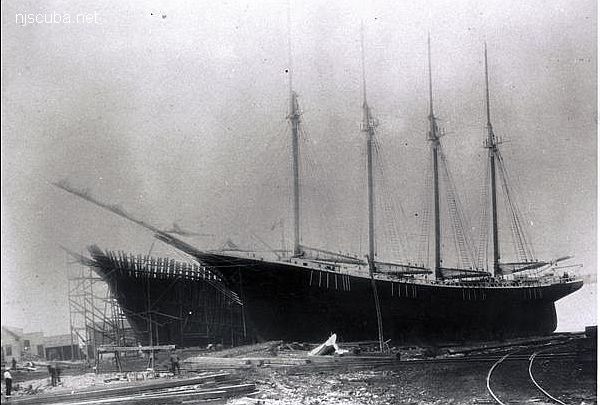
Launching of the John D. Colwell
Type:
shipwreck, sailing ship
Built:
1906, Cobb, Butler & Co, Rockland, Maine, USA, as John D. Colwell
Specs:
( 192 x 39 ft ) 1,042 gross tons, 14 passengers & crew
Sunk:
Wednesday May 12, 1920
collision with tanker Laramie, no casualties
Depth:
95 ft
Logwood
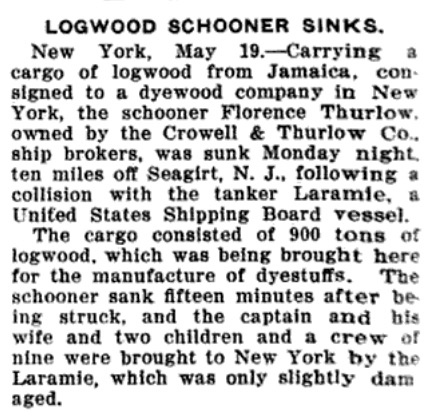
Lumber Manufacturer and Dealer: Volume 65, 1920

The Laramie was found to be solely at fault. The Florence Thurlow, buoyed up by her cargo of lumber, did not immediately sink, and was eventually removed as an obstruction to navigation by the Coast Guard, probably with dynamite.

Today the "Logwood" is a typical New Jersey lobster "snag". It consists of a pile of rusted chain surrounded by low timbers running off in several directions in the sand. This wreck is in an area that scallop boats frequent, and shows the signs of being dragged apart. Each year pieces of wreckage are missing or dragged far off the main wreck site. It is a good place to find scallops and, depending on how frequently she's dived, not a bad place for lobster.
Logwood

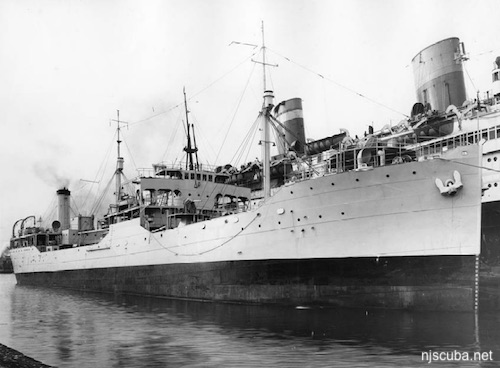
Laramie, later during World War II as USS Laramie; launched in 1919. At the time of the collision, the brand-new ship was owned by the United States Shipping Board, and the incident is expunged from her official Navy histories. At 446 feet and 14,950 tons fully loaded, even a glancing blow from Laramie would have been fatal to the schooner.

The wreck was identified by Dan Lieb of the New Jersey Historical Divers Association ( although it was always known as the "Logwood", which in hindsight was a dead giveaway. )

Comments on Logwood

Questions or Inquiries?

Just want to say Hello? Sign the .

Submit a Comment

Your email address will not be published. Required fields are marked *


Click image to replace if unable to read.

Enter the digits from the image above, except for the last one:

This site uses Akismet to reduce spam. Learn how your comment data is processed.


Warning:

Results from this program are not verified. Neither the author nor this website are liable for any loss, damage, or injury, including death, which may result from engaging in either scuba diving, snorkeling, or any of the activities mentioned within this site. These tools and calculators are provided for educational and convenience purposes only and should not be used for planning or conducting actual dives.


 Waypoints ( ft )
Table Generator      Show Profiles

Depth:
(ft)
Open-Circuit Bailout
Time:
(min)
from: to: step:

Equipment &
Environment
Salt   Fresh     Altitude: ( ft )    Metric

Open Circuit   
SCR (cmf) Warning    SCR (vmf)    CCR    O2 for bailout


OC
SAC
(cfm)

*
FO2
Main

*
FHe
Main

RB
O2 Rate
(lpm)

Loop
Vol
(liters)

SCR
flow
(lpm)

SCRv
PO2
boost

CCR
PO2
shallow

CCR
PO2
deep

CCR
Split
Depth

Model

 ZHL16B '90
 ZH-L16C '90

 ZH-L12C *
 ZH-L8C *
   Workman '65
   ZH-L12 '83
   ZH-L16A '90
   DCAP '88
   Haldane '08
   Navy '55?
   DSAT '87
Model Options

 z1 ( 4min )
 z1b ( 5 min )
 H2O effects
   RQ
 He effects (a/b)
  Conservatism

   GF-high
   GF-low
   PR-high
   PR-low
Last Stop Surface

 Decompression Stops ( ft )
Deep:  ZH-L17TS   Pyle min
 Shallowest Stop
   Depth Step
   Extend Last Stop ( minutes )
   include ascents in deco stop times


 Add Safety Stops if no deco required
 depth for    minutes

 Automatic Gas Switches
Deco Gas 1   FO2:    FHe:
Deco Gas 2   FO2:    FHe:
Deco Gas 3   FO2:    FHe:
   Max PO2 ( limit 1.65 )
   Max Gas-Switch Depth
Ascents & Descents ( ft )

Descent Rate (/min) show

Shallow

Deep

Split Depth

Ascent Rate (/min) show

Shallow

Deep

Split Depth

Output

 Net Bottom Times
 run times     segment times

Print headers last
Pressure Graphics
False Precision
  M-values
  Trace
 

TTF Altitude: ( ft )          Password: 

DO NOT USE THESE RESULTS FOR REAL DIVE PLANNING

[113]