A ship is a large watercraft that travels the world's oceans and other sufficiently deep waterways, carrying goods or passengers, or in support of specialized missions, such as defense, research, and fishing. Ships are generally distinguished from boats, based on size, shape, load capacity, and tradition.
Also known as the Italian Wreck, the Ajace was sunk at 4:00 AM on March 4, 1881. At the time, she was carrying a small cargo of scrap railroad iron and 2,040 empty petroleum barrels. While bound for New York from Belgium, the Ajace was caught in one of the worst storms of the year and ran aground off Rockaway beach. Many sources report that Captain F. Morice, seeing that all hope was lost, opened his private supply of brandy and shared it with his crew. Soon after, the crew became badly beaten from the pounding of the waves and drunk from the brandy.
The Alex Gibson shipwreck is the remains of a wooden barge. The barge was built in 1877 was 180 ft long and displaced 2154 tons. She was sunk in the 1930s and now sits in 40 ft of water on a clean sand bottom.
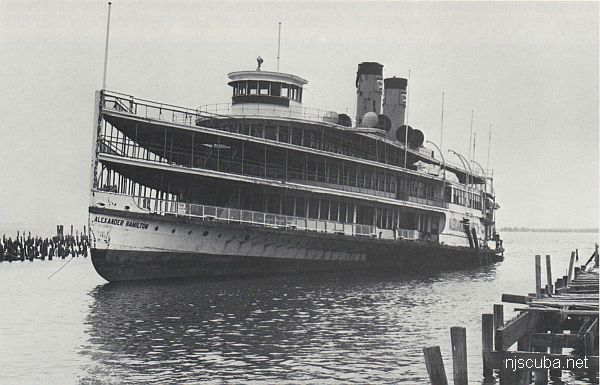
The Alexander Hamilton was the last of the steam-powered side-wheel riverboats of the Hudson River Day Line. Built in 1924, she ceased operations in 1971. A well-meaning group pulled the Hamilton from the mud in 1977 and moved her to a temporary berth along the east side of the Navy pier, planning to restore her as a museum. Unfortunately, at the new more-exposed location, the old vessel was sunk and reduced to scrap by a sudden storm in November of that year. The last records indicate that the wreck is still there, and you can even make out the outline on Google Earth.