
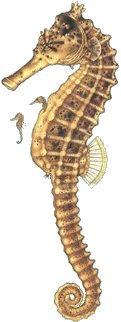
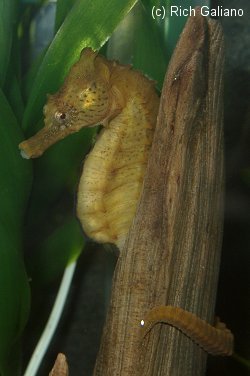
Lined Seahorse

Seahorse

Hippocampus erectus

Size: to 6"

Habitat: Weedy protected shore waters.

Notes:

Look for Seahorses in still weedy areas, where they cling to plants and objects with their prehensile tails. Color and body form are highly variable, as these masters of camouflage adapt to their surroundings. Strays may be found at sea, or even washed up on the beach.

Locomotion is accomplished by fluttering the dorsal and pectoral fins, and they are extremely weak swimmers, utterly unable to buck a current. Males have a brood pouch where they incubate the eggs, then give birth to fully-formed miniature copies of themselves. Seahorses feed on plankton, which they suck up with their tubular snouts, making a distinct popping sound. They are tolerant of brackish water, but not fresh.
By Bret Gilliam - 3/16/01
Technical Diving Editor and CEO
Technical Diving International

Are we hypocrites, or just following established guidelines established by reasonable people to protect our clients??

The April 2001 issue of Rodale's Scuba Diving has numerous articles acknowledging the practice and practicality of Solo Diving. I'm going to enter the articles and acknowledge the authors of each (rather than plagiarize these good peoples work)

Let's welcome the new millennium by finally ending the absurd controversy over solo diving and grant certification status to experienced divers through formalized process.

Codifying solo-diving with practical standards makes sense for two reasons: First, divers are who currently diving independently without formal training will be encouraged to receive the instruction they need. Second, the buddy system is deeply flawed. It fosters dependent behavior in many divers and is a proven not to enhance safety. In fact, it may do just the opposite for many divers forced into the role of buddy.