River & Inlet
These fishes are most likely to be found on or near the bottom in the rivers and inlets, either resting or swimming around. In addition, many of the types more often found out at sea may be found in the rivers and inlets. In addition, many tropical fishes may be found here as well.
Many of the types presented here are representative of entire families of similar related species. While some are closely related, others are not. These particular species are the most common in our area.
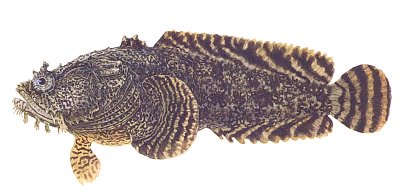
Opsanus tau
Size: to 15"
Habitat:
Generally inshore on hard bottoms and in shellfish beds, in 30-40 foot depths.
More: Oyster Toadfish ...
Myoxocephalus octodecimspinosus
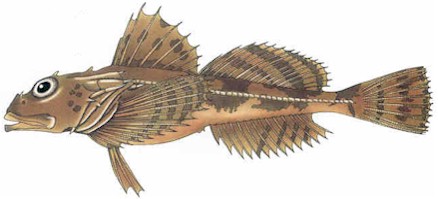
Size: to 18"
Habitat: Generally inshore in harbors and inlets, in 30-40 foot depths, but moves out to deep waters in winter.
Notes:
Sculpins have sharp spines around the head area - best to leave them alone. Sculpins are capable of loud vocalizations. Grubby is similar but smaller with a more rounded tail.
More: Longhorn Sculpin ...
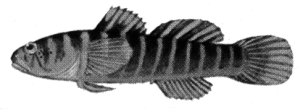
Gobiosoma bosci
Size: to 2-1/2 "
Habitat: bays, estuaries, protected coastal waters
Notes:
This is a funny little fish that prefers to hide under oyster shells and the like. Named for its complete lack of scales.
More: Naked Goby ...
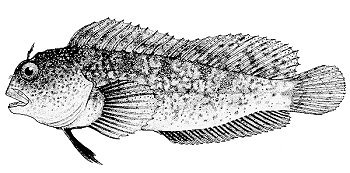
Hypsoblennius hentzi
Size: to 5"
Habitat: bays, estuaries, protected coastal waters
Notes:
Blennies live on the bottom in oyster beds or mussel beds. If you find an old piece of pipe or a bottle in the river, look inside - you'll probably find a blenny.
More: Feather Blenny ...
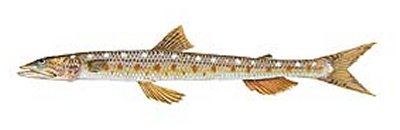
Synodus foetens
Size: to 18"
Habitat: almost anywhere, but favors shallow waters
Notes:
You will find these at night in the river, perched on their fins, with alligator-like jaws studded with teeth waiting for some unfortunate killy to come by. Spook it, and the Lizardfish will dart away too fast to see.
More: Inshore Lizardfish ...
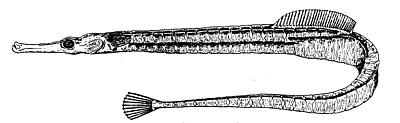
Syngnathus fuscus
Size: to 12"
Habitat: Weedy protected shore waters.
Notes:
The Northern Pipefish is the only common inshore species in our area. Pipefishes are closely related to Seahorses and found in the same kind of habitats. They lack the seahorse's prehensile tail but are much better swimmers than their coiled cousins.
More: Northern Pipefish ...
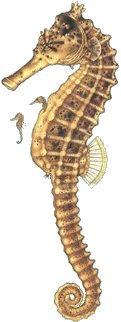
Hippocampus erectus
Size: to 6"
Habitat: Weedy protected shore waters.
Notes:
Look for Seahorses in still weedy areas, where they cling to plants and objects with their prehensile tails. Color and body form are highly variable, as these masters of camouflage adapt to their surroundings. Strays may be found at sea, or even washed up on the beach.
More: Lined Seahorse ...
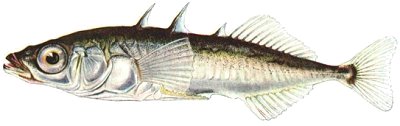
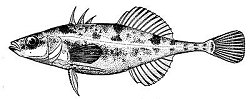
Gasterosteus aculeatus
( Threespine, right )
Apeltes quadracus
( Fourspine, below )
Size:
to 4" (threespine)
to 2" (fourspine)
Habitat:
Weedy shore waters, occasionally at sea or even in freshwater.
Notes:
Sticklebacks are related to Pipefish and Seahorses. Three- and four-spined varieties are common in our area. A Ninespine variety is also possible.
More: Sticklebacks ...
- Sea Basses & Porgies ...
- Blackfish & Cunner ...
- Cods & Allies ...
- Triggers, Puffers, & Sunfish ...
- Flounders ...
- Drums ...
- Ocean Bottom ...
- Baitfishes ...
- River & Inlet ...
- Pelagics ...
- Tropical Fishes ...
- Sharks - Inshore ...
- Sharks - Offshore ...
- Sharks - Dogfishes ...
- Skates & Rays ...
More: Marine Fishes ...
Fish
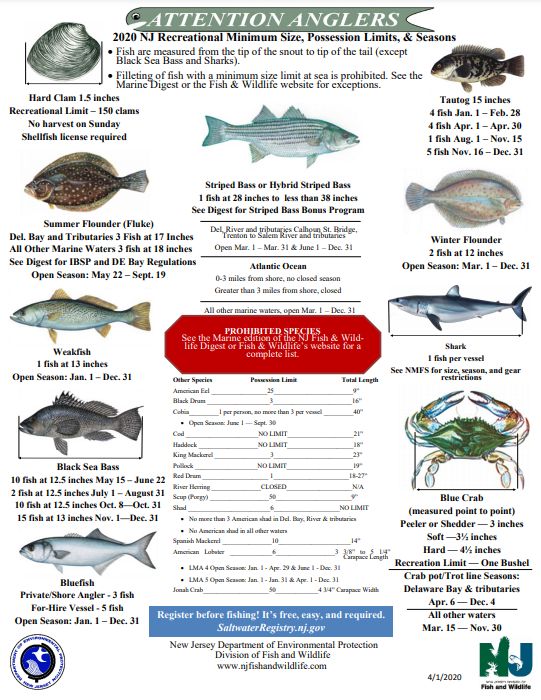
New Jersey now requires registration for saltwater fishing, including lobsters. Registration is free and can be done online at nj.gov/dep/saltwaterregistry.
This listing is for New Jersey waters only - if you cross into New York or Delaware, or Federal waters ( more than 3 miles offshore, ) you are subject to their regulations. Federal regulations supersede state regulations whenever stricter.
Lobster
More: Fishing Regulations ...