Fishing Regulations
Fish
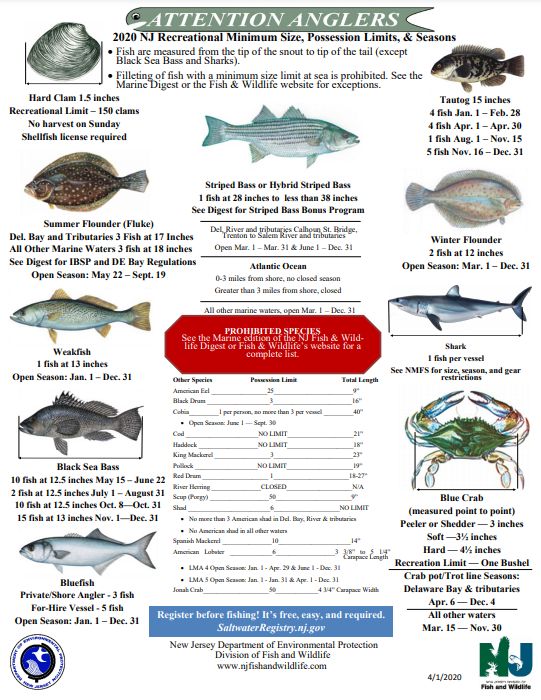
New Jersey now requires registration for saltwater fishing, including lobsters. Registration is free and can be done online at nj.gov/dep/saltwaterregistry.
This listing is for New Jersey waters only - if you cross into New York or Delaware, or Federal waters ( more than 3 miles offshore, ) you are subject to their regulations. Federal regulations supersede state regulations whenever stricter.
Lobster
Jan 1 - April 29, limit 6
June 1 - Dec 31, limit 6
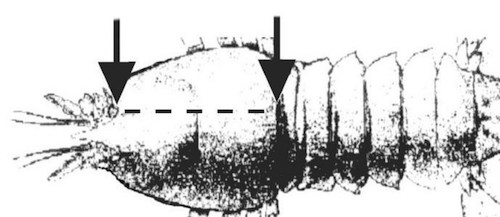
The legal possession size limit of whole lobsters, measured from the rear of the eye socket along a line parallel to the centerline of the body shell to the rear of the body shell, shall be not less than 3⅜ inches nor greater than 5¼ inches. Lobster parts may not be possessed at sea or landed. There is no harvest or possession of lobster in Lobster Management Area 4 from April 30 – May 31 and Lobster Management Area 5 from February 1 – March 31.
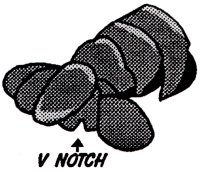
The possession limit is six lobsters per person. No person shall possess any lobster with eggs attached or from which eggs have been removed or any female lobster with a v-notched tail, as illustrated.
Special Lobster Restrictions:
No person shall use, leave, deploy, or tend any lobster, fish, or conch pot within an artificial reef located in state waters except in areas designated as full access zones. Within these designated full access zones lobster, fish, and conch pots shall be used, left, deployed, or tended only between sunrise and sunset.
Shellfish
This is a shocker:
All persons must be licensed to harvest any shellfish. Shellfish means any species of benthic mollusks (except conch) including hard and soft clams, oysters, surf clams, bay scallops, and mussels.
Those big bags of mussels that everyone takes are technically illegal without a $10 license, as are scallops. I've never heard of anyone getting in trouble, but if a brown shirt was in a bad mood ...
23:10-20. Searches and seizures; immunity from civil suit
A member of the Fish and Game Council and any conservation officer may, without warrant search and examine any boat, conveyance, vehicle, fish box, fish basket, game bag, game coat or other receptacle for game and fish, when he has reason to believe that a provision of this Title, or any law supplementary thereto, or the State Fish and Game Code has been violated, and shall seize and take possession of any firearms, bows and arrows, shells or cartridges, fishing rods and reels, fishing lines, knives, lights, slingshots, traps, spears, spear guns or any other article or equipment that has been illegally used or any bird, animal or fish unlawfully caught, taken, killed, had in possession or under control, shipped or about to be shipped. A court, upon receiving proof of probable cause for believing in the concealment of a bird, animal or fish so unlawfully caught, taken, killed, had in possession or under control, shipped or about to be shipped, shall issue a search warrant and cause a search to be made in any place, and to that end, may, after demand and refusal, cause any building, enclosure or car to be entered, and any apartment, chest, box, locker, crate, basket or package to be broken open and its contents examined by a member of the Fish and Game Council or any conservation officer. All firearms, bows and arrows, shells or cartridges, fishing rods and reels, fishing lines, knives, lights, slingshots, traps, spears, spear guns or any other article or equipment that has been illegally used and seized by a member of the council or any conservation officer shall be returned to the defendant when and if the case has been dismissed, if he has been found not guilty, or if he has been convicted and has paid the penalty and costs imposed, if any.
The member of the council or conservation officer shall not be liable for damages by reason of any such search or the seizure of any nets or fishing, hunting or trapping apparatus in accordance herewith.
Amended by L.1948, c. 448, p. 1830, s. 88; L.1972, c. 184, s. 1, eff. Dec. 12, 1972.
I have to say ...
Fisheries management is educated guessing that is often based on far too little data. Scientists can collect reports from commercial and recreational fishermen, and also go out and do biomass surveys, often by trawling, just as the commercial fishermen do. They do the best they can, but none of this is enough to really say what is down there, let alone predict what will happen in the future.
One thing is for sure though - the old man fluking off a bulkhead with his grandkids isn't going to catch anything he can keep, but he is going to keep whatever he can catch. Excessive regulation turns us all into scofflaws - did anyone ever actually drive 55 mph? It is my belief that recreational fisheries are over-regulated to placate commercial interests. If damage is being done, it is the commercial fishermen, with their giant sea-going vacuum cleaners and miles of long-lines, that are doing it, not you and me with our bare hands.
A thing that works out disastrously is setting the catch limit to one. That just makes people go on butchering fish all day, trying to get their one big one. Catch and release has a high mortality rate, especially in deep water. "Functionally dead" is the scientific term for something that is still moving right now, but it is not going to live, whether or not you release it. Have you ever seen a fish with its guts pushed out of its body by its over-expanded swim bladder? Or a fish with its mouth torn apart by a hook? That is functionally dead. Scientists made up this term, yet fisheries management bureaucrats never seem to have heard it.
Setting minimum size limits unrealistically high is simply going to result in the massacre of "undersized" fish the same way. And if you really want to get steamed, commercial fishermen are held to quite different rules that allow them to keep smaller fish than you or I would be permitted. In fact, the commercials have a lower minimum size for just about every regulated species. But then, pretty much everything they pull up in a trawl or hook on a long-line is going to be "functionally dead", so they might as well keep it.
If you really want to protect the fish, set the limit to ZERO - no fishing at all. That wouldn't make very good politics though, and unfortunately, fisheries management is far more politics than science. And the commercial fishermen are really, really, well-organized on that front. But don't be too hard on them - do you like to have fish in the supermarket? They have to come from somewhere. Those guys have families to support too.
The Blackfish rules are designed to spare the pregnant females until after they spawn, which is a good idea. The Black Sea Bass rules are similar - they go stupid during their brief spawning season. I don't think there is much rhyme or reason to the Summer Flounder rules - they come and go as they please - some years there are none, and then the next year they are everywhere.
I don't mind the increased minimum for lobsters - 3-1/4" is really not much of a bug. But I do resent them taking away our trophies. There are plenty of giant bugs out in deep water where no diver can go, but the commercial fishermen can drop a pot to any depth. They should not have applied the maximum size to the recreational fishery, but then the commercials would be screaming 'unfair', and in the end, as I said, it all comes down to politics.
Biology ( including medicine ) is the most imprecise of the sciences. The systems are so huge, complex, subtle, and/or random, that it is often difficult to determine anything at all. So they collect what data they can ( often not nearly enough ) and then statistically analyze the hell out of it to try to prove something. And maybe they do, and maybe they don't; no one ever publishes a paper that says "we didn't find anything, it was a waste of time," at least not more than once.
A well-trained scientist will never admit he is wrong, or that an experiment failed. Grant-funded science doesn't work that way.
Stupid regulations turn everyone into scofflaws