
Ayrshire
- Type:
- shipwreck, sailing ship, England
- Sunk:
- Saturday, January 12, 1850
grounded in storm - 1 casualty
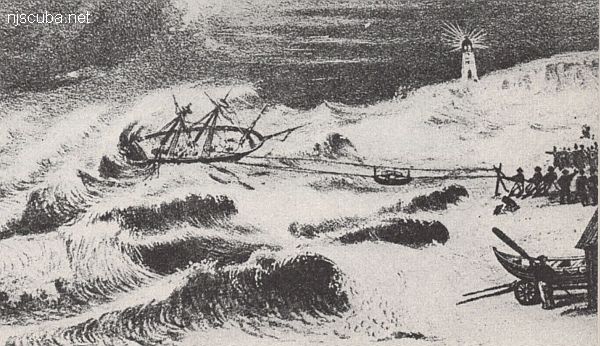
All but one of the approximately 200 passengers and crew were gotten off safely using a surf car. The one casualty was unnecessary - a man tried to cling to the outside of the surf car while his family was inside, and drowned.
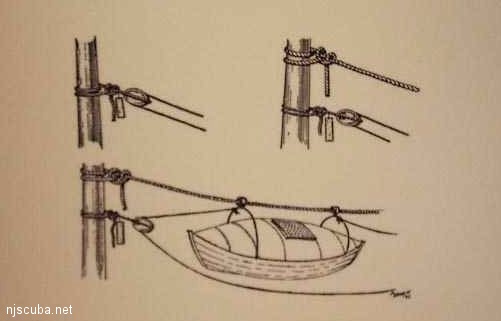
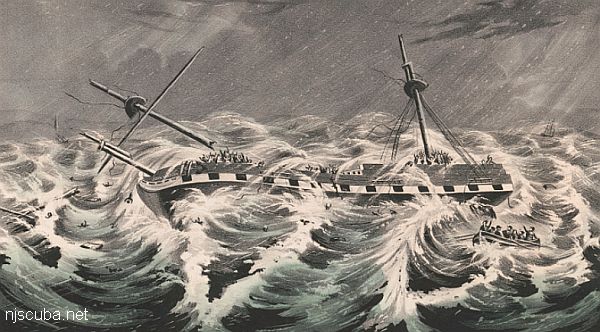
The invention of the lifesaving surf car was a direct result of the sinking of the John S Minturn and many other vessels in a horrific storm several years earlier.
Shipwreck Uncovered on Brick Beach
Dan Radel, November 6, 2014
ASBURY PARK PRESS
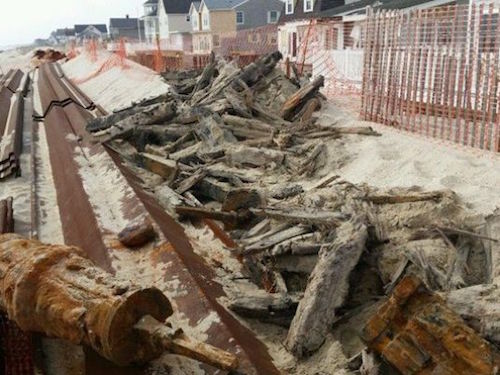
Timber from a 19th-century shipwreck uncovered on Brick beach
Excavators drilling on Brick beach for a coastal sea wall project unearthed what shipwreck historians believe is a 19th-century sailing vessel. Workers made the discovery last week after a specialized drill struck the relic about 20 to 25 feet under the sand, said Dan Lieb, trustee at the New Jersey Shipwreck Museum in the InfoAge Science Center.
"It's a snapshot of history," said Lieb. Experts are still speculating about what type of ship it is. Two ideas being floated around is that the shipwreck is an old barge or possibly the Ayrshire, a Scottish brig that grounded onto a sandbar on Jan. 12, 1850.
"It could be the Ayrshire. Geographically it is about three-quarters of a mile from the location," said Lieb. "It could have drifted from the spot. I don't know what happened to it. It could have been dragged up on the beach and burned for its metal."
The Ayrshire was carrying 201 British and Irish immigrants when it struck a sandbar off what was known as Squan Beach then, a seven-mile stretch of sand from the Manasquan Inlet south to the Cranberry Inlet, which no longer exists, Lieb said.
"If I recall there was only one loss of life," Lieb said. According to Lieb, the Francis life-car, a metal life raft with a roof was deployed to rescue the passengers. The Francis life-car used a pulley system, a line tethered from the shore to the vessel to shuttle passengers to land. The Ayrshire was the first rescue the car was used.
If it's not the Ayrshire, Lieb is confident it is at least a sailing vessel from the early to mid-1800s. He said that could be a barge because barges of that time period were also sailing vessels, not the rectangular-flat box styles of today.
The remnants consist of 98-percent timber, some iron and debris, along with an intact windlass, a device used to release the anchor, which Lieb said is a textbook match for the era. A hawsepipe, where the anchor chain passes through the bow was also discovered.
Lieb believes there is much more to wreck still underground waiting excavation. "A professional archaeologist under contract with the state will make a determination on the wreck," said Lieb."
Dive Sites, Manasquan Dive Sites, New Jersey Dive Sites, Sailing Ships,
Manasquan Chart
- Barge #10
- 120 Wreck
- 3 Sisters
- Ambrose Buoy
- A Street - Shark River
- Across
- Adele
- Ajace
- Alex Mac
- Allenhurst Jetty
- Anastasia
- Antioch
- Arnoff
- Arundo
- Asfalto
- Aurora
- Ayuruoca
- BA Wreck
- Shark River - Back Bay
- Balaena
- Bald Eagle
- Barnegat Inlet
- BD1738
- USS Benson
- Beth Dee Bob
- Blue Boy
- Bonanza
- Brick barge
- Bronx Queen
- Brunette
- Cecilia M Dunlap
- Cornelius Grinnell
- Catherine Jackson
- Chauncy Jerome
- Caddo
- Cadet
- Capt Smitty
- Catamount
- Charlemagne Tower
- Chaparra
- Chesapeake
- Choapa
- clam boat
- Continent
- crane barge
- Creole
- Daghestan
- Delaware
- drydock
- Dryland
- dump
- Duncan
- Edmund Phinney
- Elberon Rocks
- Emerald / USS Hibiscus
- Eureka
- Francis A Perkins
- William R Farrell
- FF Clain
- Finance
- Fort Victoria
- Gassoon
- German
- Lady Gertrude
- GL78
- Glen II
- Glory Wreck
- I.P. Goulandris
- Granite Wreck
- Great Isaac
- Gulftrade (stern)
- Gulftrade (bow)
- Gypsy
- Horseshoe Cove
- Alexander Hamilton
- Hankins (Big)
- Hankins (Offshore)
- Hankins 3
- Happy Days
- Cornelius Hargraves
- Harry Rush
- Harvey's Schooner
- Thomas Hebert
- Ida K
- Immaculata
- Inshore barge/tug
- Irene/Truro
- Irma C
- John Minturn
- Jack I
- Joan La Rie III
- Klondike Rocks
- Lizzie H. Brayton
- Lana Carol
- Larsen
- Lavallette Wreck
- Leon Walter
- Lillian
- Lizzie D
- Long Branch locomotives
- Logwood
- H.W. Long
- Macedonia
- Mahogany
- Malta
- Manasquan Inlet
- Marion
- Maurice Tracy
- Mediator
- Meta
- Middle Barge
- Mistletoe
- R.C. Mohawk
- Mohawk
- Manasquan Wreck
- Nautilus
- Navesink River
- Northeast Sailor
- New Reef
- New Deal
- New Era
- NW Barges
- Olsen
- HMS Pentland Firth
- Park City
- Peerless
- Persephone
- Long Branch Pier Rubble
- Pinta
- Pliny
- Plymouth
- Pocopson
- Remedios Pascual
- Ruth Shaw
- Ramos
- Ranger
- Reliable
- Relief Lightship
- Rickseckers
- Ridge Schooner
- Riggy
- Rjukan
- Rockaway Belle
- Roy's barge
- RP Resor
- Manasquan River Railroad Bridge
- Rudder Wreck - Pocono
- Rump
- Rusland / Adonis
- Scotland Buoy
- San Saba
- Sandy Hook Pilot Boat
- SC-60
- Sea Girt Inlet
- Sea Girt Wreck
- Sea Hag
- Seaside Crane Barge
- Shark River Inlet
- Shrewsbury Rocks
- Simala
- Spring Lake Sailor
- Steel Wreck
- Stolt Dagali
- Sumner
- Southwest Mohawk
- Sylvanus
- Tampa III
- Thurmond
- Tolten
- Train Wheel
- Troop Carrier
- USS Turner
- AWOIS 8087
- AWOIS 8097
- u11
- AWOIS 7509
- AWOIS 7932
- AWOIS 9768
- AWOIS 12966/11422
- AWOIS 1609
- AWOIS 8084
- AWOIS 7940
- AWOIS 7938
- AWOIS 8076
- AWOIS 4600
- AWOIS 8075
- Valerie E
- Vega
- Vivian
- Vizcaya
- Warrior
- Western World
- Edward W Winslow
- Yankee (G+D)
- Yellow Flag
- ZPG-3W
More: Manasquan Dive Sites Chart ...
- Type:
- shipwreck, sailing ship, USA
- Built:
- 1841, Westerly RI USA
- Specs:
- ( 119 x 27 ft ) 398 tons
- Sunk:
- Thursday February 15, 1846
ran aground in storm - approximately 10 survivors and 40 dead - Depth:
- 20 ft
More: John Minturn ...
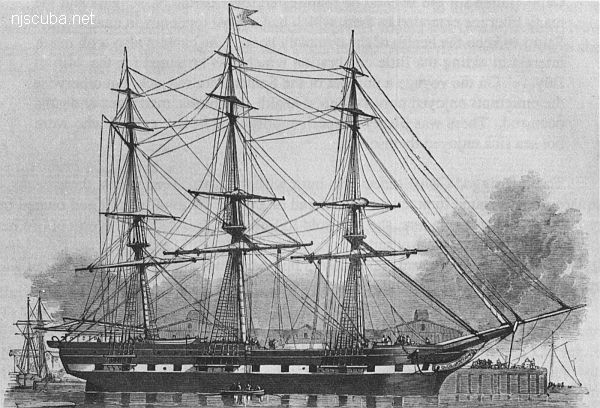
- Type:
- shipwreck, sailing ship, USA
- Specs:
- ( 180 x 38 ft ) 1100 tons
- Sunk:
- Monday, January 13, 1853
grounded in storm - no casualties
More: Cornelius Grinnell ...
Questions or Inquiries?
Just want to say Hello? Sign the .