
USS Turner DD-648 (1/3)
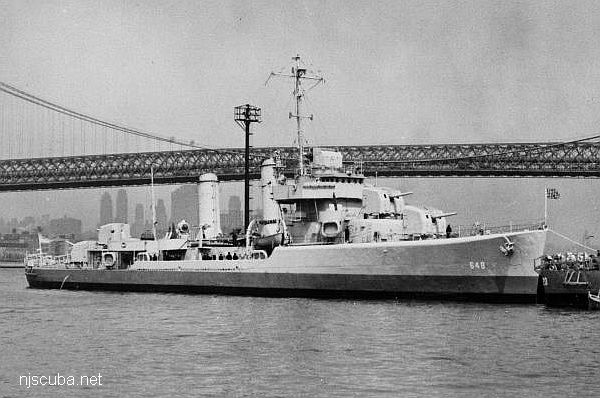
- Type:
- shipwreck, destroyer, Bristol class, U.S. Navy
- Built:
- 1942, Federal Shipbuilding, Kearny NJ USA
- Specs:
- ( 350 x 36 ft ) 1700 displacement tons, 301 crew
- Sunk:
- Monday January 3, 1944
munitions explosion while at anchor - 138 casualties - Depth:
- 55 ft
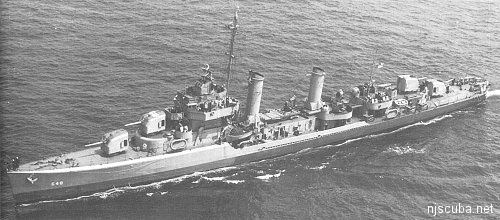
There doesn't seem to be a whole lot left of the Turner. The wreck was demolished and even partially removed by Navy. After much trolling around to anchor into "the big part" of the wreck, all that I found was a small patch of rubble.
In one part, the boilers were clearly evident, recognizable by piles of tubes. However, the rest of the wreckage is low. But with two foot viz ( four if you looked both ways ) I could certainly have missed a lot.
The explosion and subsequent sinking of the Turner are attributed to accidental detonation of Mousetrap ASW weapons during unloading, which is also thought to be the cause of the loss of the USS Solar.
Anti-Submarine Projector Mk 20 & 22 ( Mousetrap )
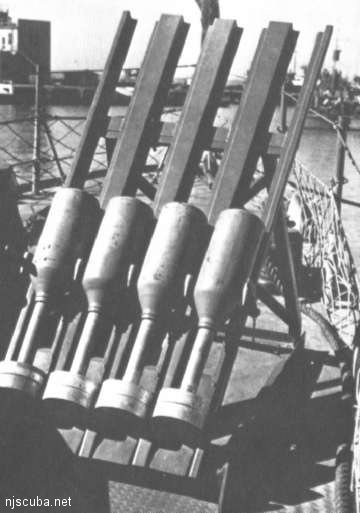
Though Hedgehog had been a success, its large dimensions, especially weight, caused much trouble in the fleet. In fleet destroyers, for example, one of the forward 5" mounts would have been due for removal if a Hedgehog was to be installed; this, among other reasons, caused Hedgehog in the U.S. Navy to be exclusively fitted to destroyer escorts and license-built British frigates and ASW refits of flush-deck destroyers.
However, the benefits of Hedgehog could be of use in the large number of small sub hunters, the PCs, which rarely even sighted a submarine but which made for good coastal escorts nevertheless. The new weapon, ordered developed early in 1942, was to fit on the small ships and yet be able to deliver an effective pattern of charges, 70 ft wide. Those were originally intended to be slightly larger than the original Hedgehog round, but problems with the development of that new charge caused it to be abandoned in favor of the original Hedgehog round. A rocket (in this case meaning a slow-burning propellant) was attached to the lower body to make it fireable without the recoil inherent in Hedgehog.
Mousetrap suffered from a far smaller pattern, lack of stabilization and range adjustment, and was not the equal of Hedgehog. It was, nevertheless, installed in large numbers aboard small craft and even on twelve fleet destroyers ( because it could be mounted alongside the superstructure. ) These weapons were Mk 22 projectors, paired to equal a Hedgehog salvo, but was unsuccessful, probably causing the loss of the destroyer Turner in early 1944.
Mk 20 was a four-rail projector, while Mk 22 added two rails on each side for a total of eight. Mk 22 was standard later in the war; Mk 20 being adapted to fit the additional rails.
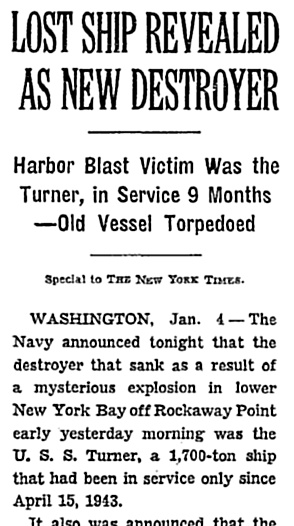
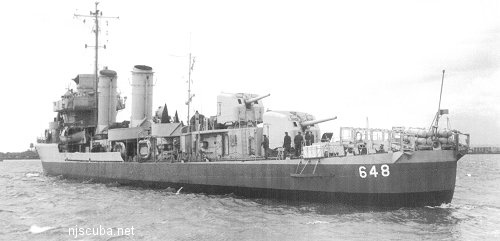
The second Turner (DD-648) was laid down on 16 November 1942 at Kearny, N.J., by the Federal Shipbuilding & Drydock Co.; launched on 28 February 1943; sponsored by Mrs. Louis E. Denfeld; and commissioned on 15 April 1943 at the New York Navy Yard, Lt. Comdr. Henry S. Wygant in command.
Turner completed outfitting at the New York Navy Yard and then conducted shakedown and antisubmarine warfare training out of Casco Bay, Maine, until early June. On the 9th, she returned to New York to prepare for her first assignment, a three-day training cruise with the newly commissioned carrier, Bunker Hill (CV-17). Returning to New York on 22 June, she departed again the next day on her first real wartime assignment, service in the screen of a transatlantic convoy. First, she sailed with a portion of that convoy to Norfolk, Va., arriving that same day. On the 24th, the convoy departed Hampton Roads and shaped a course eastward across the Atlantic. After an uneventful voyage, she escorted her convoy into port at Casablanca, French Morocco, on 18 July. She departed with a return convoy on the 23d and arrived back in New York on 9 August. Later that month, she was in the screen of a convoy to Guantanamo Bay, Cuba, making a brief stop at Hampton Roads along the way. On the return trip, she rendezvoused with HMS Victorious and accompanied the British carrier to Norfolk.
During the first two weeks of September, Turner conducted ASW training at Casco Bay, Maine, and then returned to New York to prepare for her second transatlantic voyage. On 21 September, the destroyer headed south to Norfolk. She arrived there on the 23d and, the following day headed out across the Atlantic with her convoy. After an 18-day passage, during which she made one depth-charge attack on a sound contact, Turner arrived at Casablanca on 12 October. Four days later, she departed again and headed for Gibraltar to join another convoy. The warship reached the strategic base on the 17th and, after two days in port, stood out to join the screen of Convoy GUS-18.
On the night of 23 October, Turner was acting as an advance ASW escort for the convoy when she picked up an unidentified surface contact on her SG radar. At 1943, about 11 minutes after the initial radar contact, Turner's lookouts made visual contact with what proved to be a German submarine running on the surface, decks awash, at about 500 yards distance. Almost simultaneously, Turner came hard left and opened fire with her 6-inch, 40-millimeter, and 20-millimeter guns. During the next few seconds, the destroyer scored one 6-inch hit on the U-boat's conning tower as well as several 40-millimeter and 20-millimeter hits there and elsewhere. The submarine began to dive immediately and deprived Turner of any opportunity to ram her. However, while the U-boat made her dive, Turner began a depth-charge attack. She fired two charges from her port K-gun battery, and both appeared to hit the water just above the submerged U-boat. Then, as the destroyer swung around above the U-boat, Turner rolled a single depth charge off her stern. Soon after the three depth charges exploded, Turner crewmen heard a fourth explosion, the shock from which caused the destroyer to lose power to her SG and FD radars, to the main battery, and to her sound gear. It took her at least 15 minutes to restore power entirely.
Meanwhile, she began a search for evidence to corroborate a sinking or regain contact with the target. At about 2017, she picked up another contact on the SG radar - located about 1,600 yards off the port beam. Turner came left and headed toward the contact. Not long thereafter, her bridge watch sighted an object lying low in the water. Those witnesses definitely identified the object as a submarine which appeared to be sinking by the stern. Unfortunately, Turner had to break contact with the object in order to avoid a collision with another of the convoy's escorts. By the time she was able to resume her search, the object had disappeared. Turner and Sturtevant (DE-239) remained in the area and conducted further searches for the submarine or for proof of her sinking but failed in both instances. All that can be said is that probably the destroyer heavily damaged an enemy submarine and may have sunk her. No conclusive evidence exists to support the latter conclusion.
On the 24th, the two escorts rejoined the convoy, and the crossing continued peacefully. When the convoy divided itself into two segments according to destination on 4 November, Turner took station as one of the escorts for the Norfolk-bound portion. Two days later, she saw her charges safely into port and then departed to return to New York where she arrived on 7 November.
Following 10 days in port, the warship conducted ASW exercises briefly at Casco Bay before returning to Norfolk to join another transatlantic convoy. She departed Norfolk with her third and final convoy on 23 November and saw the convoy safely across the Atlantic. On 1 January 1944, near the end of the return voyage, that convoy split into two parts according to destination as Turner's previous one had done. Turner joined the New York-bound contingent and shaped a course for that port. She arrived off Ambrose Light late on 2 January and anchored.
Early the following morning, the destroyer suffered a series of shattering internal explosions. By 0660, she took on a 16- degree starboard list; and explosions mostly in the ammunition stowage areas - continued to stagger the stricken destroyer. Then, at about 0750, a singularly violent explosion caused her to capsize and sink. The tip of her bow remained above water until about 0827 when she disappeared completely taking with her 15 officers and 123 crewmen. After nearby ships picked up the survivors of the sunken destroyer, the injured were taken to the hospital at Sandy Hook. A Coast Guard Sikorsky HNS-1 flown by Lt. Comdr. F. A. Erickson, USCG - in the first use of a helicopter in a life-saving role - flew two cases of blood plasma, lashed to the helicopter's floats, from New York to Sandy Hook. The plasma saved the lives of many of Turner's injured crewmen. Turner's name was struck from the Navy list on 8 April 1944.
-- from Navy historical records
Shirley Pope:
May 30, 2021 at 2:08 PM
I'm wondering if any survivor alive knew Toxie Anderson from Purvis, Ms. Lamar County