City of Athens (1/2)

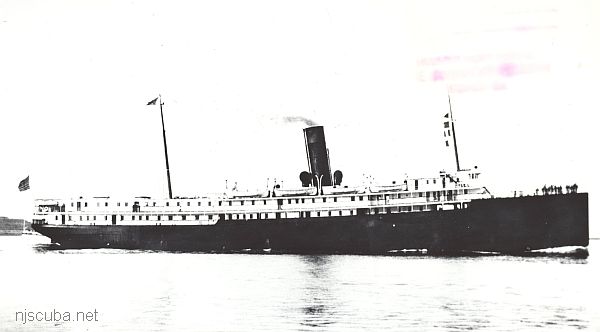
Shipwreck City of Athens
Type:
shipwreck, liner, USA
Built:
1911, New York Shipbuilding, Camden NJ USA, as Somerset
Specs:
( 309 x 46 ft ) 3648 gross tons, 135 passengers & crew
Sunk:
Wednesday May 1, 1918
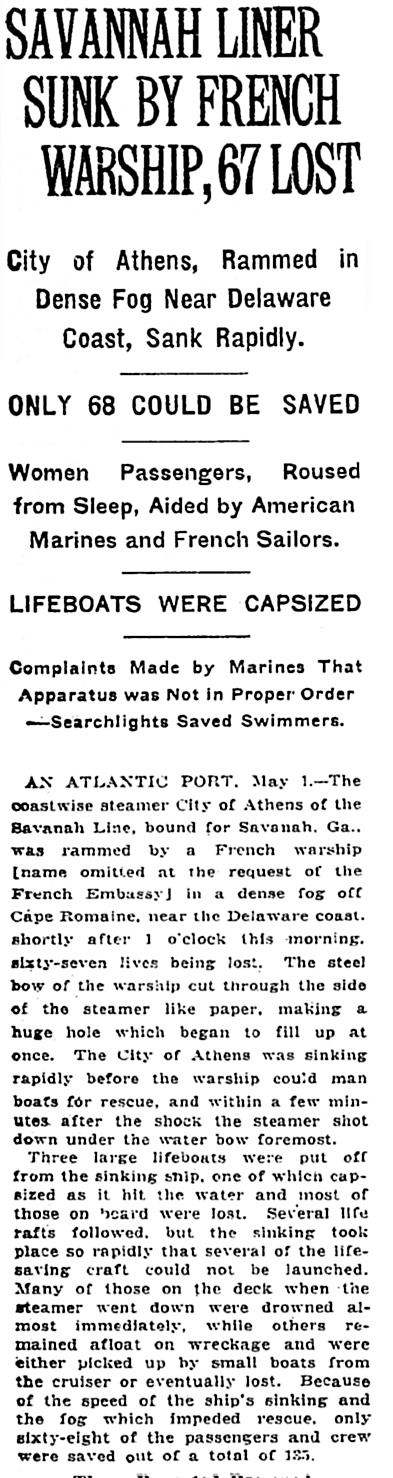
collision with French Navy cruiser La Gloire - 67 casualties
Depth:
110 ft

Today the City of Athens sits in 110 ft of water on a sandy bottom. The wreck is in one contiguous piece, however, quite broken up. The most distinctive features are the large boilers near her midsection. Decking and hull plates have collapsed in on her. There is a small section of wreckage believed to be the bridge not far off the port side, some 30 yards or so. The mass of twisted wreckage gives good home to fish and lobsters. Artifacts are also found. Ammo, bottles, brass, and china, have all been found. While some can still be found amidst the metal, most artifacts require digging. Because of her distance from shore, visibility is usually quite good, averaging around 35-40 ft, and occasionally exceeding 60.

The bow is quite intact with the anchor resting at the same place it was stowed. The depth at this point is 93 ft and drops to around 108 as you descend into the hold.

Fish are everywhere, but few large specimens. A nice school of Spadefish cruised the wreck during our visit. Artifacts are present for the patient hand-fanner, along with lobsters. Bits of broken glass and pottery shards lie exposed from earlier artifact hunters. Mussels hang in pods from the rusting hulk.

Visibility is better when a current is present on this site. We had around 25 ft with nice ambient light. Conditions can be on the intense side at times - darkness and a swift current are not uncommon. This should be considered an advanced dive.

- Jeff Barris
Shipwreck City of Athens New York Times
 1 2  

Comments on City of Athens

Questions or Inquiries?

Just want to say Hello? Sign the .

Submit a Comment

Your email address will not be published. Required fields are marked *


Click image to replace if unable to read.

Enter the digits from the image above, except for the last one:

This site uses Akismet to reduce spam. Learn how your comment data is processed.


mitts

Diving gloves should be close-fitting, with long, gusseted, zippered, or Velcro gauntlets that overlap your suit sleeves. This is especially important with a drysuit, since the glove will protect the delicate wrist seal on the suit. Thin tropical gloves are of very limited use in the north - your gloves should be at least 5mm thick. Three-fingered mitts are much warmer than five-fingered gloves and are really not much clumsier. They are also much easier to get on and off, which makes me wonder why so few people use them. A little spray soap will make any glove easier to get on.

A hood is critical for maintaining warmth in the water. A good hood will be as close-fitting as possible, and have a generous collar for tucking into your wetsuit, thin skin-in seal around the face, and baffled vents in the top to release bubbles. A neck skirt is much less necessary with a drysuit, but it is a simple matter to cut one off if you don't like it. A neoprene cold-water hood should be at least 5-6mm thick.

The face-hole of a hood should be as small as possible - there is no reason to expose any skin here. The face seal of the hood should overlap your mask skirt, with just barely enough room below for your regulator. You can always trim out a too-small face-hole, but a too-big one pretty much negates any other good qualities a hood may have. Ideally, with mask and hood on, you should expose a small patch on each cheek, and no more.