YP-387

YP-389
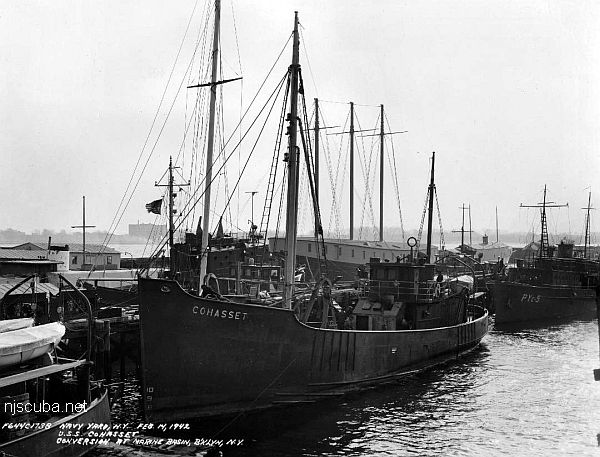
Sister YP-389, built in the same yard at the same time to the same specs
Type:
shipwreck, patrol boat, U.S. Navy, converted trawler
Built:
1941, Bethlehem Quincy, Quincy MA, USA, as Salem
Specs:
( 102 x 22 ft ) 301 tons, 21 crew
Sunk:
Wednesday May 20, 1942
collision with collier Jason - 6 casualties
Depth:
40 ft

On 10 September 1947, Windlass, in company with Salvager, began searching for the sunken YP-387. She located the wreck and began salvage operations while Salvager returned to Bayonne, apparently to get necessary equipment. Windlass apparently shifted briefly to Norfolk, Va., for the same reason before both heavy lifting salvage vessels returned to the site of the sunken YP off Hereford, N.J., on 1 October 1947. Two days later, they placed demolition charges in the sunken "Yippie boat" and blew her up to prevent her from being a hazard to navigation.

-- exact location unknown

From: the Dictionary of American Naval Fighting Ships

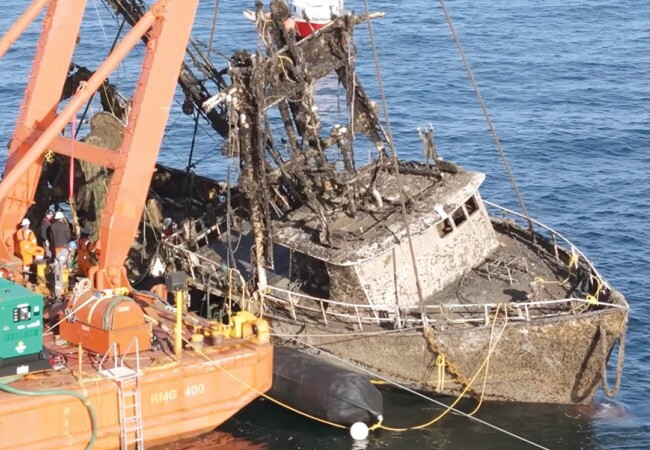
The Navy acquired three of these "Yippie" boats together, identical sisters. They all came to bad ends. The YP-387 was sunk in a collision off Cape May. The YP-389 was sunk by gunfire of the U-701 in 1942, unable to fight back because her one 3" gun was broken. The YP-388 sank in a collision in Boston harbor in 1951 and was not raised for almost a year.
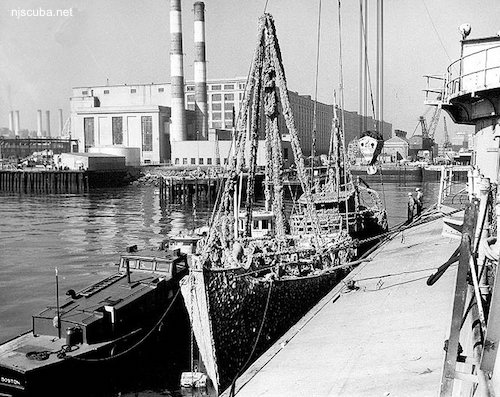
YP-388
YP-388
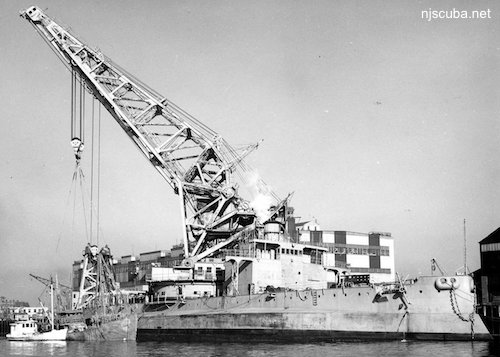
Identical sister YP-388, raised by the crane-ship Kearsarge, and looking like a prototype for an artificial reef.
YP-389
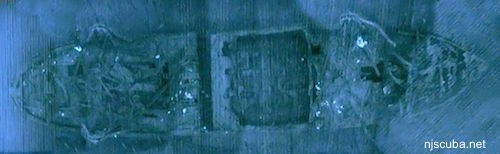
YP-389 side-scan sonar image in 2009, depth: 300 ft
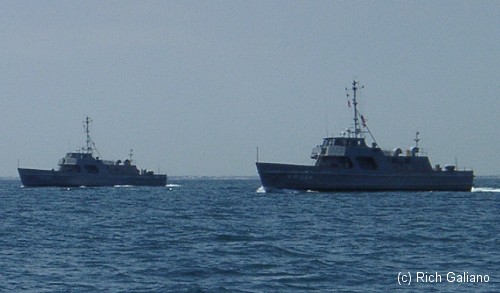
Navy Yippie boats

These modern Navy "Yippie" (YP) boats are a common summer sight. They are used to train cadets in boat handling and seamanship and are usually found in groups of four or more, executing synchronized maneuvers.
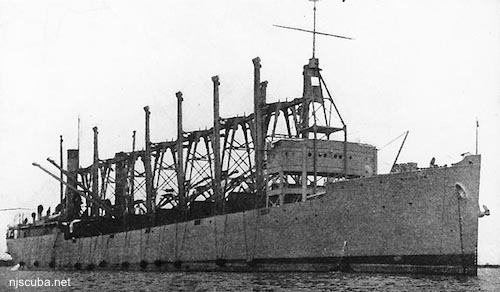
Jason
Jason as USS Jason


Comments on YP-387

Questions or Inquiries?

Just want to say Hello? Sign the .

Submit a Comment

Your email address will not be published. Required fields are marked *


Click image to replace if unable to read.

Enter the digits from the image above, except for the last one:

This site uses Akismet to reduce spam. Learn how your comment data is processed.


Marine Life Colonization of Experimental
Reef Habitat in Temperate Ocean Waters of New Jersey

By Bill Figley
January 2003

This investigation was partially funded by the Federal Aid to Sportfish Restoration Program

for the original paper, see here.


ABSTRACT

A biological colonization study of experimental reef habitats in temperate ocean waters off New Jersey was conducted over a 96-month period. A total of 145 different taxa of 9 phyla were identified within the experimental units, including 42 arthropoda, 37 annelida and 43 molluska. Individual organisms had an estimated mean abundance of 534,566 organisms/m2 of habitat footprint, including 105 fish, 4,639 crabs and 14 lobsters. Colonial organisms covered 87,554 cm2 of the habitat surface area. Mean total biomass of the organisms inhabiting the units was 84,175 g/m2, with blue mussel comprising 63 percent of the total. The carrying capacity of the experimental habitat for all species of marine life was about 152,801 g/m2. Predation accounted for an 80 percent reduction of biomass between surfaces exposed and not exposed to predators. There were no statistically significant differences in biological colonization rates of sessile epibenthos on concrete, rock, steel and rubber substrates. On an equivalent area basis, the biomass enhancement ratios of the experimental reef habitats over surf clam-dominated and polychaete/crustacean-dominated sand bottom habitats ranged from 35 to 1,124 and 2,773 to 3,200 times, respectively. A simplified, three-tiered reef habitat food chain consisted of 84.5 percent sessile/sedentary invertebrates, 11.0 percent mobile invertebrates and 4.5 percent juvenile and adult fish. The results suggest that complex reef habitats provide both attachment surfaces and refuge habitats that support a diverse and abundant marine life community.