
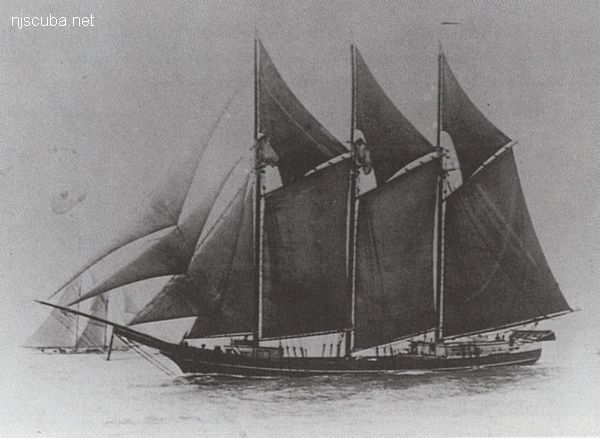
Cornelia Soule

Shipwreck Cornelia Soule
Type:
shipwreck, schooner, USA
Specs:
306 tons, 6 crew
Sunk:
Saturday April 26, 1902
ran aground in bad weather - no casualties
GPS:
40°25.992' -73°10.620' (AWOIS 2013)
Depth:
25 ft

Cornelia Soule

CDROM

The Cornelia Soule was a 306-ton three-masted schooner. She was bound from Maine to Philadelphia, heavily loaded with a cargo of cut granite jetty stones at the time of her demise.

On April 26, 1902, during a heavy sea and gale-force wind, the vessel ran aground on Rockaway Shoals. Because of the heavy sea, lifesavers could not reach the schooner until the next morning. At that time, Captain Bennett and his entire crew of five men were rescued and treated for exposure ailments.
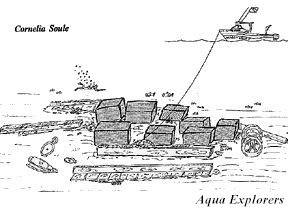
Shipwreck Cornelia Soule

Because of the cargo she was carrying, this wreck is better known as the Granite Wreck. She lies inshore and west of the Warrior Buoy in 25 feet of water. Most of her wood hull has become deteriorated or buried, but some ribs and planking can be seen on the west side of the wreck. The stern can be distinguished by some remaining steering machinery, but most of the wreck left to be explored is her cargo of granite slabs. This little wreck has become a good spot for spearfishing, especially Blackfish. She has also been a fairly productive, shallow water site for lobsters.

Excerpted from Wreck Valley CDROM by Dan Berg

Comments on Cornelia Soule

Questions or Inquiries?

Just want to say Hello? Sign the .

Submit a Comment

Your email address will not be published. Required fields are marked *


Click image to replace if unable to read.

Enter the digits from the image above, except for the last one:

This site uses Akismet to reduce spam. Learn how your comment data is processed.


The Buoyancy Compensator or BC is thought of primarily as a flotation device, and for warm-water divers with not much more than a single tank and reg, this is pretty much all it needs to be. However, for cold-water divers, the BC serves another and equally if not more important function: it is the base around which all the rest of your gear is assembled. For cold-water diving, a BC may be called upon to support multiple tanks, weights, gauges, bags, and myriad accessories - much more equipment than a tropical diver would ever carry. And not all BC designs are equally good at this.

BCs come in essentially two styles: the jacket style, where the entire BC is sewn into something like an inflatable vest, and the "tech" style, which consists of a web harness to which a back-mounted air bladder is attached for floatation. One thing that most beginners do not realize is that if you planned your dive and weighting correctly, you should be carrying very little air in your BC during your dive; especially true if you use a drysuit. Therefore, many of the manufacturer's big selling points of "interconnected three-dimensional air cells" and the like are more specious marketing hype than useful features, and the old inverted-U back bladder ( clearly descended from an automobile inner tube ) will work just as well as the much more complex and expensive designs, and sometimes better.