
Triangle Wrecks
- Type:
- shipwreck, tugboat, schooner barge, barge (?)
- Depth:
- 65 ft
One of these three closely grouped wrecks appears to be the remains of a large unidentified steam-powered ocean-going tugboat. A considerable amount of metal wreckage and a large boiler remain; the engine is nowhere to be found. The hull was probably 100-150 ft long, but the wreck has been dynamited to bits. Hull plates, I-beams, a small pilothouse, and other wreckage lie in twisted heaps strewn in all directions on a coarse sandy bottom. An interesting dive, with plenty to explore and even a few lobsters.
The second one of these wrecks, also known as the "Jack-I", looks like a wooden schooner barge with a cargo of rubble stone. Draped with old ropes and fishing line, this is not nearly as good a dive. The third wreck of the triangle is a broken-down old barge. The scow B.B.-59 is recorded as sunk on this spot on Friday, June 6, 1924, and could well be one of these. Currents in this vicinity are strongly dependent on the tide, and can be vicious. Visibility is often impaired by silty Hudson river and Raritan bay water and is usually poor.
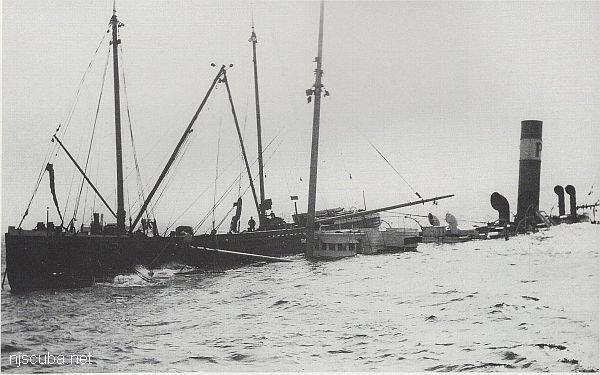
Somewhere around this area should also be the remains of the steamer Finance (below), for which I have never found a precise location.
Finance
- Type:
- steamer, Panama Railroad Company
- Built:
- 1883, Delaware River Iron Shipbuilding & Engine Works, Chester PA USA
- Specs:
- ( 295 x 38 ft ) 2603 gross tons, 155 passengers & crew
- Sunk:
- Thursday November 26, 1908
collision with freighter Georgic - 4 casualties
The Finance sank in only 15 minutes at a location about 3 (nautical) miles off Sandy Hook, directly under the shipping lane. The Finance sank with $100,000 in gold on board, all of which was salvaged by divers the next day. The wreck was later dynamited level with the seabed.


Questions or Inquiries?
Just want to say Hello? Sign the .