
American

American reef
Type:
artificial reef, schooner
Built:
1921, Arthur D. Story, Essex MA USA
Specs:
( 125 x 18 ft )
Sponsor:
Cold Springs Dock
Sunk:
Monday June 3, 1985 - Atlantic City Artificial Reef
GPS:
39°13.855' -74°12.332'
Depth:
120 ft

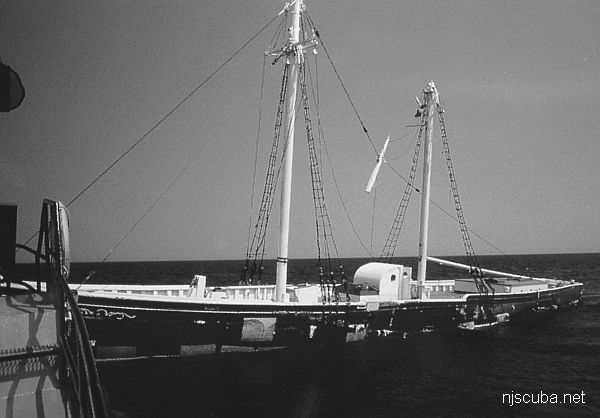
The American was the last Grand Banks fishing schooner to operate out of Gloucester MA. The wooden vessel carried 14 dories, from which fishermen jigged cod on the Georges and Grand Banks. In 1965 she was retired to Cape May Harbor where she spent 20 years as a floating cocktail lounge.

Wally Laudeman and his wife Marijane opened The Marine Bar in 1954 as a small restaurant primarily specializing in seafood and burgers. In 1964 the Laudemans expanded into what is now The Lobster House Restaurant at Fisherman’s Wharf.

Wally had the notion to find a schooner to dock outside the eatery. He found the vessel, Roy M, a 125-foot fishing schooner built in Lundenburg, Nova Scotia. Wally had the Roy M towed down from Lundenburg, and in 1965, the renamed schooner American opened to the public. The schooner featured a bar and served burgers delivered from the restaurant.

Despite a dock fire in 1972, the American spent 20 years moored alongside the Lobster House Restaurant. But eventually, the years and Mother Nature took their toll, and in 1985 the old schooner was replaced with a new vessel.

American reef
as Roy M
American reef

After sinking, the wooden masts came loose and floated to the surface, and had to be retrieved. As a result, vessels like this are no longer used as reefs. Today little remains, her wooden ribbing rises from the sandy bottom, planking and scattered wreckage, are spread around the site, mostly buried in the sand. There is one section that provides higher relief, covered in anemones and hydroids. Some lobster, and cunner. Visibility is standard for the area, ranging from 20 - 40 ft.

American reef side-scan

Comments on American

Questions or Inquiries?

Just want to say Hello? Sign the .

Submit a Comment

Your email address will not be published. Required fields are marked *


Click image to replace if unable to read.

Enter the digits from the image above, except for the last one:

This site uses Akismet to reduce spam. Learn how your comment data is processed.


Marine Life Colonization of Experimental
Reef Habitat in Temperate Ocean Waters of New Jersey

By Bill Figley
January 2003

This investigation was partially funded by the Federal Aid to Sportfish Restoration Program

for the original paper, see here.


ABSTRACT

A biological colonization study of experimental reef habitats in temperate ocean waters off New Jersey was conducted over a 96-month period. A total of 145 different taxa of 9 phyla were identified within the experimental units, including 42 arthropoda, 37 annelida and 43 molluska. Individual organisms had an estimated mean abundance of 534,566 organisms/m2 of habitat footprint, including 105 fish, 4,639 crabs and 14 lobsters. Colonial organisms covered 87,554 cm2 of the habitat surface area. Mean total biomass of the organisms inhabiting the units was 84,175 g/m2, with blue mussel comprising 63 percent of the total. The carrying capacity of the experimental habitat for all species of marine life was about 152,801 g/m2. Predation accounted for an 80 percent reduction of biomass between surfaces exposed and not exposed to predators. There were no statistically significant differences in biological colonization rates of sessile epibenthos on concrete, rock, steel and rubber substrates. On an equivalent area basis, the biomass enhancement ratios of the experimental reef habitats over surf clam-dominated and polychaete/crustacean-dominated sand bottom habitats ranged from 35 to 1,124 and 2,773 to 3,200 times, respectively. A simplified, three-tiered reef habitat food chain consisted of 84.5 percent sessile/sedentary invertebrates, 11.0 percent mobile invertebrates and 4.5 percent juvenile and adult fish. The results suggest that complex reef habitats provide both attachment surfaces and refuge habitats that support a diverse and abundant marine life community.