New Jersey Dive Sites (17/31)

Dive Sites - New Jersey

 1  16 17 18  31  

Shipwreck Macedonia
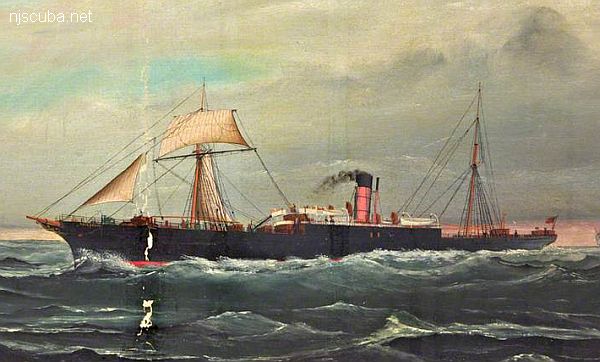
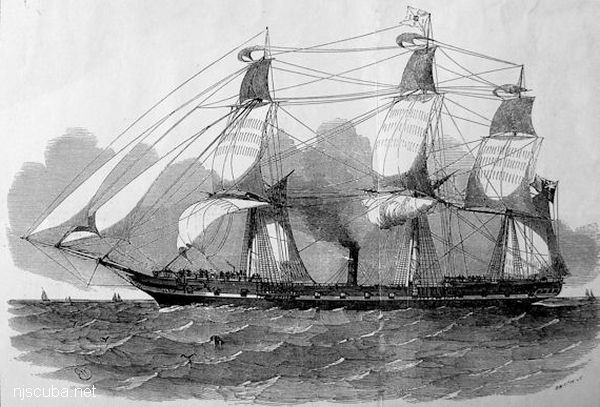
I found this old painting labeled "Macedonia" and "1894". This certainly could be the same ship. Another Macedonia enters the records in 1900, just a year after this one was lost.
Type:
shipwreck, steamer, Germany
( at time of loss chartered to Ward Lines, see Mohawk )
Name:
Macedonia is a region in the southern Balkans, adjoining Greece, and formerly part of Yugoslavia.
Built:
1894, England
Specs:
( 280 x 41 ft ) 2268 gross tons, 19 passengers & crew
Sunk:
Tuesday June 13, 1899
collision with liner Hamilton ( 3127 tons) - 1 casualty
GPS:
40°21.418' -73°56.153' (AWOIS 1991)
Depth:
60 ft


Shipwreck Malta
As Queen of the South, with a steam engine
Type:
iron-hulled steamer, converted to sail
Built:
1852
Specs:
( 244 x 40 ft ) 1600 displacement tons, 24 crew
Sunk:
Saturday November 24, 1885
ran aground in bad weather - 1 casualty
Depth:
20 ft

Manasquan Inlet

Type:
tidal river inlet with stone jetties or bulkheads on both sides
Depth:
30 ft

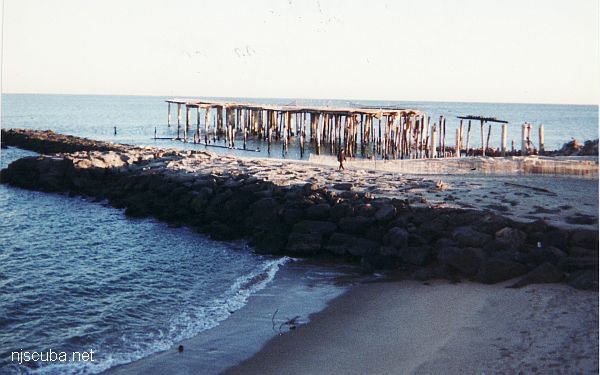
This inlet has a long slightly L-shaped jetty on the north side and a longer straight jetty on the south side. Both jetties are made of large stones and concrete, and the ends are built out of man-made concrete "jacks", shaped like an H with a 90-degree twist in the middle.


Manasquan Artificial Reef

2 miles off Manasquan Inlet, 0.99 sq miles
Depth: 67-74 ft [download]


Manasquan River
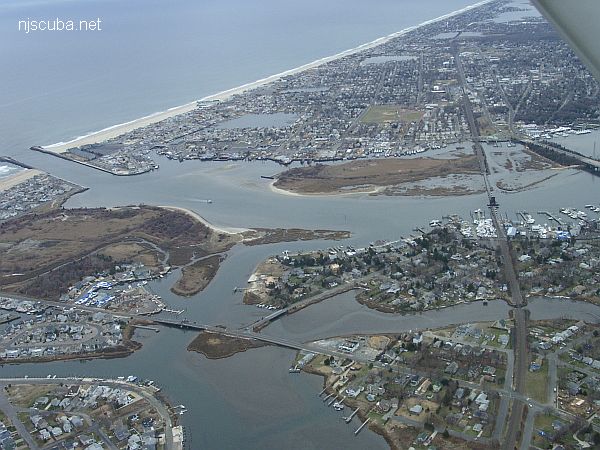
Aerial shot of the entire Manasquan River estuary, looking southeast. The Railroad Bridge dive site is at the upper-right.

The Manasquan River is overall not as nice a place to dive as the Shark River. The currents are stronger, the water never seems as clean, and the bottom is silty wherever it is not covered with mussels. The inlet jetties can be downright dangerous, and the boat traffic in the channel there is often very heavy. Off the north jetty is the so-called "Manasquan Wreck", but this is a long swim from shore and probably best approached with a boat.


Shipwreck Manasquan Wreck
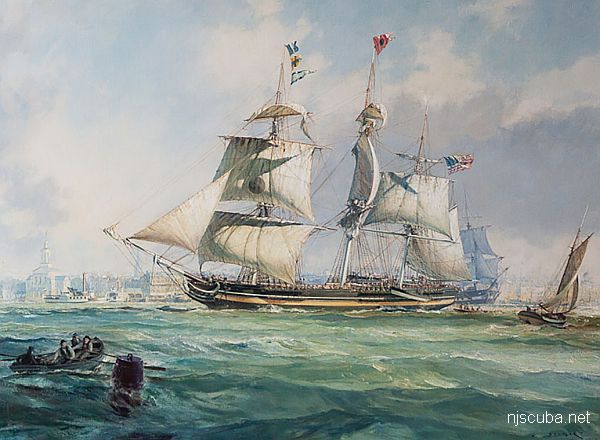
A Black Ball packet ship ( Orpheus ) leaving New York, 1835. Note the Black Ball insignia on the fore-topsail.
Type:
shipwreck, sailing ship, USA
Built:
1816, New York NY, USA
Specs:
382 tons
Sunk:
Saturday April 24, 1824
ran aground in a fog - no casualties
Depth:
30 ft

Type:
shipwreck, sailing ships
Sunk:
Sunday April 16, 1854
foundered in storm
Depth:
35 ft

The packet ship Manhattan sank with eight of her nine crew. In the same storm, the 200 ft schooner Powhattan was also lost nearby, with over 350 immigrants on board and no survivors. Neither wreck has been positively identified, although there are several candidates, including one old wooden hull buried up to the gunwales in the sand.


Type:
shipwreck, iron-hulled schooner barge ( formerly a Scottish/Italian bark )
Built:
1868, Dundee, Scotland
Specs:
693 tons
Sunk:
Saturday October 29, 1938
Depth:
60 ft


New Jersey Dive Sites

 1  16 17 18  31  

natural selection

Here is an abbreviated classification or taxonomy of all the organisms presented in this website, as well as a few others of interest. This is not meant to be a complete listing of all living things, nor even a completely correct one, since these classifications change as new theories come into favor. One should realize that every one of the groupings presented below is a judgment call representing collective scientific opinion, rather than a hard fact.

The classification of living things into groups depends not only on their differences and similarities but also on the degree to which they are studied and understood. For example, lesser-studied types such as mollusks tend to be lumped together into broad classifications, while popular and easily-studied types tend to be divided into fine distinctions. For a prime example of this, pick up any field guide on birds, and see how many Warblers there are in it. Birds are widely considered to be "over-split" - divided into many different species and families that are really not different. Coincidentally, bird-watching is an extremely popular pastime among scientists and laymen alike. Conversely, mollusks are probably "under-split", but then mollusk-watching is no fun at all.