
New Jersey Dive Sites (14/31)
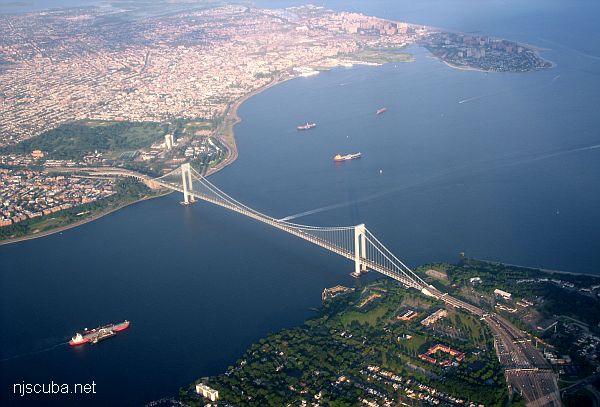
Looking roughly south: Sandy Hook is barely visible at upper-right, Rockaway inlet at the upper-left, Brooklyn at lower-left, Staten Island at lower-right. The shipping channel is also plainly obvious.
More: Hudson/East Rivers ...
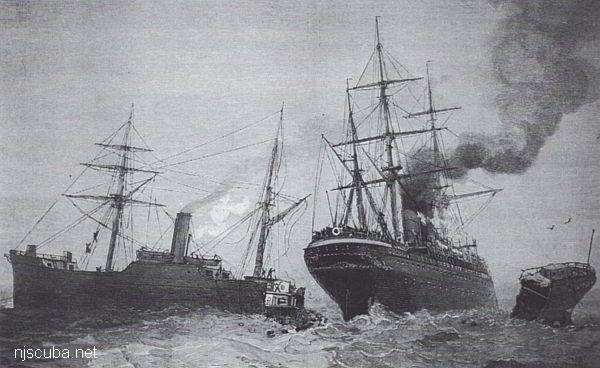
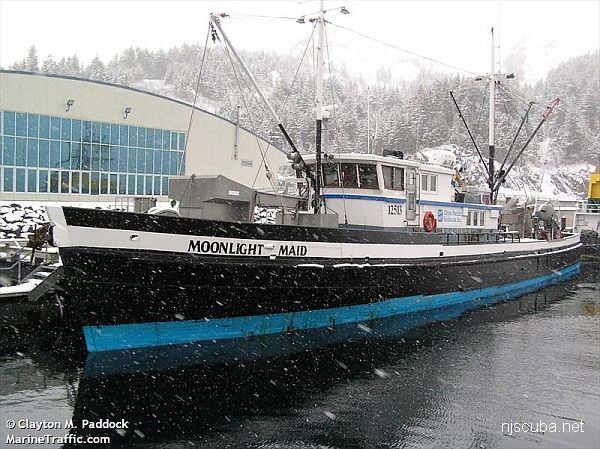
- Type:
- submarine chaser, later trawler, scallop boat, USA
- Built:
- 1943, Elizabeth City Shipyard, Elizabeth City NC USA
- Specs:
- ( 112 x 18 ft ) 99 gross tons
- Sunk:
- ???
- Depth:
- 90 ft
More: Ida K SC-1282 ...
- Type:
- shipwreck, barge
- Depth:
- 95 ft
This wreck seems to be one or more wooden barges, possibly garbage barges from the 1920s. There is an anchor in one spot near a machinery pile, and in other spots, the old walls rise perhaps 10 ft off the bottom. But otherwise, everything is pretty broken down. This forms many hiding holes for lobster and rock crabs, and there is one in almost every hole, and some quite large. The Sea Bass are also good-sized. Yellowish natural sponges and bottles are easy to find.
More: Immaculata ...
- Type:
- schooner barge & tugboat ?
- Depth:
- 85 ft
This is a fascinating big wreck of a wooden schooner barge. The broken stern is upended, forming a hollow pyramid that is full of fish. The sides and keel extend north from there to the bow, from which extends a chain which reaches to another much smaller wreck, which is known as the "Inshore Tug."
More: Inshore Barge/Tug ...
- Type:
- shipwreck, barges ( 2 )
- Sunk:
- Saturday May 26, 1934
foundered in storm - 2 casualties - Depth:
- 70 ft
More: Irene/Truro ...

- Type:
- shipwreck, party boat
- Specs:
- ( 47 ft ) 22 crew & passengers
- Sunk:
- Sunday Oct 24, 1982
foundered in rough weather - 6 casualties - Depth:
- 80 ft
probably nothing left but the engine, and that is probably buried
More: Joan LaRie III ...