
Evelyn Doris

- Type:
- artificial reef, towboat, USA
- Built:
- 1957, Vicksburg Marine Ways, Vicksburg MS USA, as Ernest Mack
- Specs:
- ( 64 x 23 ft ) 92 gross tons
- Sponsor:
- Dick Herb, Cape May County Charter Boat Association, Sport Fishing Fund
- Sunk:
- July 30?, 2025 - Cape May Artificial Reef
- GPS:
- 38°50.544' -74°42.479'
- Depth:
- 60 ft
Built in 1957 by Vicksburg Marine Ways Incorporated of Vicksburg, Mississippi (hull #9) as the Ernest Mack, for the M. & M. Towing Company of Baton Rouge, Louisiana. In 1994, the tug was acquired by the Augusta Towing Company Incorporated of Barhamsville, Virginia, where she was renamed as the Evelyn Doris. In 2004, she was acquired by Intracoastal Marine Incorporated of Chesapeake, Virginia. In 2021, the tug was phased out of active service and was "laid up" at Chesapeake, Virginia. She was a twin-screw towboat, rated at 1,000 horsepower.
tugboatinformation.com

The Evelyn Doris was contracted for $95,000 by Delaware in 2023, but for some reason ended up in New Jersey, albeit not far from Delaware. Another vessel on the same contract, the burned-out Spirit of Norfolk, went to Florida. Reef programs in both Delaware and New York seem to be stalled. A third vessel on that contract, a "70-foot steel trawler", has not turned up yet.
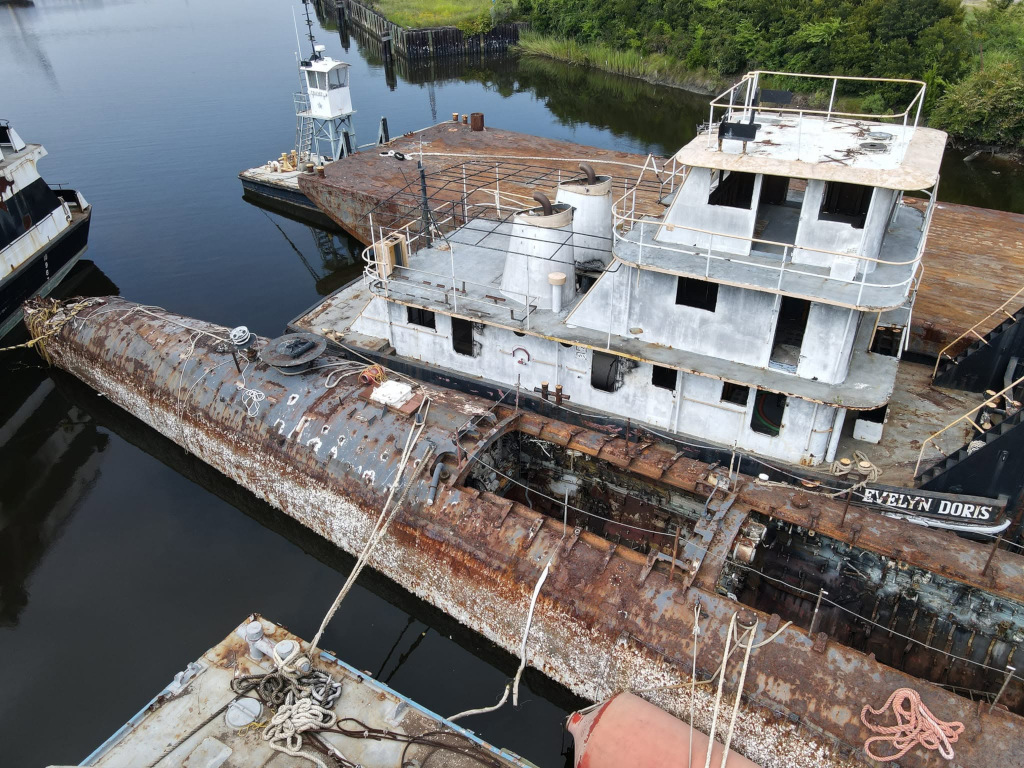
The tube next to her is the remains of USS Clamagore SS-343
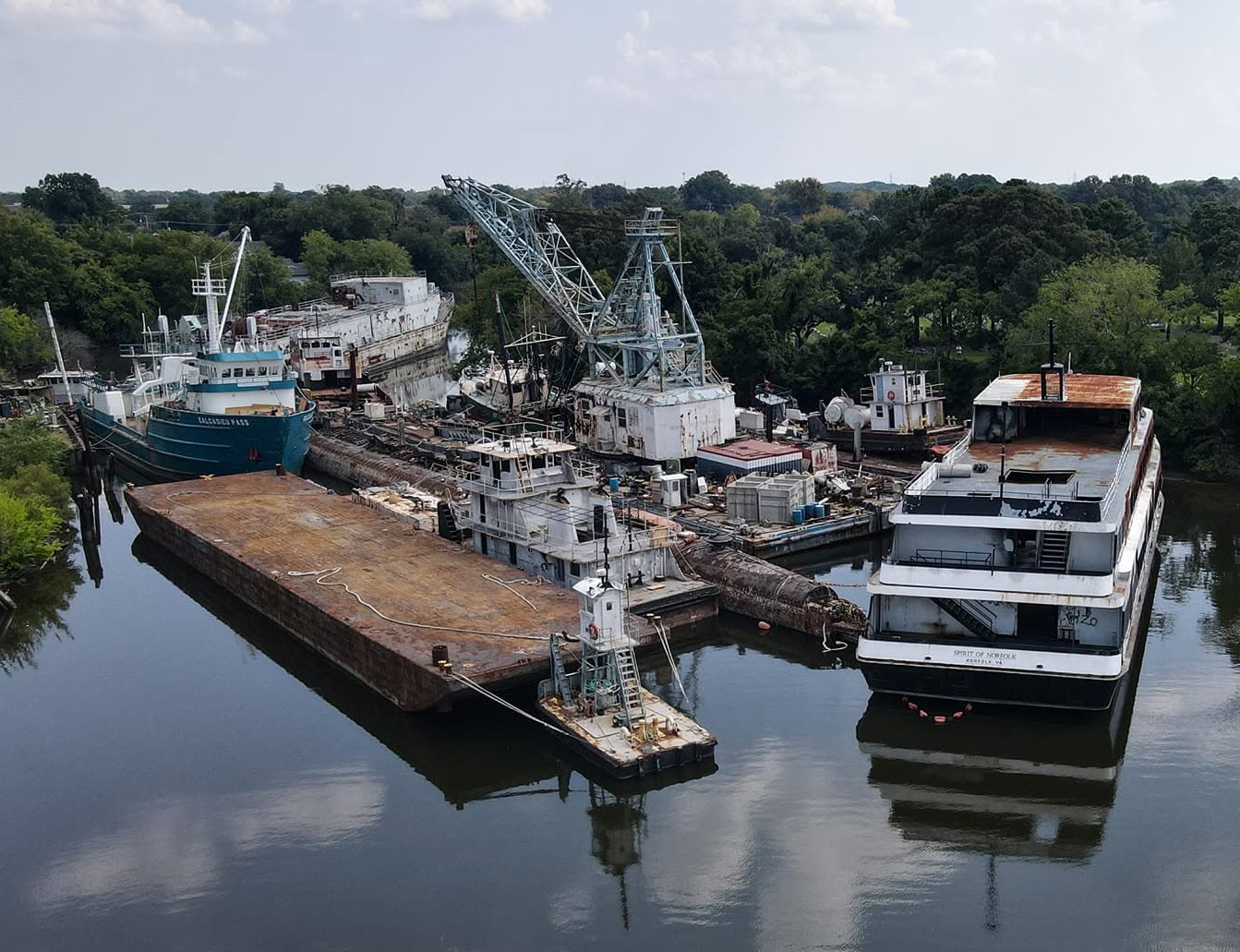
at Coleen Marine; Spirit of Norfolk at right
Coleen Marine, Norfolk VA
274942
Artificial Reef Sites, Artificial Reefs, Cape May Artificial Reef, McAllister Towing & Transportation, Military Reefs, New Jersey Artificial Reef Sites, New Jersey Artificial Reefs, Tugboats,
Cape May Artificial Reef
8.5 Nautical Miles off Cape May, 5.34 sq miles
Depth: 50-75 ft [download]
More: Cape May Artificial Reef ...
Cape May Chart
- Absecon Inlet
- USS Akron
- Alex Gibson
- Alexander
- Almirante
- American
- Astra
- Atlantus
- Azua
- Dorothy B Barrett
- Brigantine Beach Wreck
- USS Blenny
- boiler wreck
- Bonito
- Brian C
- Brigantine Inlet
- Brigantine Buoy Wreck
- Charles Morand
- Cape May Inlet
- Cassandra
- Cayru
- Champion
- USS Cherokee
- China Wreck
- City of Athens
- City of Georgetown
- Cleopatra
- Clermont
- Corson’s Inlet
- Crystal Wave
- William B Diggs
- dredge
- Admiral DuPont
- Elizabeth Palmer
- Elizabeth Warren
- Evening Star
- car float
- Florida
- Galimore's Cayru
- Gory Wreck
- Great Egg Inlet
- Gypsum Prince
- Hereford Inlet
- Hornet
- Hvoslef
- Independence Day
- India Arrow
- Indian River Inlet
- USS Jacob Jones
- John Marvin
- China Junk Wreck
- Kennebec
- King Cobra
- Lemuel Burrows
- Lake Frampton
- Lady Mary
- Linda Snow II
- Manhattan
- Marine Electric
- Miraflores
- Misty Blue
- Mohawk
- Montgomery
- USS Moonstone
- EF Moran
- Northern Pacific
- New Orleans
- USS Nina
- Nuphar
- Ocean Quest
- Oklahoma
- Patrice McAllister
- Pet Wreck
- Poseidon
- Ranald
- RJ Walker
- Southern Lillian
- USS S-5
- Salem
- Salem
- San Jose
- Sea Girt
- Sea Wolf
- Shookus
- Sindia
- Slabs
- General Slocum
- Southern Sword
- Townsend's Inlet
- Varanger
- Washingtonian
- Wayne
- Wily Fox
- YP-387
More: Cape May Dive Sites Chart ...
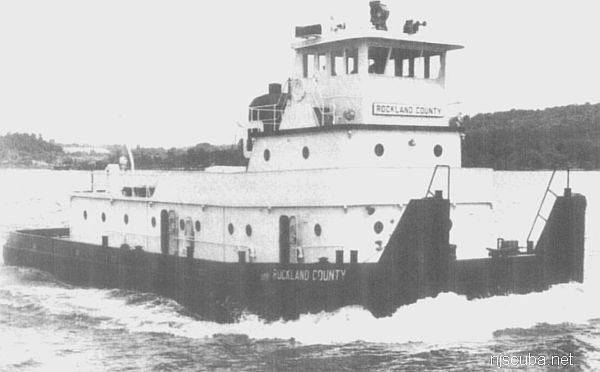
- Type:
- artificial reef, towboat
- Built:
- 1960, Dravo, Wilmington DE USA
- Specs:
- ( 105 x 24 ft )
- Sponsor:
- Spentonbush Red Star Company
- Sunk:
- Friday February 14, 1986 - Sea Girt Artificial Reef
- GPS:
- 40°07.942' -73°55.879'
- Depth:
- 80 ft
More: Rockland County ...
Questions or Inquiries?
Just want to say Hello? Sign the .