
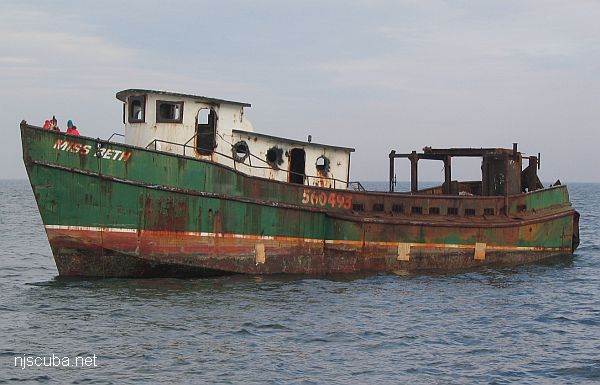
Miss Beth
- Type:
- artificial reef, trawler, USA
- Built:
- 1974, Andy International, Brownsville TX, USA as Southport II
- Specs:
- ( 80 x 20 ft ) 146 gross tons
- Sunk:
- Tuesday January 29, 2008 - Cape May Artificial Reef
- GPS:
- 38°53.237' -74°40.545'

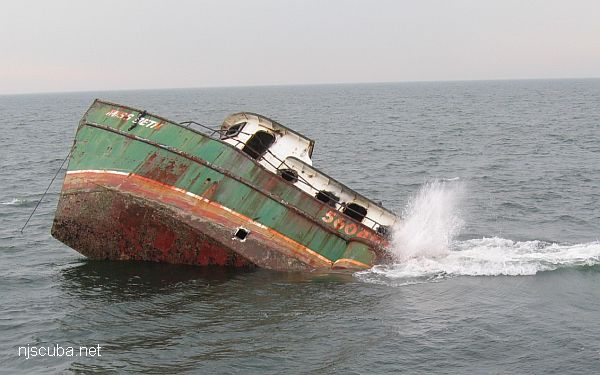
You can tell a lot about the method of sinking from these pictures. In the first one, three rectangular tan patches are weakly welded over three holes that were cut in the hull above the waterline. There are three matching ones on the other side. They are located to open up any compartments inside the hull, which have likewise been holed.
In the second picture, you can see the patches have been knocked out with a sledgehammer. Then a seacock is opened to start the flooding process. This is very slow, by itself, a seacock would take hours to sink the vessel. Hours and hours and hours. But with the big open holes in the hull, as soon as the first one touches the waterline, the process speeds up considerably.
560493

Questions or Inquiries?
Just want to say Hello? Sign the .