
U-869 (1/5)
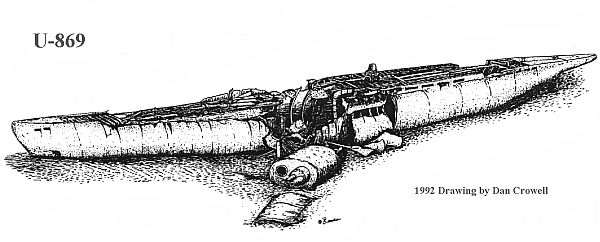
- Type:
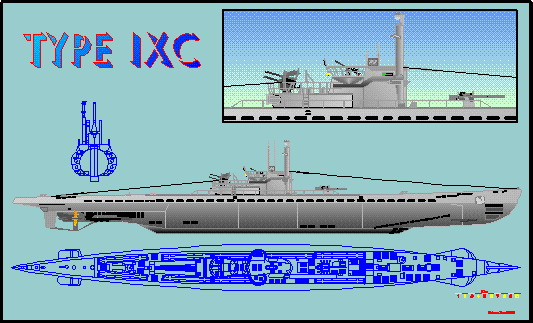
- shipwreck, Type IXc/40 U-boat, Kriegsmarine, Germany
- Specs:
- ( 252 x 22 ft ) 1051 displacement tons, 48-56 crew
- Built:
- 1944, Germany
- Sunk:
- February 11, 1945
sunk by destroyer escort USS Howard D. Crow - no survivors - Depth:
- 240 ft
U-869

The "U-Who?" was identified as the U-869. This took some detective work, as neither US nor German records placed the U-869 anywhere near the eastern seaboard, and no submarine was recorded as sunk at the location of the wreck. The initial theory was that the U-869 was the victim of a circular-running torpedo, one which malfunctioned and homed in on the sub that launched it. While there are numerous documented cases of this, a submarine can usually detect a circular-runner and evade it by diving under it. Self-kills were rare.
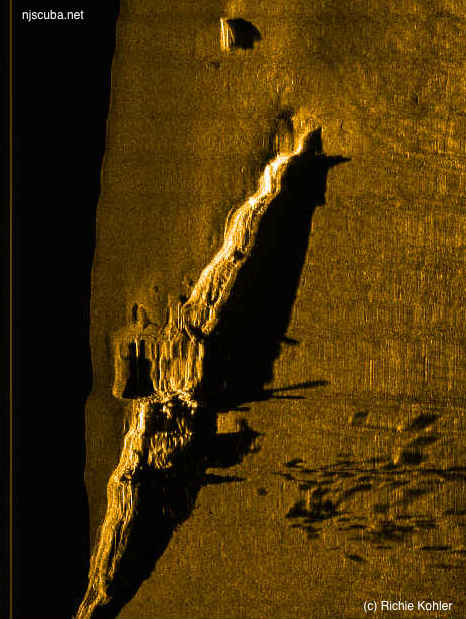
That theory also does not explain the extensive damage at two locations on the wreck. ( Two torpedoes? Even more unlikely. ) Much more likely is that the sub was sunk by Coast Guard convoy escorts in an attack on Feb 11, 1945. But since there was no definite confirmation of a kill, the Navy denied the Coast Guard credit for anything, which was not uncommon. According to Navy records, the Coasties just wasted a lot of ammunition on nothing. See below for details.
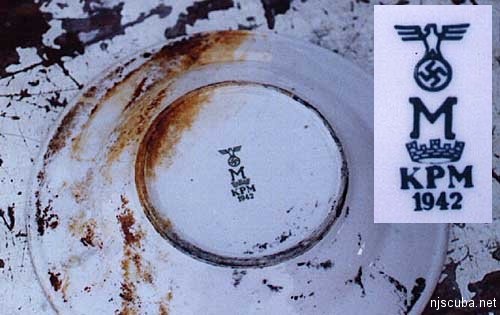
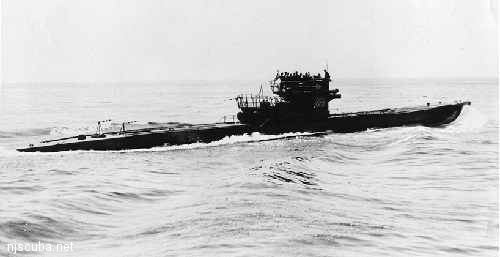
The U-869 never sank a ship. The remains of the crew are still inside the broken hull, and even today this hapless boat continues to take lives: 3 divers have died on her since her discovery in 1991.
Deep Sea Dive Sites, Dive Sites, New Jersey Dive Sites, New York Dive Sites, Submarines, World War II,
Deep Sea Chart (pan right for more)
- Four Daughters
- 44097 Weather Buoy
- 44402 Weather Buoy
- USS Akron
- Andrea Doria
- Atlantic Princess
- Azua
- USS Baldwin
- Bidevind
- Brian C
- Carolina
- Catamount
- Cayru
- Champion
- USS Cherokee
- Coimbra
- Corvallis
- Deepwater Dump
- Durley Chine
- Edward H Cole
- Galimore's Cayru
- Lady Gertrude
- Herbert Parker
- Thomas Hebert
- Hvoslef
- Isabel B Wiley
- India Arrow
- USS Jacob Jones
- Jacob M Haskell
- Lady Mary
- Lillian
- Maiden Creek
- Miraflores
- Misty Blue
- Montgomery
- USS Moonstone
- USS Murphy
- Northern Pacific
- Norness
- Pan Pennsylvania
- Republic
- Rio Tercero
- RP Resor
- Southern Lillian
- USS S-5
- USS Salmon
- SC-209
- Sebastian
- Shookus
- Sommerstad
- USS Spikefish
- Suffolk
- Texas Tower
- Texel
- U-550
- U-869
- Varanger
- West Wreck
- Wily Fox
- Winneconne
More: Deep Sea Dive Sites ...
World War I
World War I Losses
World War II
World War II Losses
- Arundo
- Ayuruoca
- USS Bass
- Bidevind
- Black Point
- Catamount
- Cayru
- Choapa
- Coimbra
- Continent
- I.P. Goulandris
- Gulftrade (stern)
- Gulftrade (bow)
- Gypsum Prince
- Hvoslef
- India Arrow
- USS Jacob Jones
- Lemuel Burrows
- Lake Frampton
- Maiden Creek
- Maurice Tracy
- Miraflores
- USS Moonstone
- USS Murphy
- Norness
- HMS Pentland Firth
- Pan Pennsylvania
- Persephone
- Rio Tercero
- RP Resor
- San Jose
- Suffolk
- Tolten
- USS Turner
- U-550
- U-853
- U-869
- Varanger
- YP-387
More: Wartime Losses ...
Warships
- USS Akron
- USS Algol
- USS Baldwin
- Bronx Queen
- Capt Henry
- Catamount
- USS Cherokee
- HMS Culloden
- Great Isaac
- HMS Hussar
- Ida K
- Intrepid
- USS Jacob Jones
- Massachusetts
- R.C. Mohawk
- USS Moonstone
- USS Murphy
- New Jersey
- USS Ohio
- Olympia
- Peggy Diana
- USS Radford (main)
- USS San Diego
- SC-209
- SC-60
- USS Tarantula
- Texas Tower
- USS Turner
- ZPG-3W
A number of warships are sunk in New Jersey and New York waters:
More: Warships ...

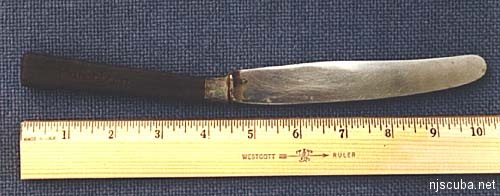
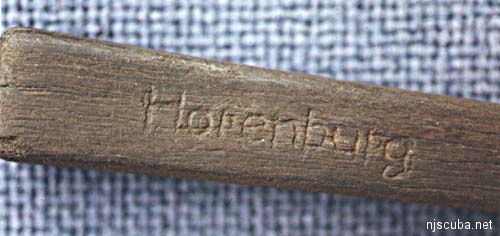
knife, the most tangible clue to the
identity of New Jersey's mystery U-boat.
In 1991, while checking out an obscure site known for hanging up fishing lines, I dropped down the anchor line only to find a virgin German U-boat. A wreck diver's fantasy of discovering a new shipwreck somehow had become a reality, and it was every bit as good as could be imagined. While reveling in the experience, I wondered if I would have enough skill and luck to ever make it happen again. Several discoveries later, the challenge is still irresistible.
More: Searching For Shipwrecks ...
John Hines:
July 12, 2022 at 2:47 pm
Is U 869 still being dived on?
Paper records, enigma recovered??
njscuba:
July 12, 2022 at 3:37 pm
I don't think any charter boat is going out there anymore. AFAIK the enigma machine is still in it. It's not worth your life!