
USS G-2 SS-27
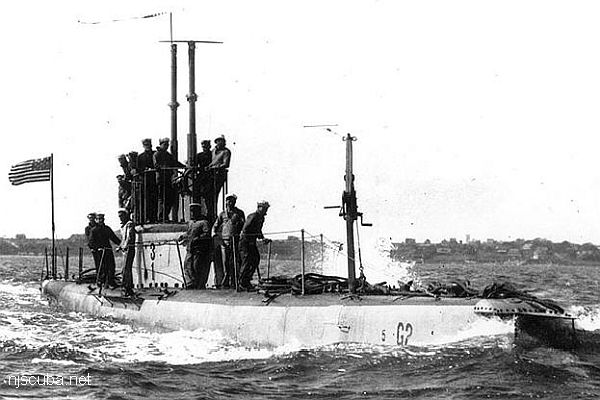
- Type:
- shipwreck, submarine, U.S. Navy
- Built:
- 1912, Lake Torpedo Boat Company, Newport News, VA USA
- Specs:
- ( 161 x 13 ft ) 400 tons, no crew
- Sunk:
- Wednesday July 30, 1919
foundered after weapons tests - 3 casualties (inspection crew) - Depth:
- 81 ft
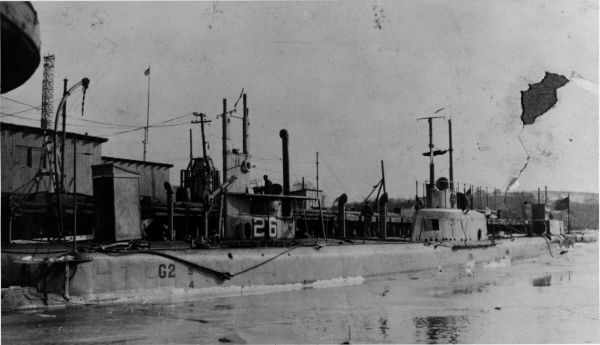
USS G-2
(Submarine No. 27: displacement 375 (surf.), 516 (subm.); length 161'; beam 13'1"; draft 12'6"; speed 14 knots (surf.), 10 knots (subm.); complement 26; armament 6 18" torpedo tubes; class G-1)
Tuna (Submarine No. 27) was laid down on 20 October 1909 at Bridgeport, Conn., by the Lake Torpedo Boat Co.; renamed G-2 on 17 November 1911; launched on 10 January 1912; sponsored by Miss Marjorie F. Miller; towed to the New York Navy Yard after the termination of the Lake contract on 7 November 1913; and commissioned on 1 December 1913, Lt. (j.g.) Ralph C. Needham in command.
Departing New York under tow of submarine tender Ozark (Monitor No.7) the submersible torpedo boat arrived at the torpedo station, Newport, Rhode Island, on 28 February 1914. Attached to the Atlantic Submarine Flotilla, G-2 spent the next five months conducting dive training and engineering exercises with G-1 in Long Island Sound and Narragansett Bay. During these trials, the boat made six submerged runs to a maximum depth of 37 feet. Her engines proved troublesome, however, and after the port armature shaft failed on 31 March, the boat was towed to New York for repairs. While there, financial considerations led to G-2 being put in reserve commission on 15 June 1914.
G-2 was placed in full commission at New York on 6 February 1915, Lt (jg). Ralph C. Needham in command. Attached to Division Three, Submarine Flotilla, Atlantic Fleet, the boat joined G-1, Fulton (Submarine Tender No.1), and tug Sonoma, for a cruise to Norfolk on 25 March. Arriving there two days later, the submersible conducted maneuvers in Hampton Roads before proceeding to Charleston in April, arriving there on the 17th. Following a short yard period for repairs, the division proceeded back to New York, mooring alongside the 135th Street pier on 9 May.
On 18 May, G-2 joined other warships and passed in review before President Woodrow Wilson, who looked on from the yacht Mayflower. The boat then sailed to Nantucket, to participate in a war problem off Block Island, before unloading her torpedoes at Newport on 25 May. Ordered back to New York for an overhaul, the submersible again transited the familiar waters of Long Island Sound before arriving at the mouth of the East River on 22 June. While standing down the river with G-4, however, the two boats collided with submarine K-22 in an unusual three-boat accident. Fortunately, none of the boats suffered any damage. G-2 entered the Navy Yard there for an extended overhaul later that day.
Escorted to Provincetown, Mass., by tug Iwana and Ozark, G-2 commenced final acceptance trials between 1-10 December. Following those successful evolutions, during which the Trial Board noted numerous items requiring modernization, the boat moved back to New York for an overhaul on 14 January 1916. Six months later, G-2 shifted to the Lake Torpedo Boat Company yard for completion, receiving new diving rudder gear, hydroplanes, electrical wiring, and a new crankshaft. This yard work required extensive alterations and the boat did not return to service until convoyed to New London by Sunbeam II (SP-42) on 28 June 1917.
On 21 August, G-2 sailed to Boston via the Cape Cod Canal to operate with Aylwin (Destroyer No. 47), submarine chaser SC-6, and steam yacht Margaret (SP-527). There, the boat helped a Navy Experimental Board embarked in Margaret carry out various sound detector tests in nearby waters. The submarine also conducted practice approaches and served as an instruction platform for officer and enlisted submarine students.
Shifting back to New London on 20 October, G-2 combined work on sound detection devices with training for the newly established Submarine School off Block Island and in Long Island Sound. During seven months of operations, she experimented with magnetic detectors and dragging devices and tried out new periscopes and other submarine equipment. The boat carried out these tests with section patrol boats Wacondah (SP-238) and Thetis (SP-391), as well as numerous subchasers. Learning of the possible proximity of German U-boats, she conducted four-day patrols off Block Island in late June 1918 and again in mid-July.
G-2 continued schoolship duty out of New London through the end of World War I, testing listening and flare signaling devices among other pieces of equipment. On 30 August, for example, her crew tested the strength of the pressure hull, and the reliability of electric equipment, against depth charge explosions. On 12 September Thetis experimented with a magnetic detector while G-2 lay on the bottom in 86 feet of water and, in November, G-2 even conducted experimental work with patrol seaplanes. This duty ended in January 1919 when she was scheduled for inactivation.
Decommissioned on 2 April 1919, the boat was designated as a target for testing depth charges and ordnance nets in Niantic Bay, Conn. Tragically, during inspection by a six-man maintenance crew on 30 July 1919, the boat suddenly flooded and sank at her moorings in Two Tree Channel near Niantic Bay. She went down in 13-1/2 fathoms, drowning three of the inspection crew. Too deep and too old to salvage, the submarine was struck from the Navy List on 11 September 1919.
from Navy historical records
Long Island East Dive Sites, Long Island Sound Dive Sites, New York Dive Sites, Submarines,
Long Island Sound - West Chart
- Amsterdam
- Atlantic
- Barataria
- USS Bass
- Bayville barge
- Black Point
- Celtic/Cape Race
- Condor
- HMS Culloden
- Defender
- John A. Downs
- Essex
- Gwendoline Steers
- USS G-1
- USS G-2
- Grecian
- Horton's Point / Commodore
- Huntington Artificial Reef
- HMS Hussar
- USS L-8
- Larchmont
- Lexington
- Lightburne
- Malden
- Matinecock Artificial Reef
- Mattituck Inlet
- Mattituck Artificial Reef
- Montauk Inlet
- Mount Sinai Harbor
- Myronus
- USS Ohio
- Olinda
- Pinnacle
- Poling Bros #2
- Port Jefferson Artificial Reef
- Port Jefferson Inlet
- Puszta
- Shoreham Nuclear Power Plant
- Smithtown Artificial Reef
- Snug Harbor
- Thames
- Thelma Phoebe
- U-853
- Volund
- Delaware River Water Gap
- Block Island Wind Farm
Long Island Sound - East Chart
- Amsterdam
- Atlantic
- Barataria
- USS Bass
- Bayville barge
- Black Point
- Celtic/Cape Race
- Condor
- HMS Culloden
- Defender
- John A. Downs
- Essex
- Gwendoline Steers
- USS G-1
- USS G-2
- Grecian
- Horton's Point / Commodore
- Huntington Artificial Reef
- USS L-8
- Larchmont
- Lexington
- Lightburne
- Malden
- Matinecock Artificial Reef
- Mattituck Inlet
- Mattituck Artificial Reef
- Montauk Inlet
- Mount Sinai Harbor
- Myronus
- USS Ohio
- Olinda
- Pinnacle
- Poling Bros #2
- Port Jefferson Artificial Reef
- Port Jefferson Inlet
- Puszta
- Shoreham Nuclear Power Plant
- Smithtown Artificial Reef
- Snug Harbor
- Thames
- Thelma Phoebe
- U-853
- Volund
- Delaware River Water Gap
- Block Island Wind Farm
More: Long Island Sound Dive Sites Chart ...
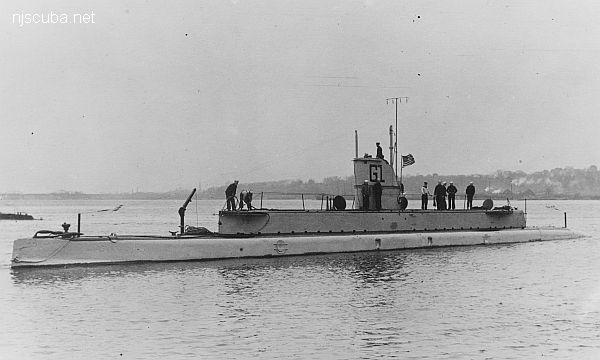
- Type:
- shipwreck, submarine, U.S. Navy
- Built:
- 1911, Lake Torpedo Boat Company, Newport News, VA USA
- Specs:
- ( 161 x 13 ft ) 400 tons, no crew
- Sunk:
- Tuesday June 21, 1921, deliberate - weapons test
More: USS G-1 SS-19 ...
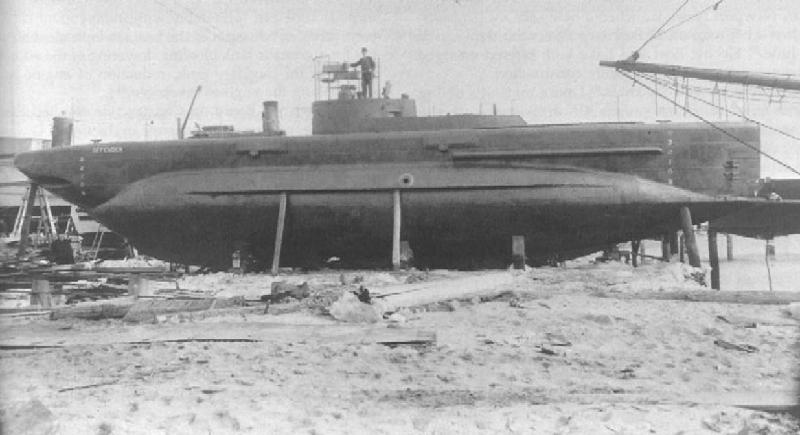
- Type:
- shipwreck, submarine, private
- Built:
- 1906, Lake Torpedo Boat Company, Newport News, VA USA,
as Simon Lake XV - Specs:
- ( 92 x 13 ft ) 200 tons
- Sunk:
- 1946, scuttled
More: Defender ...
Questions or Inquiries?
Just want to say Hello? Sign the .