YP-387

YP-389
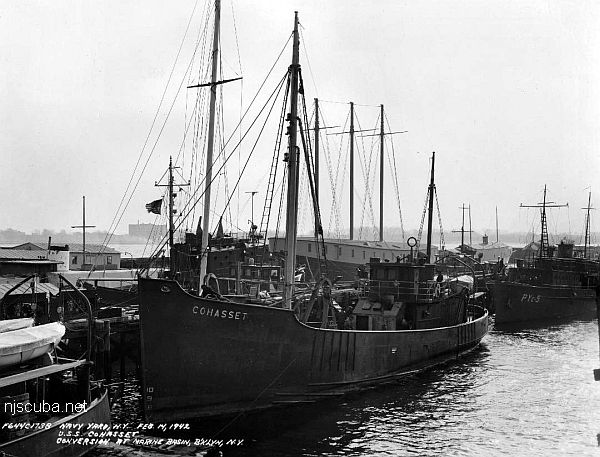
Sister YP-389, built in the same yard at the same time to the same specs
Type:
shipwreck, patrol boat, U.S. Navy, converted trawler
Built:
1941, Bethlehem Quincy, Quincy MA, USA, as Salem
Specs:
( 102 x 22 ft ) 301 tons, 21 crew
Sunk:
Wednesday May 20, 1942
collision with collier Jason - 6 casualties
Depth:
40 ft

On 10 September 1947, Windlass, in company with Salvager, began searching for the sunken YP-387. She located the wreck and began salvage operations while Salvager returned to Bayonne, apparently to get necessary equipment. Windlass apparently shifted briefly to Norfolk, Va., for the same reason before both heavy lifting salvage vessels returned to the site of the sunken YP off Hereford, N.J., on 1 October 1947. Two days later, they placed demolition charges in the sunken "Yippie boat" and blew her up to prevent her from being a hazard to navigation.

-- exact location unknown

From: the Dictionary of American Naval Fighting Ships

The Navy acquired three of these "Yippie" boats together, identical sisters. They all came to bad ends. The YP-387 was sunk in a collision off Cape May. The YP-389 was sunk by gunfire of the U-701 in 1942, unable to fight back because her one 3" gun was broken. The YP-388 sank in a collision in Boston harbor in 1951 and was not raised for almost a year.
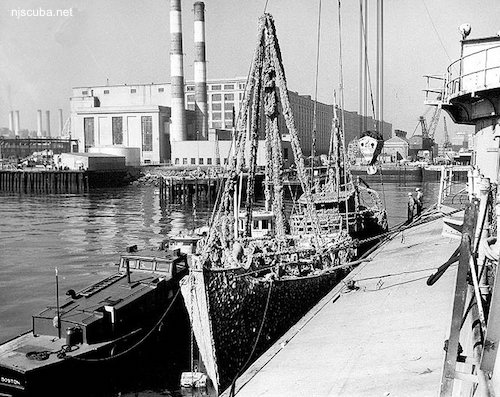
YP-388
YP-388
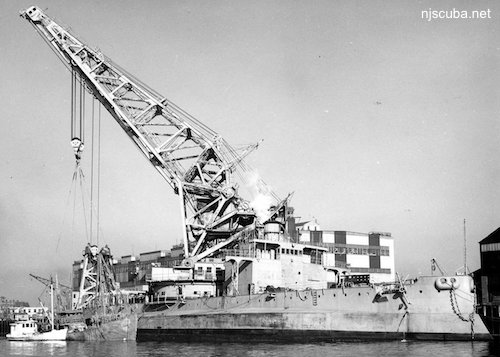
Identical sister YP-388, raised by the crane-ship Kearsarge, and looking like a prototype for an artificial reef.
YP-389
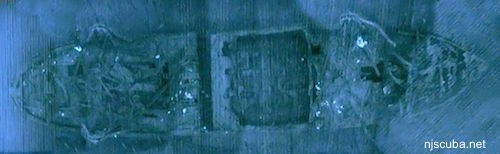
YP-389 side-scan sonar image in 2009, depth: 300 ft
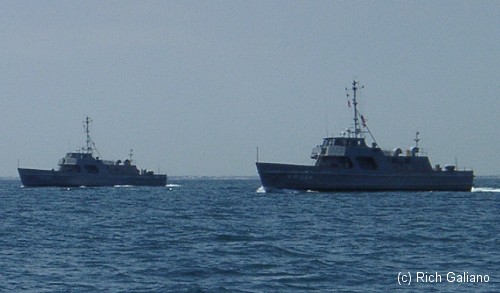
Navy Yippie boats

These modern Navy "Yippie" (YP) boats are a common summer sight. They are used to train cadets in boat handling and seamanship and are usually found in groups of four or more, executing synchronized maneuvers.
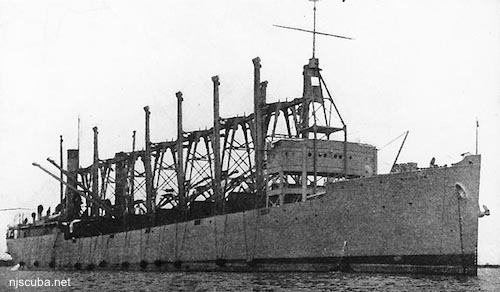
Jason
Jason as USS Jason


Comments on YP-387

Questions or Inquiries?

Just want to say Hello? Sign the .

Submit a Comment

Your email address will not be published. Required fields are marked *


Click image to replace if unable to read.

Enter the digits from the image above, except for the last one:

This site uses Akismet to reduce spam. Learn how your comment data is processed.


lift bag
lift bag

Lift bags are commonly used for recovering heavy objects from the bottom. The bag is simply tied on, inflated from a regulator, and shot to the surface. An often-overlooked use for a lift bag is to get yourself to the surface in a safe manner when you have become lost and can't find the anchor, or if the anchor has pulled out of the wreck. Using your reel as described above, you can shoot a bag directly to the surface and then ascend on the line.

However, under such circumstances, I prefer to get myself off the bottom and up to my decompression or safety stop depth as quickly as possible, and then deploy a bag to the surface using a short length of line attached to the bag for just that purpose. Either way, the bag marks your position for the crew of the dive boat. You should write your name in bold letters on your bag, so you can be identified before you surface. The bag will also keep you from being sucked down to the bottom if there is a strong current. Most lift bags have open bottoms. A bag like this can hit the surface, tip over, and deflate. For self-rescue, as described, you should use a bag with a self-closing bottom.