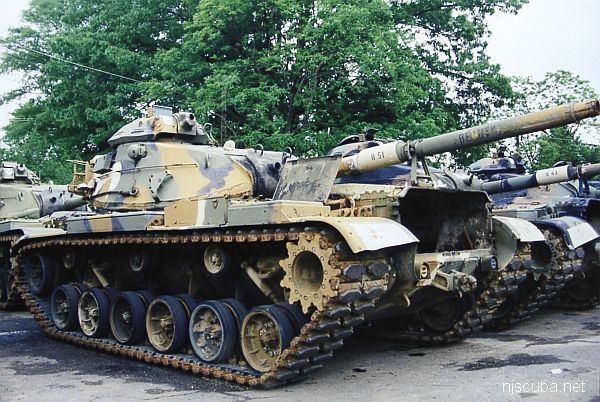
M60 tanks undergo a thorough cleaning before use as reefs
The Artificial Reef Program used four types of obsolete Army armored vehicles as artificial reef materials off the New Jersey coast. These were cleaned at local military bases, loaded onto barges for transport, and pushed off at their final destination. Once the Army had disposed of its excess inventory, the program ceased, around 1999. The Artificial Reef Program has sunk almost 400 tanks altogether, far too many to list them here in this website.
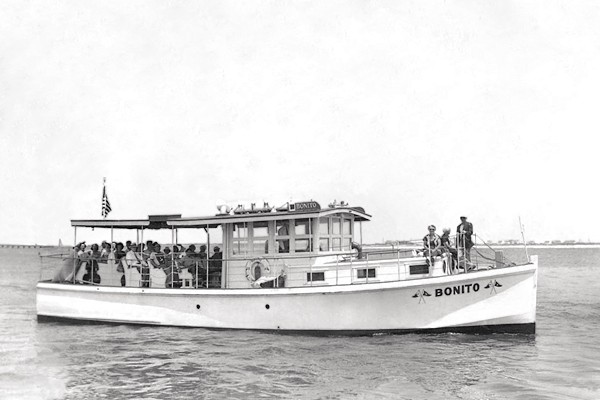
The Bonito was sunk as a "fish haven", an artificial reef in modern parlance. I'm sure there is nothing left of the wooden hull, and anything else has long since disappeared into the sand, but it is interesting for being one of the earliest documented reefs.
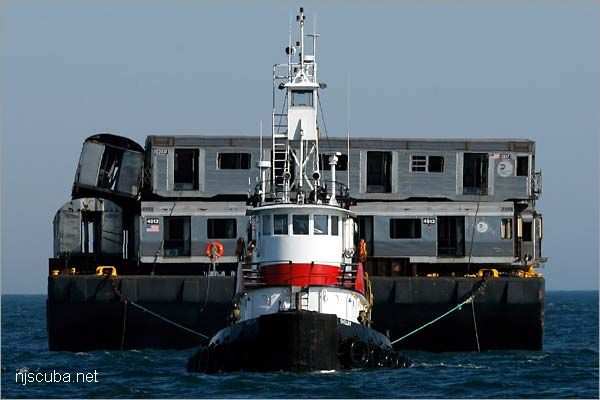
~100 "Brightliner" subway cars - NYC Subway system
Built:
1963-1964 - Budd Company - Model R32 # 3350-3949
1966-1967 - St. Louis Car - Model R38 # 3950-4149
1967-1969 - St. Louis Car - Model R40 # 4150-4349
1969-1970 - St. Louis Car - Model R42 # 4550-4949
Specs:
( 60 x 10 ft ) 10 tons ( all, typical, body only )
Sunk:
44 cars were sunk on Atlantic City Reef on April 3, 2008
more in Cape May reef and Delaware reefs
Sponsor:
New York City Metropolitan Transportation Authority ( MTA )
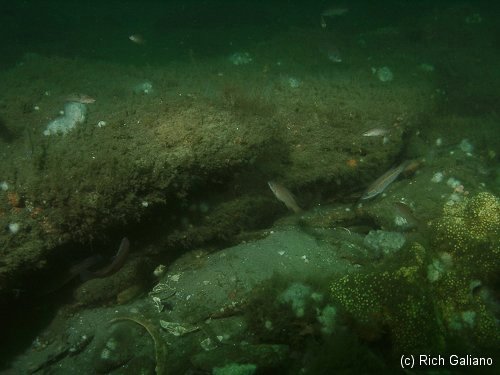
The low, shelf-like structure of the rocks, which seldom rise more than two feet above the bottom. Cunners
These low outcroppings appear in small to large patches over a two-mile area called the Klondike, and elsewhere, at depths ranging from 60 to 90 feet. The overhangs, crags, and holes afforded by the piles of rocks and boulders provide excellent homes for fish and lobsters. Visibility can be great here at times, but it is usually 10-20 ft, with a silty bottom in most places. The larger areas extend for many hundreds of feet, and an incautious diver can easily get lost. The stone itself is a type of sandstone known as Greensand, which occurs along the northern part of the New Jersey coast, and parts of Long Island, most famously as the Shrewsbury Rocks.