
Regulators - Hose Protectors
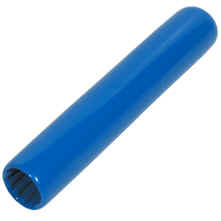
Hose protectors are those funny rubbery tubes that fit over the ends of your air hoses. Their purpose is to prevent the hose from being bent sharply at the connector, which will eventually cause it to fail. However, they are practically impossible to put on. Here's a hint that makes it easy:
Soak the hose protector for a few minutes in not-quite-boiling water. This will make it much more soft and pliable. Then fish it out and jam it onto the hose quickly before it cools and hardens. Be careful not to get water in the hose orifice. Maybe I'm slow, but it took me quite a while to figure out this simple trick.
Some people claim that hose protectors promote corrosion of the metal hose fittings beneath. My experience is that if you clean your gear properly after every dive, this is not an issue, and in any case, the soft rubber of the hose is far more at risk than the hard stainless steel of the connector.
Another use for a hose protector is as a cap for a spear point.