
Delaware Bay Reefs

Delaware Artificial Reefs

Delaware has a string of artificial reef sites in the Delaware bay, but they are of little interest to divers. Most of the sites are quite shallow and perilously close to the shipping lanes, several of them were actually reduced for this reason. The conditions in the bay are hardly good for diving. The reefs consist mostly of concrete rubble from construction in Philadelphia and other cities on the river. Also shown is New Jersey's sole artificial reef in the bay.

There are however, 5 small vessels sunk in the bay, so in the name of completeness, here they are:

  • Golden Eagle - a 70' tugboat sunk August 1996, minimum depth 21', on reef site #8
  • A 40' steel pilot boat - sunk June 2006, depth 30', on reef site #1
  • P3 and Dolphin - 35’ and 42’ steel vessels, sunk April 19, 1999, depth 42', on reef site #7
  • Buchannon - a 120' x 40' steel barge sunk March 18, 2004 on reef site #6

Reef site #8 was shrunk by half and Golden Eagle is no longer actually inside the reef.

I cannot find any other documentation on these vessels, if anyone has anything, please send it in.
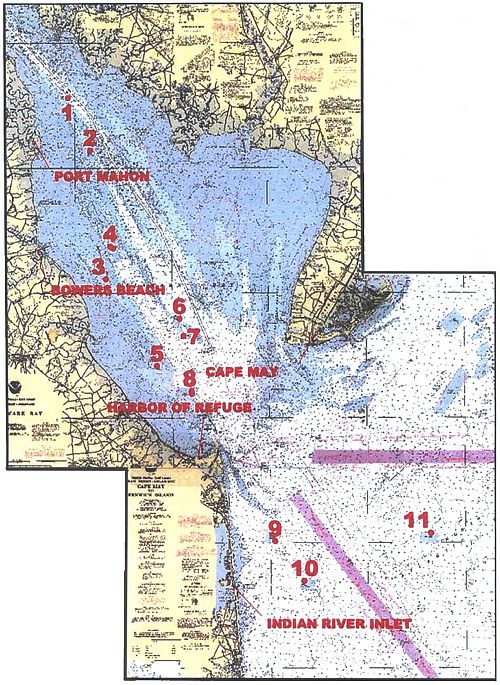
Delaware has eight permitted reefs in the Delaware Bay


bracket

Having said all that about doubles, there are still times when it makes more sense to dive "lite". Out of the water, double tanks are very heavy and cumbersome, which makes them practical only for boat entries, where you simply have to stagger across the deck and fall overboard. At other times, and in less deep situations, you can maintain a safe redundant air supply using a much lighter "pony bottle" - a small tank of 20-40 cubic feet, weighing only about 10-20 lbs, with its own regulator that is used only in an emergency. Some of the situations where this configuration is useful to include medium-depth dives, 40-80 ft, training and practice dives ( especially in the quarry, where it is possible to reach quite deep water from the shore ), and excursions to the tropics.

Larger pony bottles ( 40-50 cf ) are also useful as "swing bottles" for carrying special decompression mixes, while the smaller ones are small enough to actually take with you when you travel. Most airlines will allow it in checked baggage if you remove the valve. This is very useful since many tropical destinations are not equipped to provide the kind of safety equipment that we take for granted here. The smallest pony bottles are really not big enough to get you out of trouble on a deep Jersey dive, however.