
Marine Fishes
- Sea Basses & Porgies ...
- Blackfish & Cunner ...
- Cods & Allies ...
- Triggers, Puffers, & Sunfish ...
- Flounders ...
- Drums ...
- Ocean Bottom ...
- Baitfishes ...
- River & Inlet ...
- Pelagics ...
- Tropical Fishes ...
- Sharks - Inshore ...
- Sharks - Offshore ...
- Sharks - Dogfishes ...
- Skates & Rays ...
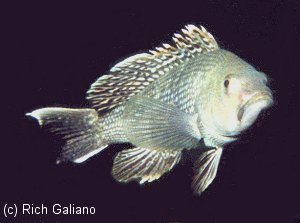
Although they are both called basses, Stripers and Black Sea Bass are not closely related. Striped Bass are more closely related to ocean perches, while Black Sea Bass are related to tropical basslets and groupers. The Striped Bass is the largest member of the sea bass family, often called "temperate" or "true" bass to distinguish it from species such as largemouth, smallmouth, and spotted bass which are actually members of the sunfish family Centrarchidae. Porgies are much more highly compressed ( side-to-side ) than basses, and are not closely related.
More: Sea Basses & Porgies ...
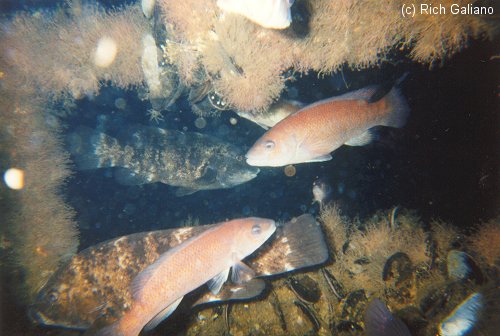
These fish are Wrasses, northern representatives of a widespread tropical family that includes Parrotfishes. Wrasses propel themselves slowly and precisely with their pectoral fins, using the tail only in emergencies. Tropical Wrasses feed on coral. Lacking this, their northern cousins feed primarily on mussels and other shellfish.
More: Blackfish & Cunner ...
Cods - family Gadidae - are one of the most commercially important families of fish in the sea. As such, they have been fished to the brink of disaster. The book above is a fascinating study of the historical relationship between western civilization and the codfish.
The only freshwater representative of the cod family is the Burbot.
More: Cods & Allies ...
Although it seems unlikely, these fishes are all related in the Order Tetraodontiformes. Common characteristics include:
- teeth fused into horny beaks
- tough leathery skin
- swimming primarily with dorsal and anal fins rather than tail
- pelvic fins lacking
They are all also possessed of rather higher intelligence than most fishes.
More: Triggers, Puffers, & Sunfish ...
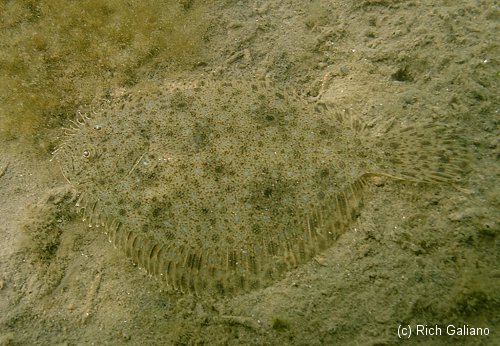
These fish all live and feed on the bottom, out in the open. Often they will hide in the sand with just their eyes visible, and most can change color to match their surroundings.
More: Flounders ...
Drums are so named for their ability to make drumming sounds with their swim bladder. Actually, many fishes are capable of making sounds, from squeaks to growls, although not all Drums can "drum". Kingfish lack a swim bladder but still vocalize by grinding their pharyngeal (throat) teeth.
More: Drums ...
These fishes are most likely to be found on or near the bottom out at sea, either resting or swimming around. In addition, many of the types more often found in the rivers and inlets may be found out at sea.
Many of the types presented here are representative of entire families of similar related species. While some are closely related, others are not. These particular species are the most common in our area.
More: Ocean Bottom ...
These fishes are often used as bait, although herrings, sardines, and anchovies are also important food fishes.
More: Baitfishes ...
These fishes are most likely to be found on or near the bottom in the rivers and inlets, either resting or swimming around. In addition, many of the types more often found out at sea may be found in the rivers and inlets. In addition, many tropical fishes may be found here as well.
Many of the types presented here are representative of entire families of similar related species. While some are closely related, others are not. These particular species are the most common in our area.
More: River & Inlet ...
The only trait that these fishes share is that they are all found in the open ocean.
More: Pelagics ...
Yes, New Jersey even gets some tropicals. These are babies, born on the coral reefs of the Caribbean, and swept north in the Gulf Stream. Unlike in the Caribbean, capturing these fish for your aquarium is perfectly legal, and is actually doing them a favor, since otherwise, they will only survive until the winter cold kills them. Almost any tropical fish can end up here, these are just some examples, although these are by far the most common.
More: Tropical Fishes ...
Here is an assortment of large sharks that can be found in New Jersey waters, by no means all of them. These are more likely to be found inshore in coastal waters. Sharks are seldom a danger to divers, they seem to be put off by the noise and bubbles. Nonetheless, all should be treated with caution.
In all my many inlet dives, I have seen a shark once, and that was in inoffensive Smooth Dogfish. I have been told that they are sometimes seen from up on the bridge in Belmar, but even then they would probably be out in mid-channel, and far away from strange noisy bubbling scuba divers. However, one of the most famous shark attacks of all time took place in New Jersey - the 1916 Matawan Creek attacks. See Bull Shark for details.
The only one of these that you are ever likely to encounter in local ocean diving is the relatively inoffensive Sand Tiger, not the similarly named and extremely dangerous Tiger.
More: Sharks - Inshore ...
Here is an assortment of large sharks that can be found in New Jersey waters, by no means all of them. These are more likely to be found offshore in oceanic waters. Sharks are seldom a danger to divers, they seem to be put off by the noise and bubbles. Nonetheless, all should be treated with caution.
Realistically, sharks in our waters are not a great concern. In over 350 northeast ocean dives, I have seen sharks on only several occasions ( not counting harmless little Dogfishes ) and only once while in the water. That one was in the Mud Hole, on the Arundo, to be precise. It was a Blue, or possibly a Mako, and wanted nothing to do with me, which was a relief since I had half an hour of deco left to do at the time! That would have left me very bent otherwise.
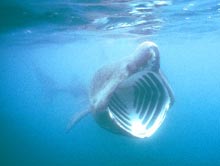 | 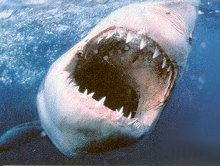 |
and the very not toothless Great White Shark at right.
If you think about it, humans must taste terrible to sharks, and scuba divers especially - with rubber suits and big metal tanks. Many shark attacks occur in murky water where the shark is not sure what it is attacking. Some attacks have been the result of the shark being stepped on in shallow water. Most shark attacks on humans are abortive, the shark taking only one exploratory bite, then realizing its mistake and breaking off the attack. Unfortunately, with a large shark, one bite and you're dead. Many predators, from bears to tigers, will prey on humans when sickness, injury, or old age make them unable to catch their normal prey. Sharks are probably no different.
More: Sharks - Offshore ...
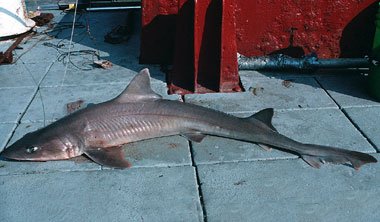
from us than we are from them.
Real sharks are ashamed of them.
"Dogfish" is a generic name for a large number of small, generally harmless, and unaggressive sharks, not all of which are very closely related. Smooth Dogfishes are related to Tiger, Bull, and other Requiem Sharks, while Spiny Dogfishes are in a completely different group, more closely related to Angel Sharks. Compare these with the unrelated Chain Dogfish, a "Cat" shark. Sandbar sharks have nothing in common with the others here, except their small size. None of these little sharks is really dangerous, although any of them could give a good bite if provoked. Generally, they will avoid you.
More: Sharks - Dogfishes ...
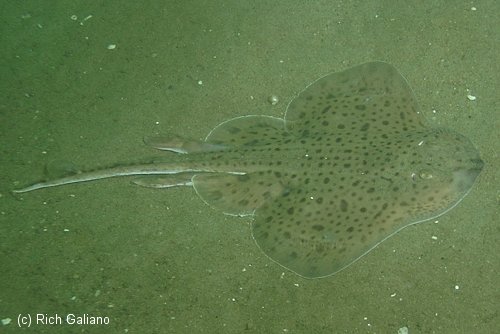
Skates and rays are related to sharks. Unlike flounders, these fish are flattened and lie on their bellies. Skates are harmless. Stingrays have one or more dangerous barbed stingers in the tail and will use them if molested. Finally, the Torpedo is an electric fish and can generate enough voltage to be dangerous. Some skates give birth to live young, while others lay their eggs encased in a horned Mermaid's Purse.
More: Skates & Rays ...
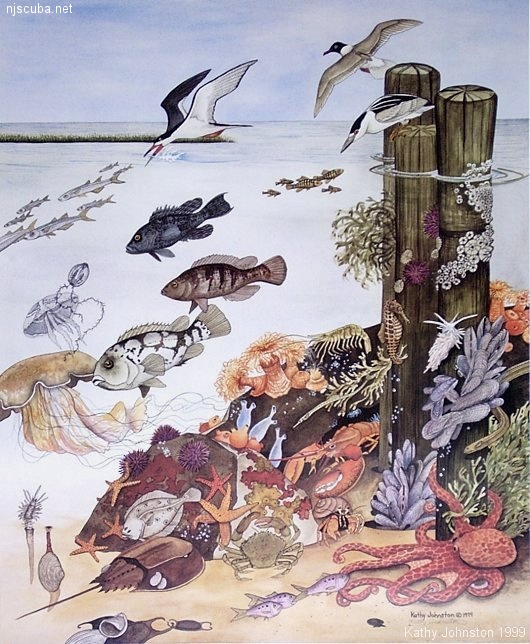
by Kathy Johnston
Courtesy of Jacques Cousteau National Estuarine Research Reserve
- Home ...
- Dive Sites ...
- Artificial Reefs ...
- Marine Biology ...
- Artifacts ...
- Gear & Training ...
- Blog ...
- Cozumel ...
More: Marine Biology & Ecology ...