
Conger Eel
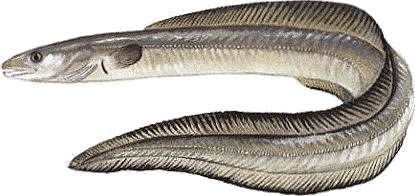
Conger oceanicus
Size
to 7 1/2 ft and 90 lbs., usually smaller
Description
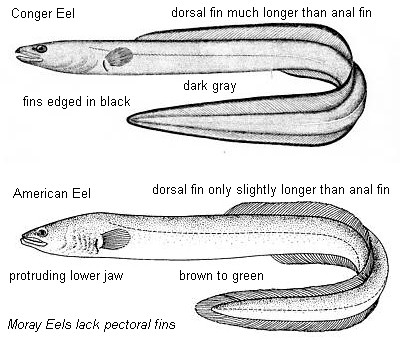
The Conger Eel closely resembles the American Eel, Anguilla rostrata, but is distinguishable by its longer snout and the very large dorsal fin that originates much closer to the pectoral fins. The Conger is also larger, frequently attaining a weight of 10 to 20 pounds and a length of 5 to 7 feet. Its European cousin, Conger conger, is even more spectacular, occasionally tipping the scales at 130 pounds and measuring over 12 feet in length. The American Conger is gray above and white underneath. The dorsal and anal fins have broad black margins. Overall, the Conger appears much lighter than the freshwater eel, thus the common name Silver Eel. The species is distributed from Massachusetts to south Florida and in the Gulf of Mexico westward to Mississippi.
Spawning probably occurs offshore during the summer. The only information available on fecundity is old and pertains to two European specimens that contained 3 million and 7 million ripe ova. Like the American Eel, young Conger metamorphose through an intermediate, ribbon-like leptocephalus stage. When searching for food, the Conger Eel is a night stalker. It feeds during the hours of darkness on fishes, crabs, worms, and other bottom-dwelling animals that it stealthily approaches and grabs.
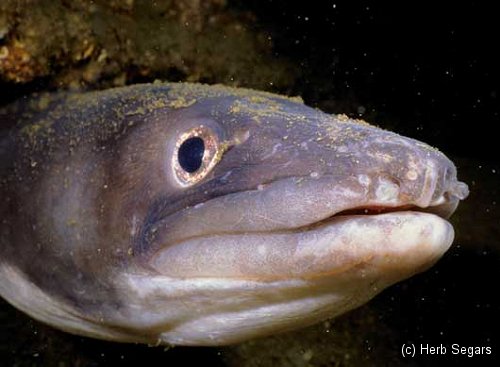
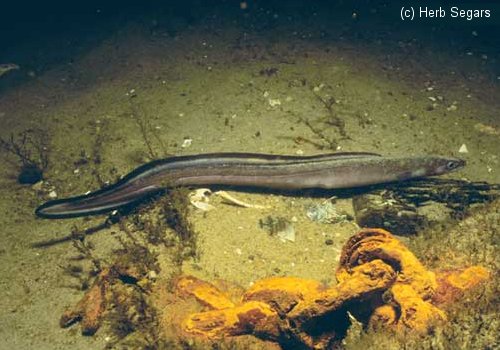

Although they can appear threatening with their large size and gaping mouths, Conger eels are inoffensive, and retreat from any approach. Conger eels in New Jersey waters generally have very high levels of toxins in their tissues, and eating them is unwise.

These fishes are most likely to be found on or near the bottom out at sea, either resting or swimming around. In addition, many of the types more often found in the rivers and inlets may be found out at sea.
Many of the types presented here are representative of entire families of similar related species. While some are closely related, others are not. These particular species are the most common in our area.
More: Ocean Bottom ...
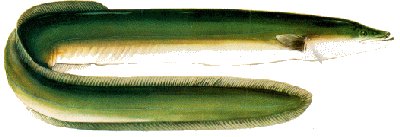
Anguilla rostrata
Size
to 60"
Species Profile
By Jeff Brust,
Research Scientist
American eels are an ecologically unique and important species that occur in fresh, brackish, and marine waters from the southern tip of Greenland to northeastern South America. This species is closely related to the European eel. Eels support a valuable commercial food fishery, are used widely as bait for sport fish such as striped bass and cobia and are an important food source for many fish and wildlife species.
More: American Eel ...