Delaware Bay Reefs
Delaware Artificial Reefs
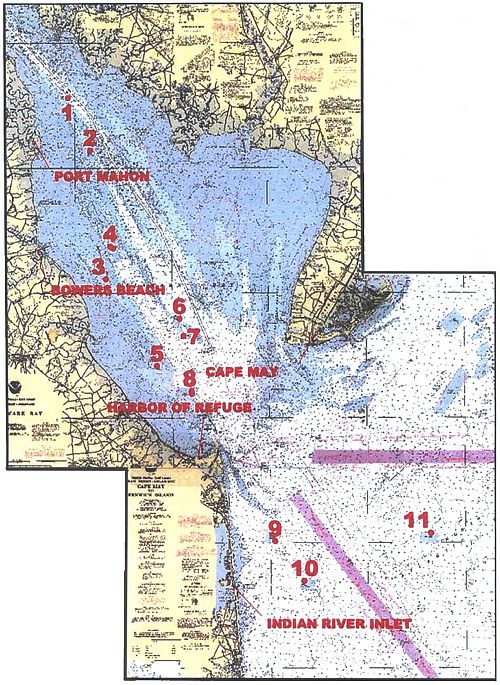
Delaware has a string of artificial reef sites in the Delaware bay, but they are of little interest to divers. Most of the sites are quite shallow and perilously close to the shipping lanes, several of them were actually reduced for this reason. The conditions in the bay are hardly good for diving. The reefs consist mostly of concrete rubble from construction in Philadelphia and other cities on the river. Also shown is New Jersey's sole artificial reef in the bay.
There are however, 5 small vessels sunk in the bay, so in the name of completeness, here they are:
- Golden Eagle - a 70' tugboat sunk August 1996, minimum depth 21', on reef site #8
- A 40' steel pilot boat - sunk June 2006, depth 30', on reef site #1
- P3 and Dolphin - 35’ and 42’ steel vessels, sunk April 19, 1999, depth 42', on reef site #7
- Buchannon - a 120' x 40' steel barge sunk March 18, 2004 on reef site #6
Reef site #8 was shrunk by half and Golden Eagle is no longer actually inside the reef.
I cannot find any other documentation on these vessels, if anyone has anything, please send it in.