Trawlers (6/6)

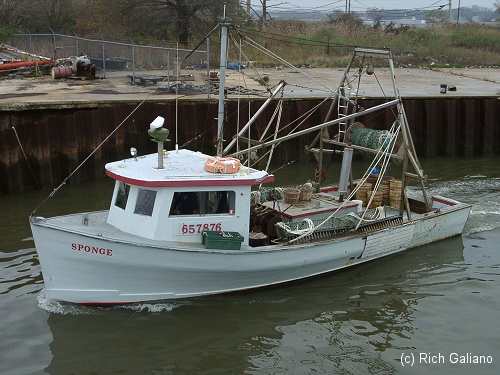
small commercial fishing vessel
A small commercial fishing vessel of unknown type, although the bushels on deck would imply that she was after some kind of shellfish.

There are three basic types of commercial fishing vessels found in the Mid-Atlantic region: trawlers, seiners/gill-netters, and long-liners. A trawler or "dragger" operates by towing its fishing gear across the bottom. Weighted nets take bottom fishes, while cage-like steel dredges take clams and scallops. A seiner uses a floating net to encircle schools of surface-swimming fishes such as herring and tuna. A long-liner sets out miles of buoyed line with baited hooks to catch sharks, tuna, and swordfish. One could also add lobster boats and charter fishing or "head" boats to this list. And of course, dive boats.

 1  4 5 6  

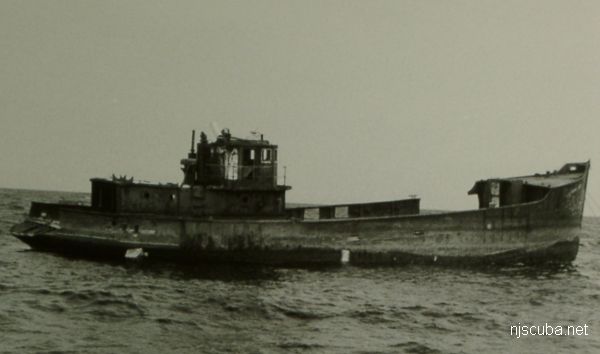
Winthrop reef
Type:
artificial reef, trawler, USA
Built:
1948, Bath Iron Works, Bath, Maine, USA
Specs:
( 117 x 24 ft ) 195 gross tons
Sponsor:
Eirek's Dock, Fish America Foundation
Sunk:
Wednesday July 12, 1989 - Cape May Artificial Reef
GPS:
38°50.825' -74°43.312'
Depth:
60 ft

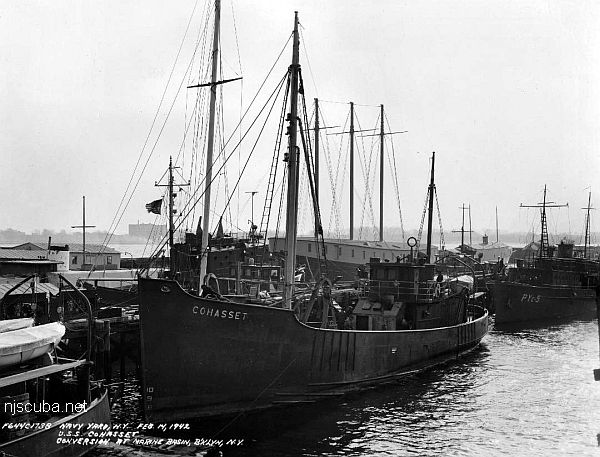
YP-389
Sister YP-389, built in the same yard at the same time to the same specs
Type:
shipwreck, patrol boat, U.S. Navy, converted trawler
Built:
1941, Bethlehem Quincy, Quincy MA, USA, as Salem
Specs:
( 102 x 22 ft ) 301 tons, 21 crew
Sunk:
Wednesday May 20, 1942
collision with collier Jason - 6 casualties
Depth:
40 ft

Trawlers

 1  4 5 6  

lift bag
lift bag

Lift bags are commonly used for recovering heavy objects from the bottom. The bag is simply tied on, inflated from a regulator, and shot to the surface. An often-overlooked use for a lift bag is to get yourself to the surface in a safe manner when you have become lost and can't find the anchor, or if the anchor has pulled out of the wreck. Using your reel as described above, you can shoot a bag directly to the surface and then ascend on the line.

However, under such circumstances, I prefer to get myself off the bottom and up to my decompression or safety stop depth as quickly as possible, and then deploy a bag to the surface using a short length of line attached to the bag for just that purpose. Either way, the bag marks your position for the crew of the dive boat. You should write your name in bold letters on your bag, so you can be identified before you surface. The bag will also keep you from being sucked down to the bottom if there is a strong current. Most lift bags have open bottoms. A bag like this can hit the surface, tip over, and deflate. For self-rescue, as described, you should use a bag with a self-closing bottom.