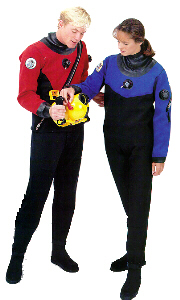
Serious New Jersey divers wear drysuits. A drysuit is a waterproof suit with built-in feet that seals around your neck and wrists ( some have built-in water-tight gloves and/or hoods as well, ) and a waterproof zipper to close it up. The idea is that although you are underwater, you don't get wet, but this is not entirely true. No seal is perfect, and certain actions will let small amounts of water leak in past the seals. However, most of the moisture that accumulates in a drysuit comes from its occupant, in the form of perspiration. If water can't get in, then it can't get out either. Perhaps these should be called dampsuits instead of drysuits.
Still, in cold water, a drysuit is much warmer than a wetsuit. This is because you maintain a constant layer of air between you and the cold, and air is an excellent insulator. While air is also the insulating factor in wetsuits, there is a difference. With either suit, the volume of air, and therefore the amount of insulation, compresses as you go deeper. With a wetsuit, there is nothing you can do about this, but with a drysuit, simply tap the inlet valve, and compressed air will flow from your tank into the suit, and puff it up again, keeping you warm. An added benefit is that by keeping the suit inflated to a constant volume, you maintain constant buoyancy, from the surface to the bottom, which can actually reduce the amount of lead you need to carry. Some divers even dispense with the BCD, considering that a drysuit can be thought of as a full-body BCD, but this is not recommended, and it is convenient to use the BCD as a quick trimming device and for surface flotation.
More: Exposure Suits - Drysuits ...



Questions or Inquiries?
Just want to say Hello? Sign the .