
Marine Invertebrates
Might as well call this the squishy section of the website. These organisms ( they aren't even all animals ) are lumped together here for their rather unappealing consistency. Disney will never make an animated adventure about any of them. That's not a scientific way to classify things, but it works pretty well for the layman.
- Plant-like Animals ...
- Jellyfishes ...
- Echinoderms ...
- Worms ...
- Squids & Octopus ...
- Algae & Seaweeds ...
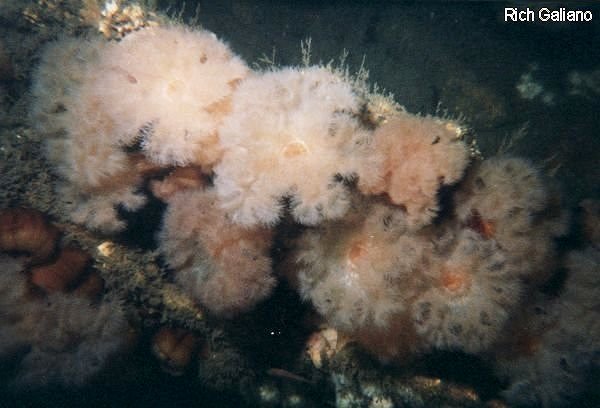
All these are animals that, in a sense, occupy the physical niche of the plants which are missing from the deeper parts of the marine environment. All are filter-feeders, straining plankton from the surrounding waters.
More: Plant-like Animals ...
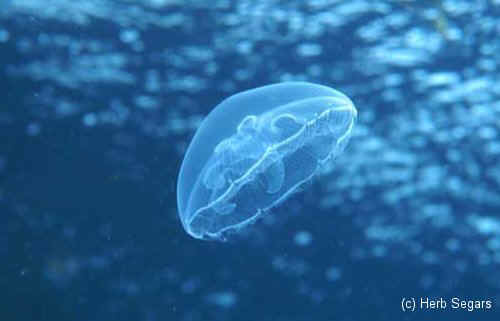
The many creatures on this page are lumped together for the one trait they all have in common - they are all "jelly-like" - soft, gelatinous, and more-or-less transparent. Other than that, they are for the most part completely unrelated. True Jellyfishes, Hydromedusae, and Siphonophores are in the phylum Cnidaria, related to bottom-dwelling Hydroids, Sea Anemones, and corals. Comb Jellies are in the phylum Ctenophora, and are completely unrelated to jellyfishes, as are Sea Butterflies and Corollas, which are mollusks. Salps are free-swimming tunicates, more closely related to us than to any of these other creatures.
More: Jellyfishes ...
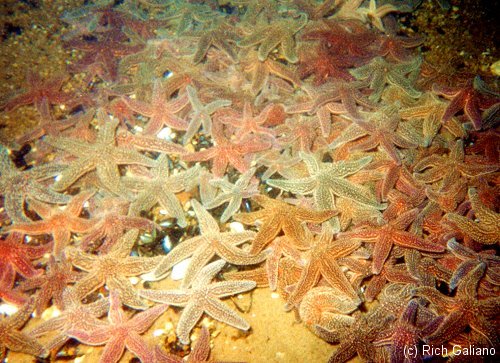
Echinoderms ( literally "spiny skins" ) are among the strangest animals on the planet. They start out as bilaterally symmetric larvae but grow into a 5-way body symmetry as adults. Some species show six, seven, or even higher levels of symmetry. Worm-like Sea Cucumbers have re-evolved a bilateral body plan over the underlying 5-way plan. Because of certain developmental traits, it is felt that despite their strangeness, echinoderms are actually more closely related to chordates than any other group.
More: Echinoderms ...
There are many types of worms, but most species are either too small or too secretive to be found by casual scuba divers. Nudibranchs are shell-less snails that resemble worms, while Teredos are nearly shell-less bivalves that also resemble worms.
More: Worms ...
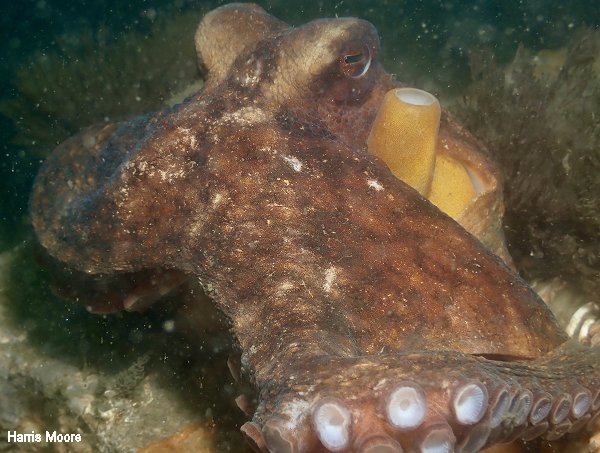
Squids and octopuses are cephalopods ( Latin: "head-foots". ) They are extremely evolved mollusks. The shell is internalized as a support structure in squids, or completely absent, as in octopi. There are probably more squids than fish in the sea, both by numbers and by mass.
More: Squids & Octopus ...
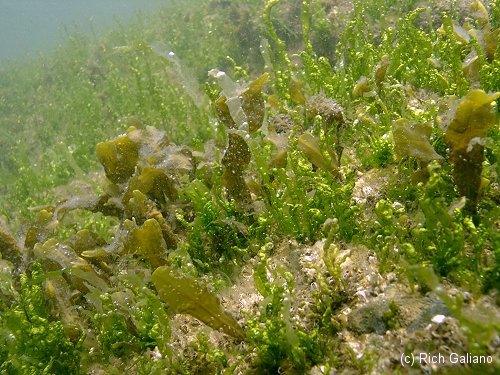
In our waters, plants and algae are found only in shallow water where sufficient light can penetrate for photosynthesis. It would be unusual to find algae below 10-20 ft, so our wrecks and reefs, despite the profusion of attached organisms, are actually devoid of plant life! Of course, that is completely neglecting the microscopic algal plankton that is so profuse in our waters and so lacking in the clear water of the tropics.
More: Algae & Seaweeds ...
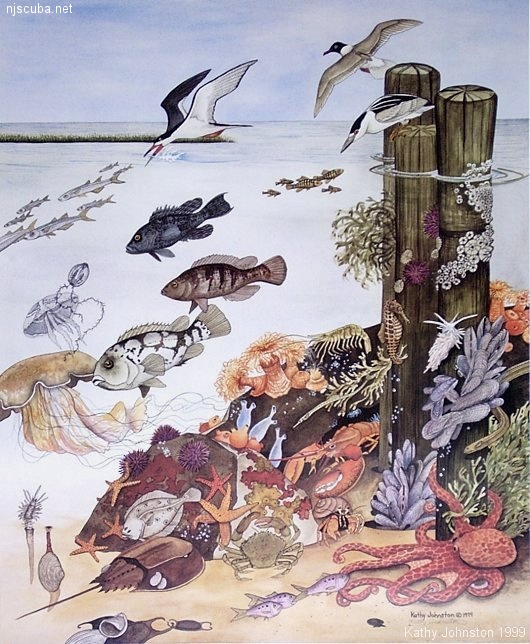
by Kathy Johnston
Courtesy of Jacques Cousteau National Estuarine Research Reserve
- Home ...
- Dive Sites ...
- Artificial Reefs ...
- Marine Biology ...
- Artifacts ...
- Gear & Training ...
- Blog ...
- Cozumel ...
More: Marine Biology & Ecology ...