Siphonophores
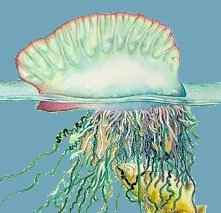
Siphonophores are free-floating or swimming colonial hydroids. All siphonophores are predatory and should be treated with respect for their venomous sting. Some of the individual animals along the length of the colony provide tentacles for defense (dactylozooids) and food capture, while others may function as swimming bells (nectophores), aid flotation (pneumatophore), provide additional defense (bracts), digest prey (gastrozooids), or serve for reproductive functions (gonozooids.) Whether siphonophores are single individuals or colonies of well-integrated polymorphic hydroid and medusoid individuals is a matter of debate among specialists.
The Portuguese Man-O-War Physalia physalia (above) is commonly observed in the open ocean and coastal seas and is often mistaken for a true jellyfish. It is found throughout the world in warmer seas and is most common in the summer months in shallow coastal waters. They are frequently found on exposed ocean beaches after strong onshore winds; they are rarely found in sheltered waters.
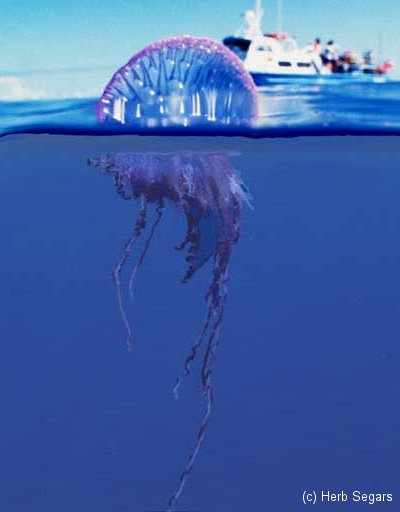
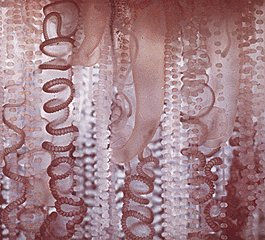
The Man-O-War gets its name from the float, which is a gas-filled bladder that can be up to 12 inches in length and rise out of the water as much as 6 inches. The float has a crest that is used much as a sail to propel the colony across the water surface when the wind blows. Clusters of colonial polyps are attached to the underside of the bladder for digestion and reproduction, with very long tentacles ( sometimes up to 32 feet ) extending from the suspended polyps. Man-O-Wars are hermaphrodites; the fertilized egg develops into a planktonic larval form that produces the large Physalia colony by asexual budding.
The Man-O-War's main food consists of surface plankton, although it can also take larger prey. Its tentacles have stinging cells called nematocysts that are capable of killing a fish up to 4 inches long. The poison secreted from the nematocysts of the Portuguese Man-O-War causes respiratory problems and muscle weakness. In humans, the sting of the Man-O-War can vary from extremely painful to incapacitating to fatal, depending on the severity and the victim's reaction.
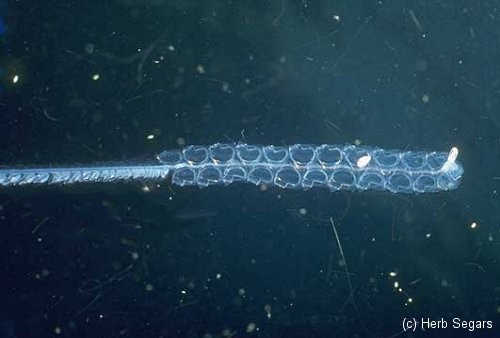
It is not hard to imagine how the hollow swimming polyps of the Chain Siphonophore could become filled with air or secreted gases and over time evolve into the float of the Man-O-War.

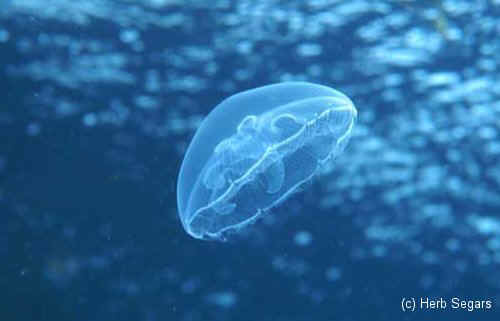
The many creatures on this page are lumped together for the one trait they all have in common - they are all "jelly-like" - soft, gelatinous, and more-or-less transparent. Other than that, they are for the most part completely unrelated. True Jellyfishes, Hydromedusae, and Siphonophores are in the phylum Cnidaria, related to bottom-dwelling Hydroids, Sea Anemones, and corals. Comb Jellies are in the phylum Ctenophora, and are completely unrelated to jellyfishes, as are Sea Butterflies and Corollas, which are mollusks. Salps are free-swimming tunicates, more closely related to us than to any of these other creatures.
More: Jellyfishes ...