
Defender
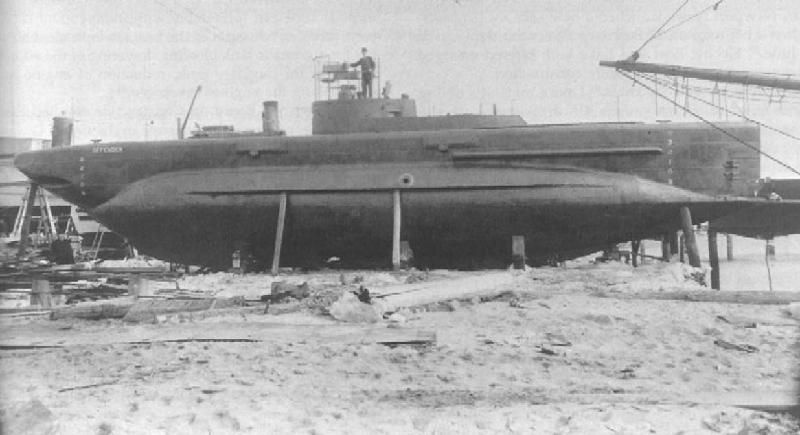
- Type:
- shipwreck, submarine, private
- Built:
- 1906, Lake Torpedo Boat Company, Newport News, VA USA,
as Simon Lake XV - Specs:
- ( 92 x 13 ft ) 200 tons
- Sunk:
- 1946, scuttled
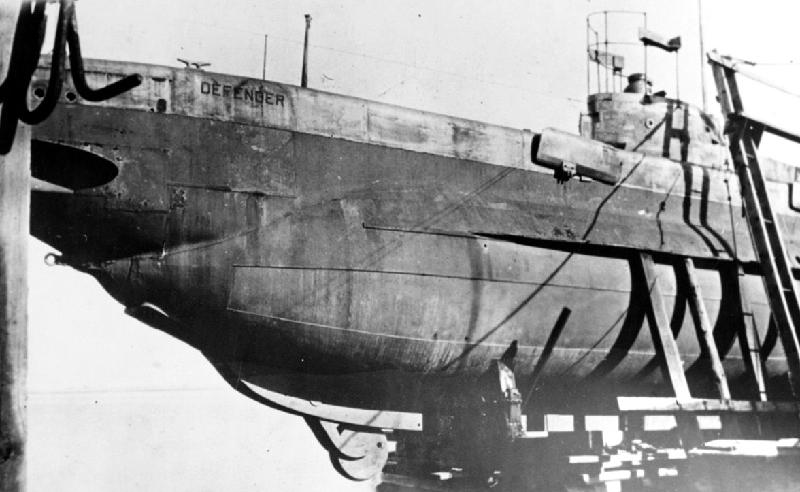
The Defender was a private venture of submarine pioneer Simon Lake. While intended for the Navy, the Navy showed no interest, especially after the boat demonstrated terrible depth-keeping and porpoised to the surface numerous times during demonstration.
A Century-Old Experimental Submarine, 'The Defender,' is Found 'Hiding in Plain Sight' in Long Island Sound
By Jake Rossen
Oct 15, 2024
Associated Press
In 1907, millionaire Simon Lake unveiled a vessel he felt would change naval operations forever. His submarine, the Defender, could scurry across the sea bottom on wheels and featured a hatch for divers. He hoped to sell the technology to the U.S. Navy. That never came to fruition, and the vessel was eventually scuttled. Now, well over a century later, the Defender has been found.
According to The Associated Press, commercial diver Richard Simon discovered the sub on Sunday in Long Island Sound. Long fascinated by its history - he grew up in the area - he was able to pinpoint its location using sonar, underwater mapping surveys, and government data gathered under the Freedom of Information Act. Divers were then able to confirm its location more than 150 feet below the surface. It was "hiding in plain sight," according to Simon.
The Defender has long been a source of fascination for nautical enthusiasts. Lake built the 92-foot-long submarine in a bid to help pioneer the modern submarine, but U.S. officials preferred the vessels of John Philip Holland. (His USS Holland is thought to be the Navy’s first modern-era sub.) When Lake failed to win a government contract, he attempted to re-imagine it for salvage work. Still, he had no takers, and the curio was abandoned - and in 1933, it was even sold to a Connecticut shipyard for $500. It was scuttled by the U.S. Army Corps of Engineers in 1946.
Simon plans to mount diving operations to explore and photograph the site, though he's reluctant to reveal its exact location over concerns treasure hunters might plunder it. He told NBC News that he has reached out to Lake’s descendants out of respect for a man he described as "ahead of his time."
Introduction courtesy of David Johnston (USN, retired)
In late 1906, Simon Lake authorized Newport News Shipbuilding in Virginia to build a boat called Simon Lake XV in response to the 1906 naval appropriations bill, which authorized the Secretary of the Navy to acquire up to $500,000 in submarines, a huge amount in that era. It was a lucrative enough of a deal to goad Lake into once again trying the U.S. market, having spent the last several years building subs for European navies. Taking a large gamble, he contacted NNS in late 1906 and had them build the Simon Lake XV on his own dime, intending to demonstrate it to the Department for approval as soon as it was completed, hoping to sell it and many more copies.
Then on 2 March 1907 the Roosevelt administration increased the amount of funding for submarines to a staggering $3,000,000 his ride on Plunger (SS-2) and this prompted Secretary Metcalf to initiate a competition to determine the best type of boat to build. This is exactly what Lake had been arguing for since 1897. Lake was convinced that his new boat was going to win and he submitted it to the trials board after rushing back from Europe. In April and May 1907 Lake was enthusiastic about his chances at the huge pile of money, and his boat, now renamed simply Lake, went head to head with EB's Octopus (later C-1).
There was only one problem. Lake lost the competition.
The Lake was judged inferior to the Octopus (SS-9) in very nearly every category. The Octopus was faster both surfaced and submerged, was more stable submerged, and dove faster. Lake did make a record dive to 136 feet, but the crew had considerable difficulty controlling her while submerged. The level diving system with midships diving planes simply did not work the way Lake wanted them to. The crew frequently lost control; the boat accidentally broached the surface 18 times. The workload of the crew was not efficiently distributed with the captain handling the helm, the diving planes, and the ballast, all the while trying to safely conn the boat. He simply couldn’t multitask at that level. The Navy chose the Octopus for series production with four more boats built that later became the C-class.
Unlike the past, Simon Lake let the defeat go unchallenged as the data was unequivocable. However, he took an entirely different opinion of the exclusive award of an additional submarine construction contract solely to EB. Engaging the help of two congressmen, Lake and his father brought charges of malfeasance and corruption against both Electric Boat and Victor Metcalf. A congressional committee appointed to investigate the unsubstantiated charges eventually found absolutely no evidence of any wrongdoing by either EB or Metcalf. In fact, Lake, his father, and their two congressional friends narrowly avoided charges being leveled against them; such was the dubious and somewhat nefarious nature of their actions.
Despite his legal tactics having backfired badly, Simon Lake refused to give up on the boat. Lake was brought to Lake’s Bridgeport, CT. yard in 1907 and rebuilt in an attempt to correct its deficiencies. It received a sharply raked and pointed bow along with other alterations. He renamed it Defender. What was done with the boat at this point is not entirely clear, but it remained under Lake ownership and was never commissioned into the Navy. The Navy wanted nothing to do with the boat.
In late 1928 the boat was returned to the Bridgeport yard where it was refitted as a salvage vessel. It was an attempt to revive Lake’s pet concept of diver operations from a submerged submarine, for mine clearance and salvage work. The Navy was anemic at best to the concept, so Defender was offered to Sir Hubert Wilkins for his Arctic expedition. Wilkins chose a larger O-12 (SS-73) instead. In June of 1929 Defender participated in a salvage demonstration for the Navy off Block Island. The Navy was once again not impressed and nothing came of it. Desperately trying to drum up publicity Lake engaged Amelia Earhart and the famous aviatrix made a dive in the boat and even locked out through the diving chamber and swam to the surface.
Lake later had plans to use Defender in a scheme to salvage gold from a sunken British frigate (HMS Hussar), but in true Lake fashion that scheme fell through too. She lingered at a dock in New London, sinking alongside several times, until finally abandoned on a mud flat near Old Saybrook. Defender was finally pulled from the mudflat by the Army Corps of Engineers in 1946 and scuttled out in Long Island Sound. She lay forgotten there until 2023 when her wreck was rediscovered and surveyed.
navsource.net
Simon Lake
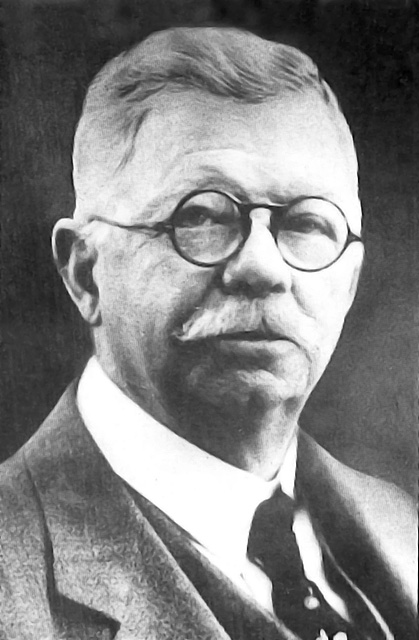
Simon Lake (September 4, 1866 - June 23, 1945) was a Quaker American mechanical engineer and naval architect who obtained over two hundred patents for advances in naval design and competed with John Philip Holland to build the first submarines for the United States Navy.
Biography
Born in Pleasantville, New Jersey on September 4, 1866. He studied at the Clinton Liberal Institute in Fort Plain, New York. Lake joined his father's foundry business after attending public schools in New Jersey and Pennsylvania. Lake had a strong interest in undersea travel.
He built his first submarine, Argonaut Junior, in 1894 in response to an 1893 request from the US Navy for a submarine torpedo boat. In 1898 he followed up with the 36-foot Argonaut 1, which he sailed from Norfolk, Virginia for one thousand miles to Sandy Hook, New Jersey (which is actually 250 miles north of Norfolk), arriving in November 1898. As a result of lessons learned on that journey, he rebuilt it into the 60-foot Argonaut 2.
Neither Argonaut nor Lake's following submarine, Protector, built in 1901, were accepted by the Navy. Protector was the first submarine to have diving planes mounted forward of the conning tower and a flat keel. Four diving planes allowed Protector to maintain depth without changing ballast tank levels, and to dive level without a down-angle. Level diving was a feature of several subsequent Lake designs, notably the first three US G-class submarines. Protector also had a lock-out chamber for divers to leave the submarine. Lake, lacking Holland's financial backing, was unable to continue building submarines in the United States. He sold Protector to Imperial Russia in 1904 as the Osetr and spent the next seven years in Europe designing submarines for the Austro-Hungarian Navy, Germany's Kaiserliche Marine, and the Imperial Russian Navy (Osetr- and Kaiman-class submarines).
He lived in Milford, Connecticut from 1907 until his death in 1945. In 1912, he founded the Lake Torpedo Boat Company in Bridgeport, Connecticut, which built 26 submarines for the United States Navy during and after World War I. Lake's first submarine for the U.S. Navy, USS G-1 (SS-19½), set a depth record of 256 feet in November 1912.
In 1922 the United States and other countries signed treaties limiting the size of their navies. This led to financial difficulties which forced the Lake Torpedo Boat Company to close in the mid-1920s. Following the company's closure, Lake continued designing maritime salvage systems including obtaining permission to partially salvage the Lusitania off the south Irish coast and then later a failed attempt to salvage gold from HMS Hussar, a British frigate that sank in 1780 in New York City's East River with his submarine, the Explorer. Lake redesigned the former USS O-12 (SS-73) as the Arctic exploration submarine Nautilus, used by Sir Hubert Wilkins in a 1931 expedition. He also advised the United States Navy on submarine technology and maritime salvage during World War II. Lake was a member, Freemason of Monmouth Lodge No. 172 in Atlantic Highlands, New Jersey. He later affiliated with Ansantawae Lodge No. 89 in Milford, Connecticut.
He died on June 23, 1945.
- Wikipedia
Long Island East Dive Sites, Long Island Sound Dive Sites, New York Dive Sites, Submarines,
Long Island Sound - West Chart
- Amsterdam
- Atlantic
- Barataria
- USS Bass
- Bayville barge
- Black Point
- Celtic/Cape Race
- Condor
- HMS Culloden
- Defender
- John A. Downs
- Essex
- Gwendoline Steers
- USS G-1
- USS G-2
- Grecian
- Horton's Point / Commodore
- Huntington Artificial Reef
- HMS Hussar
- USS L-8
- Larchmont
- Lexington
- Lightburne
- Malden
- Matinecock Artificial Reef
- Mattituck Inlet
- Mattituck Artificial Reef
- Montauk Inlet
- Mount Sinai Harbor
- Myronus
- USS Ohio
- Olinda
- Pinnacle
- Poling Bros #2
- Port Jefferson Artificial Reef
- Port Jefferson Inlet
- Puszta
- Shoreham Nuclear Power Plant
- Smithtown Artificial Reef
- Snug Harbor
- Thames
- Thelma Phoebe
- U-853
- Volund
- Delaware River Water Gap
- Block Island Wind Farm
Long Island Sound - East Chart
- Amsterdam
- Atlantic
- Barataria
- USS Bass
- Bayville barge
- Black Point
- Celtic/Cape Race
- Condor
- HMS Culloden
- Defender
- John A. Downs
- Essex
- Gwendoline Steers
- USS G-1
- USS G-2
- Grecian
- Horton's Point / Commodore
- Huntington Artificial Reef
- USS L-8
- Larchmont
- Lexington
- Lightburne
- Malden
- Matinecock Artificial Reef
- Mattituck Inlet
- Mattituck Artificial Reef
- Montauk Inlet
- Mount Sinai Harbor
- Myronus
- USS Ohio
- Olinda
- Pinnacle
- Poling Bros #2
- Port Jefferson Artificial Reef
- Port Jefferson Inlet
- Puszta
- Shoreham Nuclear Power Plant
- Smithtown Artificial Reef
- Snug Harbor
- Thames
- Thelma Phoebe
- U-853
- Volund
- Delaware River Water Gap
- Block Island Wind Farm
More: Long Island Sound Dive Sites Chart ...
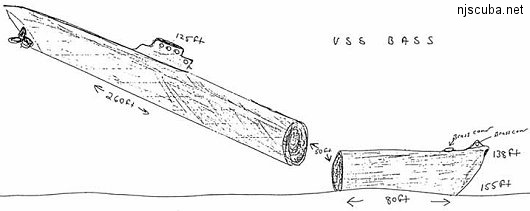
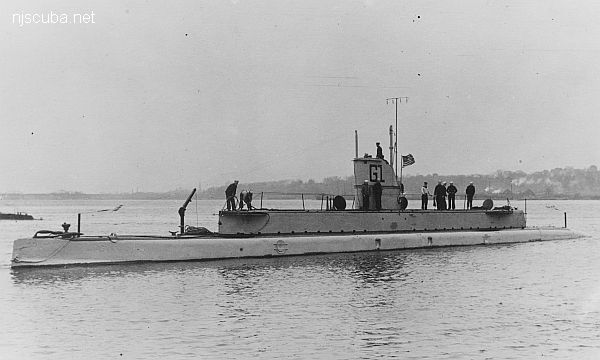
- Type:
- shipwreck, submarine, U.S. Navy
- Built:
- 1911, Lake Torpedo Boat Company, Newport News, VA USA
- Specs:
- ( 161 x 13 ft ) 400 tons, no crew
- Sunk:
- Tuesday June 21, 1921, deliberate - weapons test
More: USS G-1 SS-19 ...
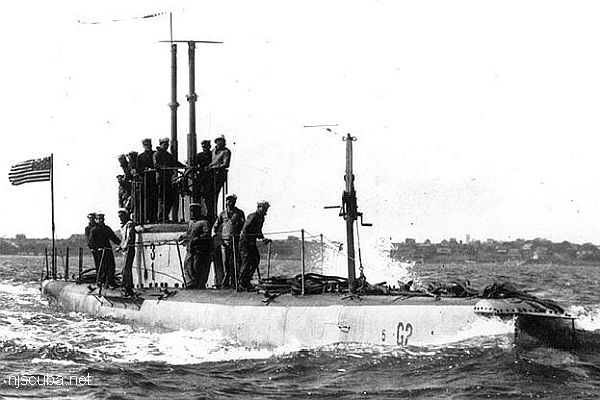
- Type:
- shipwreck, submarine, U.S. Navy
- Built:
- 1912, Lake Torpedo Boat Company, Newport News, VA USA
- Specs:
- ( 161 x 13 ft ) 400 tons, no crew
- Sunk:
- Wednesday July 30, 1919
foundered after weapons tests - 3 casualties (inspection crew) - Depth:
- 81 ft
More: USS G-2 SS-27 ...
Questions or Inquiries?
Just want to say Hello? Sign the .