
Omega Protein Artificial Reefs

Omega Protein with fishing partner Ocean Harvesters have a long history of collaborating with government agencies and non-profit organizations to offer retired vessels to artificial reef programs. The vessels that have been submerged act as a habitat for marine life, promoting biodiversity and creating recreational fishing and diving opportunities. The former vessels that have been sunk include the F/V Reedville off of the coast of Delaware in 2020, the F/V Barataria Bay off the coast of Mississippi in 2015, the F/V Great Wicomico in the Gulf of Mexico in 2009, and the F/V von Rosenberg off the coast of Mississippi in 2000.
Omega Protein's facility at Reedville VA. Docks at the left, processing plant in the center, grass runway at the right, with spotter planes at upper-right.
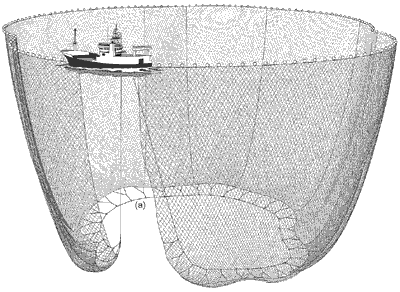
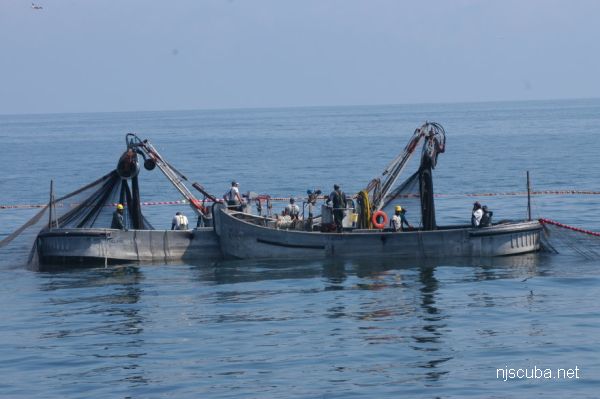
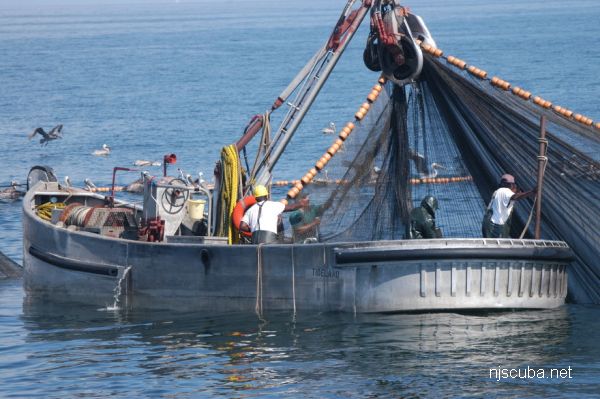
Purse Seining
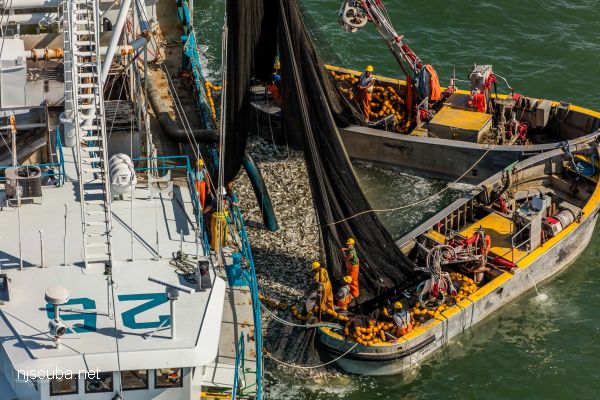
The Omega Men
Catching fish in rough weather is only one of the challenges facing the menhaden fleet of Reedville, Va.
By Kathy Bergren Smith
National Fisherman
October 2, 2013
At the bitter end of Route 360 on the Northern Neck of Virginia lies the Victorian village of Reedville, population 300. Founded in 1874 by a Maine fisherman, Elijah Reed, Reedville, from its start, has been all about Atlantic menhaden.
For generations, most people in Reedville, which consistently ranks in the top three U.S. ports by landings, have been associated with the catching and processing of this inedible fish. One by one, the factories have closed and the boats have gone where old boats go.
Today there is only one menhaden processing plant in Reedville: Omega Protein. I am heading there on a summer Sunday night to meet Capt. Lee Robbins and join his boat Shearwater for a purse seining trip.
"It looks like fishing is going to be pretty good tomorrow, we have a good fish report to work from," he says as we park in the fish processing plant's yard. A smokestack looms over a factory and several smaller buildings dot the yard. There is not the typical marina-like atmosphere around the fleet; in fact, the factory's chutes and tanks hide the boats.
We make our way to the docks where the whole fleet is tied up. Eleven boats range in length from 140 to 200 feet. Several are former Gulf of Mexico oil field service boats. Several others are converted WWII-era Army supply craft.
Each boat is configured alike: wheelhouse forward, fish holds amidships, and two 38-foot aluminum boats hang from davits above the stern. Netting is gathered in each of the small boats and draped across the cutout stern. Like the menhaden boats I watched as a child on the Jersey Shore, each mast is topped by a crow's nest and a boom secured by a cable mounted to it. The Shearwater is the fleet's second-largest boat at 166' x 32' with a molded depth of 11 feet. Twin GM 149 engines power the Shearwater.
As we tour the Shearwater's deck, Robbins calls to the Great Wicomico, tied alongside. Soon, the Great Wicomico's captain, Paul Somers, a fourth-generation waterman, and the boat's pilot, Jeffrey Dameron, appear at the rail. The men's genteel Tidewater accents seem to turn the clock back 100 years. Dameron's father piloted the menhaden boat Robbins' father, Meredith Robbins, skippered.
Talk inevitably turns to the Atlantic States Marine Fisheries Commission's decision to place commercial catch limits on menhaden for the first time in Virginia's portion of the Chesapeake. ( Maryland banned purse seining in 1931. )
"I see it as a state's rights issue; you have all these states" - the commission has two members from each East Coast state from Maine to Florida - "that have closed their grounds to our boats, and now they are telling us that we can't fish here in Virginia?" Robbins says.
The 106,000-metric ton menhaden limit the commission set became effective July 1, 2006. It was imposed in response to mounting recreational fishing industry concern that "localized depletion" of menhaden in the bay is depriving the burgeoning striped bass population of its most important food source. ( In October, the commission was to consider Virginia's proposal to raise the cap to 109,000 metric tons. )
There is a dearth of population data for menhaden in the Chesapeake specifically. But benchmarks the commission itself set show the coast-wide stock is considered healthy.
"That right there is the 'smoking gun'," Robbins says. From the fisherman's perspective, managers are bowing to political pressure from a special interest group instead of using the best available science to make a decision.
Like so many other late-night discussions, at around midnight, the fishermen decide they can't solve the world's problems and they had better get some shut-eye before the grueling workweek begins at 4 a.m.
https://www.nationalfisherman.com/old-magazine/cover-story-excerpt-39
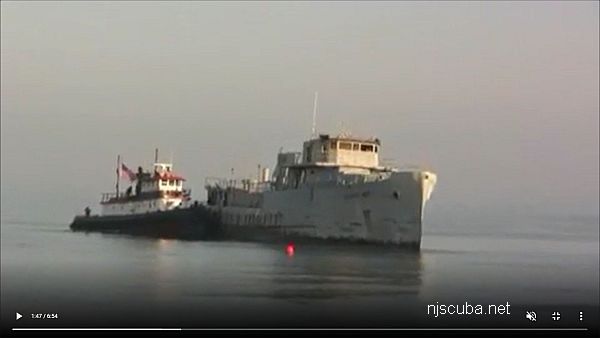
- Type:
- artificial reef, purse seiner, formerly Navy patrol craft
- Built:
- 1943, Albina Engine & Machine Works, Portland OR USA
- Specs:
- ( 185 x 33 ft ) 850 tons
- Sunk:
- Saturday, Jan 16, 2010 - DelJerseyLand Artificial Reef
- GPS:
- 38°31.063' -74°30.271'
- Depth:
- 100 ft
More: Atlantic Mist PCE-880 ...
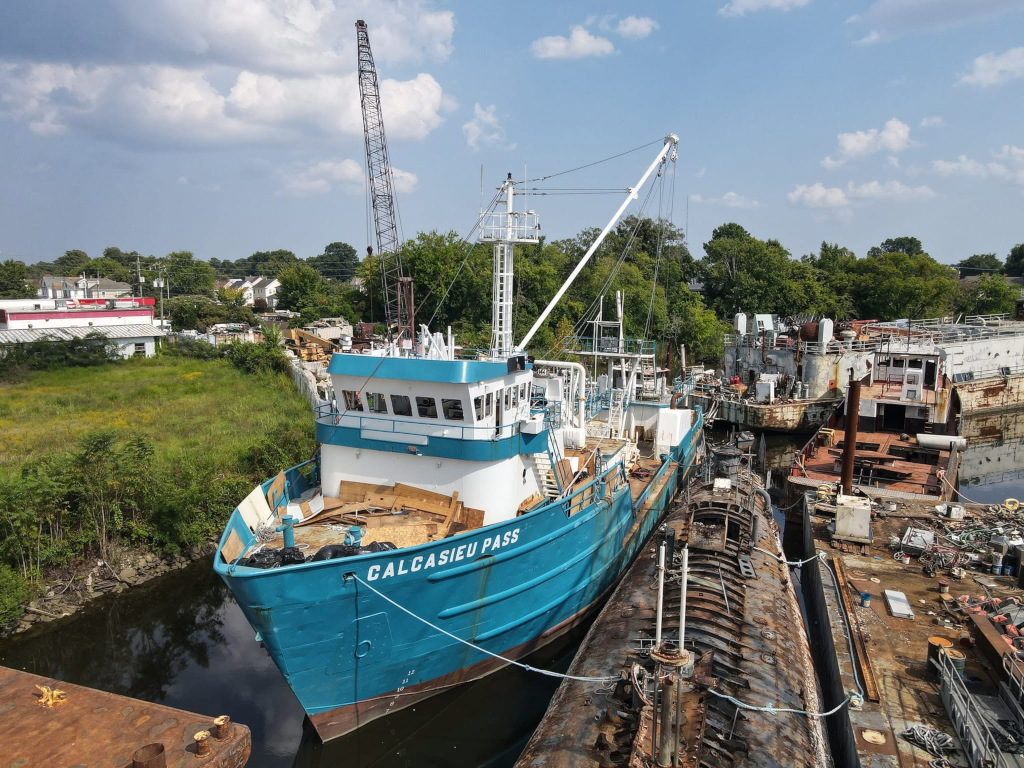
The tube next to her is the remains of USS Clamagore SS-343
- Type:
- artificial reef, purse seiner
- Built:
- 1982, Bay City Shipbuilding, Panama City FL USA, as Judy V
- Specs:
- ( 164 x 38 ft ) 409 tons
- Sunk:
- Aug 12, 2026 - DelJerseyLand Artificial Reef
- GPS:
- 38°30.715' -74°30.830'
- Depth:
- 120 ft
More: Calcasieu Pass ...
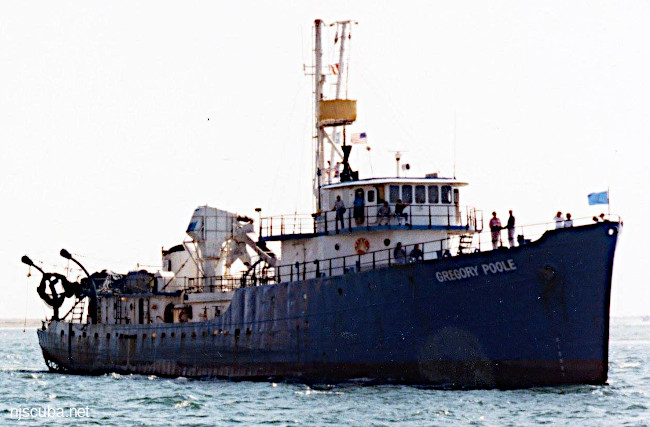
- Type:
- artificial reef, minesweeper, US Navy, later converted to purse seiner
- Built:
- 1944, Tampa Shipbuilding, Tampa FL USA as AM-215 Cruise
- Specs:
- ( 184 x 33 ft ) 650 tons
- Sunk:
- Monday, Dec 10, 2007 - DelJerseyLand Artificial Reef
- GPS:
- 38°30.910' -74°30.597'
- Depth:
- 120 ft
More: Gregory Poole AM-215 ...
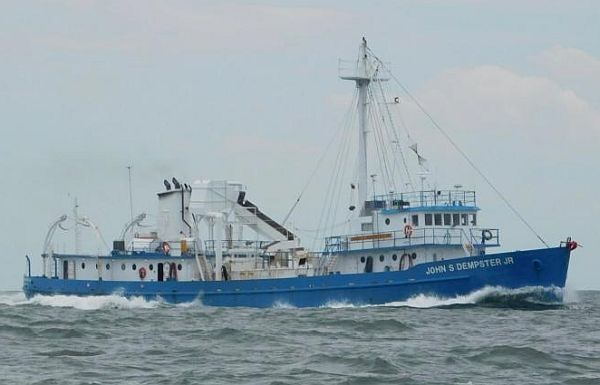
- Type:
- artificial reef, freighter, purse seiner
- Built:
- 1944, J.K. Welding, Yonkers NY, as FS-355 (US Army)
- Specs:
- ( 166 x 32 ft ) 542 tons
- Sunk:
- Thursday, Jan 21, 2021 - DelJerseyLand Artificial Reef
- GPS:
- 38°31.340' -74°30.671'
- Depth:
- 125 ft
More: John S Dempster Jr FS-355 ...
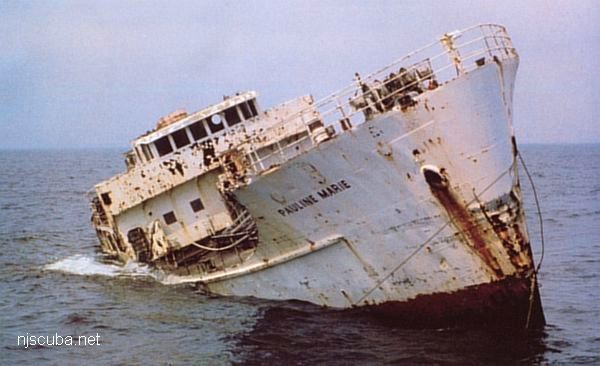
- Type:
- artificial reef, freighter, USA
- Built:
- 1944/1945 USA as FS-??? (US Army Design 381)
- Specs:
- ( 176 x 32 ft ) 560 tons
- Sponsor:
- Seacoast Products Inc, Fisherman Magazine
- Sunk:
- Friday March 29, 1985 - Atlantic City Artificial Reef
- GPS:
- 39°13.763' -74°12.182'
- Depth:
- 85 ft
More: Pauline Marie FS-??? ...
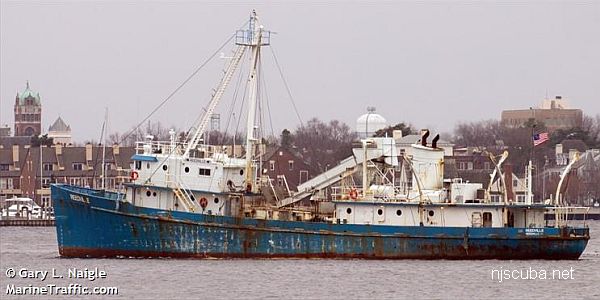
- Type:
- artificial reef, freighter, purse seiner
- Built:
- 1944, Wheeler Shipbuilding, Brooklyn NY USA, as Army FS-278
- Specs:
- ( 166 x 32 ft ) 542 gross tons
- Sunk:
- Friday, August 14, 2020 - Delaware #11 Artificial Reef
- GPS:
- 38°40.423' -74°44.295'
- Depth:
- 80 ft
More: Reedville FS-278 ...
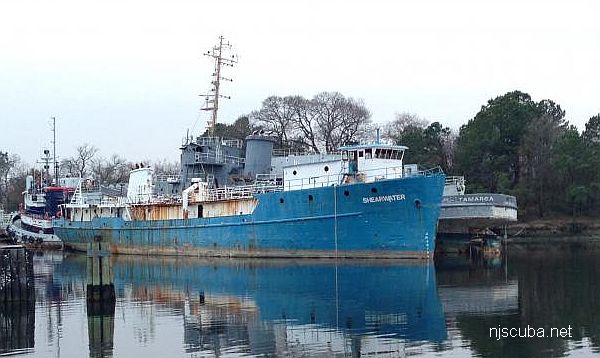
- Type:
- artificial reef, freighter, purse seiner
- Built:
- 1945, Hickinbotham Brothers, Stockton CA USA as FS-411 (US Army)
- Specs:
- ( 166 x 32 ft ) 542 tons
- Sunk:
- Dec 11, 2015 - DelJerseyLand Artificial Reef
- GPS:
- 38°31.661' -74°30.607'
- Depth:
- 120 ft
More: Shearwater FS-411 ...
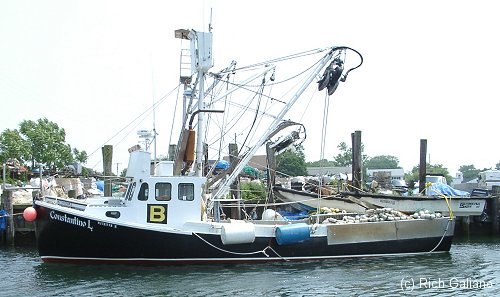
More: Purse Seiners & Gill-netters ...
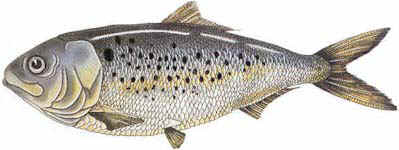
Scientific Name:
Brevoortia tyrannus
Atlantic Menhaden:
A Profile
Family:
Clupeidae
Size:
12"-15"
1 lb.
Common Names:
menhaden, bunker, mossbunker, pogy, fatback, alewife, bugfish, skipjack
Although this herring is generally considered unfit for human consumption, the menhaden fishery is one of the most important and productive fisheries on the Atlantic coast. For years, it has provided coastal communities with a stable source of employment and the nation with a major source of protein on a renewable and environmentally sound basis.
More: Atlantic Menhaden ...
Questions or Inquiries?
Just want to say Hello? Sign the .