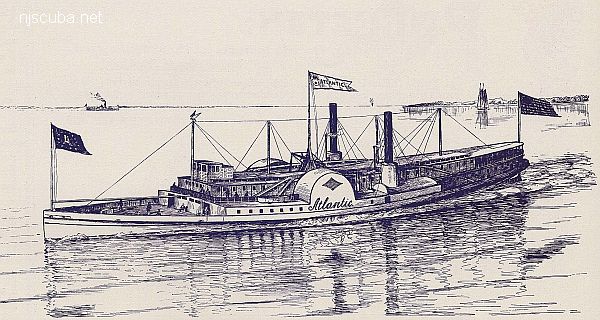
Steamer or Steamship

Steamer is an early term for any vessel power by a steam engine rather than sails.

Shipwreck Delaware
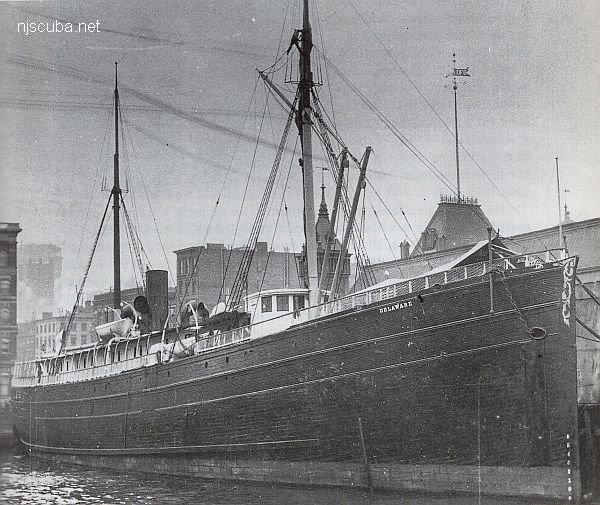
The Delaware, an 1880s screw steamer

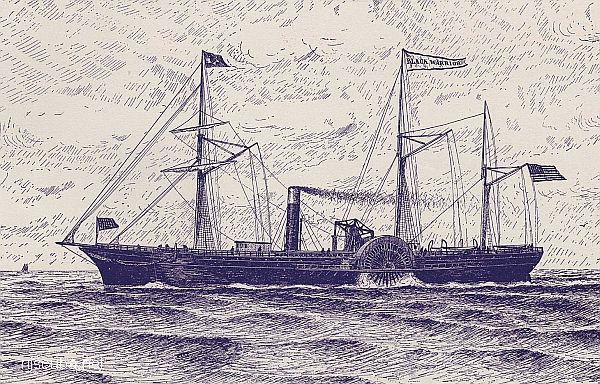
Early steamers were propelled by large paddlewheels. "Side-wheelers", with the paddlewheels on each side, were more seaworthy, and therefore more common in ocean waters, while "stern-wheelers", with a single large paddlewheel at the back, were more common as riverboats. Later, these were replaced by more efficient screw (or propeller) vessels.

Shipwreck Black Warrior
The Black Warrior, an 1850s side-paddlewheel steamer. There are no stern-wheelers in the region that I know of.
Click
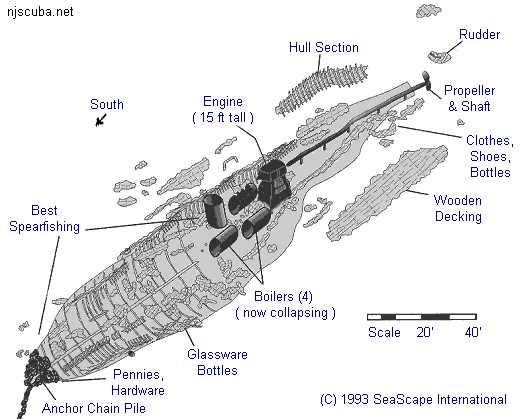
This sketch of the Delaware shows the remains that you can expect to find of such a vessel.

Of note is the universal pattern of:

< bow - boilers - engine - drive shaft - propeller - rudder/stern )

and the fact that the boilers are always in front of the engine. Identify any one of these features on the wreck, and you can orient yourself in even the murkiest conditions.

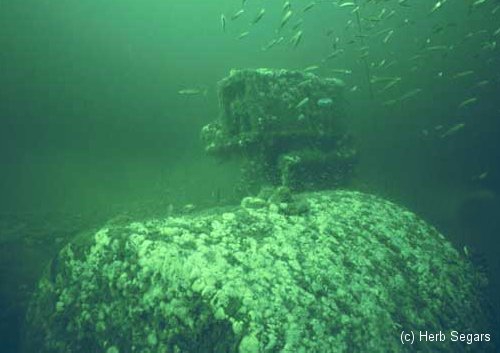
Shipwreck Delaware boiler
Boilers on the Delaware. In the foreground is an intact one. Next to that is a collapsed one; there are four altogether. In the background is the engine.
steam engine
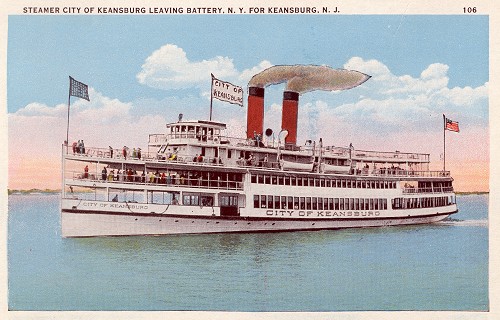
An old postcard of the City of Keansburg, the last of the New York commuter ferries, and one of the last steamships to ply local waters - until 1968.
steam engine
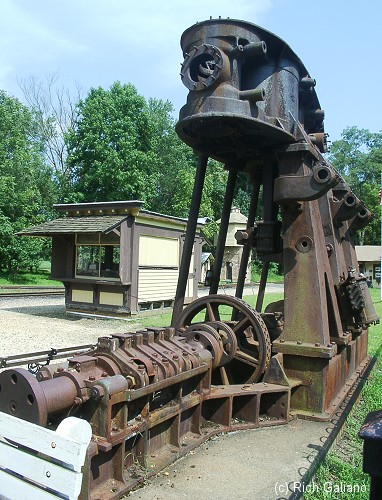
One of the Keansburg's two triple-expansion steam engines, at Allaire State Park.


Type:
shipwreck, steamer
Depth:
80 ft

A very small wreck, consisting of a primitive single-cylinder steam engine and a large, completely broken-down boiler. Odd pieces of pipe and machinery lie around, but no remains of a hull, although there appears to be some iron plating under the engine. Guessing from the technology, the construction would date to around 1860 +/- 10 years, and the sinking would have been sometime after that.


Shipwreck Essex
Type:
shipwreck, steamer
Built:
1890, Cramp Shipbuilding, Philadelphia PA USA
Specs:
( 272 x 40 ft ) 3018 tons
Sunk:
Thursday September 25, 1941
ran aground on Block Island - no casualties
Depth:
30 ft

bow, boilers, hull plates & ribs


From way back when in 1996 ...

NJ Scuba
Diving Myths
by Dr. Jolie Bookspan, author of Diving Physiology in Plain English

Myth 1 - The Dive Reflex Protects You

diving myths

In the dive reflex, heart rate and limb blood flow decrease. Careful science ( that means we didn't accidentally step on the thermisters ) shows time and again that the dive reflex does not reduce the need for oxygen underwater as it does in marine mammals. Field studies ( where you're allowed to step on the thermisters ) indicate that the dive reflex does not extend breath-holding time. Occasional cases of human survival after very cold water near-drowning are not due to the dive reflex. Cold is the likely mechanism behind the reduced metabolism that permits survival.