Copepods

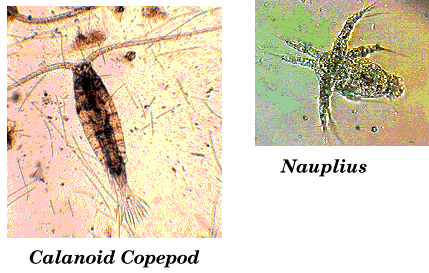
Most copepods are harmless plankters or bottom dwellers. In fact, copepods are the most numerous of all crustaceans in terms of both species and population. However, since they generally range in size from 1/16" to 1/2 ", they are not of much interest to divers.
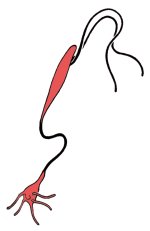
The Ribbon Louse ( Lernaeenicus spp. far right, 1 inch to 1 foot ) is a fish parasite. I have observed these bizarre creatures only in the aquarium. The head ( at lower left ) is buried in the body of the host, while the worm-like body hangs outside. Only the twin tails betray its true and almost unrecognizable nature - this is a copepod crustacean. And this is not even the extreme of crustacean evolution - some parasitic barnacles live completely inside their host, actually melding with the host's flesh until the two are inseparable, like some kind of science fiction nightmare.