
Copepods

Ribbon Louse
Copepod

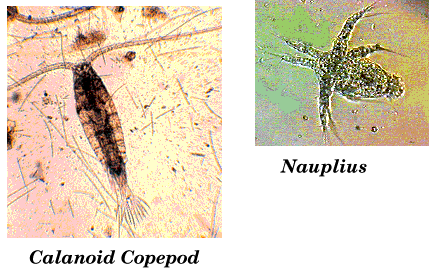
Most copepods are harmless plankters or bottom dwellers. In fact, copepods are the most numerous of all crustaceans in terms of both species and population. However, since they generally range in size from 1/16" to 1/2 ", they are not of much interest to divers.

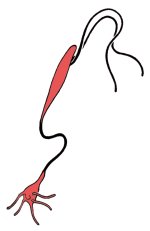
The Ribbon Louse ( Lernaeenicus spp. far right, 1 inch to 1 foot ) is a fish parasite. I have observed these bizarre creatures only in the aquarium. The head ( at lower left ) is buried in the body of the host, while the worm-like body hangs outside. Only the twin tails betray its true and almost unrecognizable nature - this is a copepod crustacean. And this is not even the extreme of crustacean evolution - some parasitic barnacles live completely inside their host, actually melding with the host's flesh until the two are inseparable, like some kind of science fiction nightmare.
Copepods
Planktonic copepods

By Alex Brylske
Reprinted from Dive Training
Sept. 1996

PARALLELS ARE OFTEN DRAWN BETWEEN DIVING AND FLYING. Both take place in an environment where the ambient pressure is different than the earth's surface - where we spend most of our time breathing - and both require formal training to qualify as a participant. Yet, on one point the two activities diverge completely. In flying, the highlight of a pilot's life is his or her first opportunity to solo - to operate the aircraft alone. In fact, after earning a private pilot's license, aviators commonly fly with no one other than God as their copilot.

Not so in diving; the admonition to "never dive alone" is considered the hallmark of safe diving.

To most divers, entering the water without a buddy is tantamount to a pilot taking off without doing a preflight check of the airplane. But to assume that buddy diving is an absolute universal practice would be a mistake. Lots of divers dive solo. Some do it intentionally, but most end up sans buddy completely by accident.