Hermit Crabs

Hermit Crab

Hermit crabs live inside empty snail shells in shallow water along beaches and in estuaries, small specimens on mudflats and large ones offshore. Some hermit crabs are entirely terrestrial, needing the water only to lay eggs. In the South Pacific, there are types that actually climb trees and very large ones that don't bother with a shell as adults.

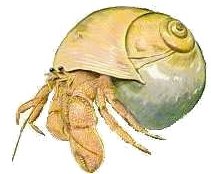
The size of the crab determines what kind of shell, and upgrades are required as the crab grows. The Flat-Clawed Hermit Crab Pagurus arcuatus (right) is the largest in our area, and will often use Moon Snails and Whelks, but you will only find the big ones in deeper water. Small ones use Periwinkles and Oyster Drills.

Hermit Crab

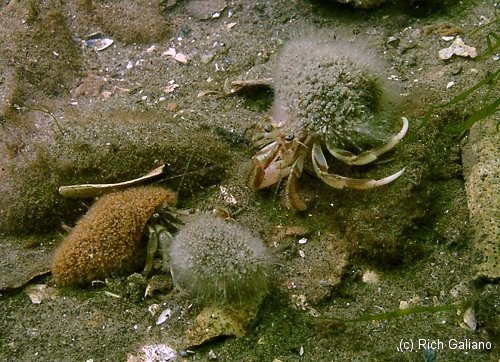
Like good suburbanites, Hermit Crabs are always on the lookout for bigger and better shells, and when they find one they like, a quick switch is in order to see how it fits. They will also try to steal good shells from each other. This makes them very amusing to watch in an aquarium. Snail Fur is a type of hydroid that lives only on Hermit Crab shells, you could call it "crabgrass".

Hermit Crabs are not true crabs but are an intermediate form having a soft shrimp-like tail that is protected inside the snail shell. The four hind legs that appear to be missing are evolved into grippers that hold the crab inside the shell so strongly that you will tear the animal in half before you can extract it. The claws are usually shaped so that together they will exactly block off the opening when the crab retreats inside.

Hermit Crab
Hermit crab anatomy - more similar to lobsters and shrimps than to true crabs.
Hermit Crab
A very unhappy hermit crab, temporarily deprived of its shell
Hermit Crab
Hermit Crab
A large Hermit Crab struggles to right its upended Moon Snail shell ...
Hermit Crab
Hermit Crab
... and succeeds.
Hermit Crab
These Hermit Crabs are covered with Snail Fur Hydractinia echinata, a type of hydroid.
Hermit Crab
Acadian Hermit Crab Pagarus acadianus
Herb Segars Photography

lanyard

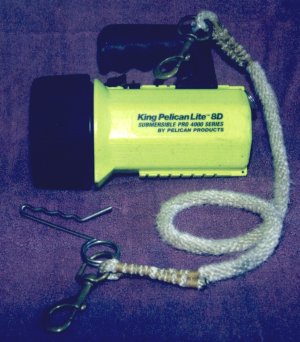
Chances are your light or other piece of gear came with a wrist lanyard. This item is probably ok for diving in the tropics where you shouldn't be doing anything with your hands anyway, but around here it is lousy. Wrist lanyards are a pain to put on and a pain to get off, and in the case of a light, if you let go of it to do something with both hands, it will invariably get in the way and bob around until it shines in your eyes and blinds you. When you finally get fed up with it, you will take it off, and in a careless moment, your equipment will be lost. Here is a much better rig, commonly known as a "hi-lo" lanyard:

Take the wrist lanyard off, and throw it away. Get two brass snaps and a piece of rope. Braided 1/2 " nylon is what I used because it is supple, won't rot, won't unravel, and doesn't float. Attach a brass snap to each end. You can just tie them on, or get fancy like me and make streamlined loops. The end-to-end length of mine is about four feet, including the snaps, but you can experiment. Attach the base ring of one of the brass snaps directly to your gear where the lanyard was.