Gallery of Ships
A ship is a large watercraft that travels the world's oceans and other sufficiently deep waterways, carrying goods or passengers, or in support of specialized missions, such as defense, research, and fishing. Ships are generally distinguished from boats, based on size, shape, load capacity, and tradition.
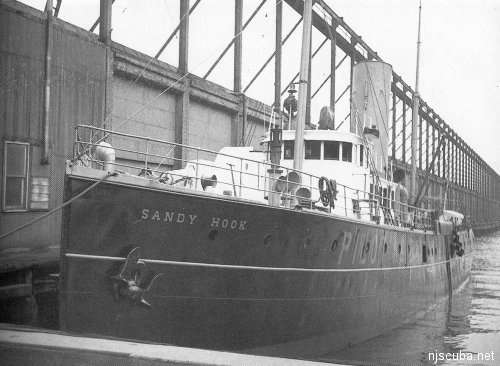
A harbor pilot is a person who takes control of a seagoing ship when it is entering or leaving port. He is expertly familiar with all the channels, shoals, currents, tides, and regulations of his particular port, and is essential to safely steer the ships in and out. It is an ancient and exclusive profession, often passed down from father to son*. In old days, the top two signal flags at right were used by ships entering and exiting a harbor to call for a pilot, while the bottom flag indicated "pilot on board."
More: Pilot Boat ...
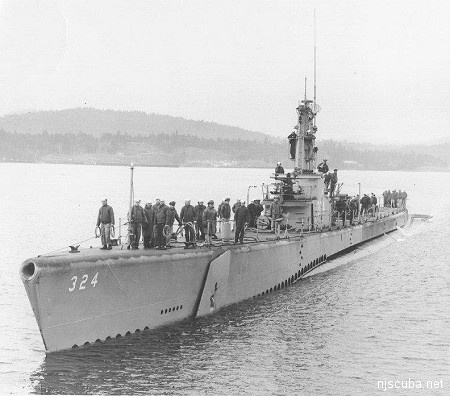
Everyone knows what a submarine is - a ship that can go underwater. Hardly needs any explanation. Unless you're in the US Navy. By the Navy definition, only their modern, nuclear-powered boats ( all submarines are called "boats" ) are true submarines, designed to operate beneath the surface almost indefinitely. Anything else is merely a "submersible", tied to the surface by the need for fuel and air. Whatever.
More: Submarine ...
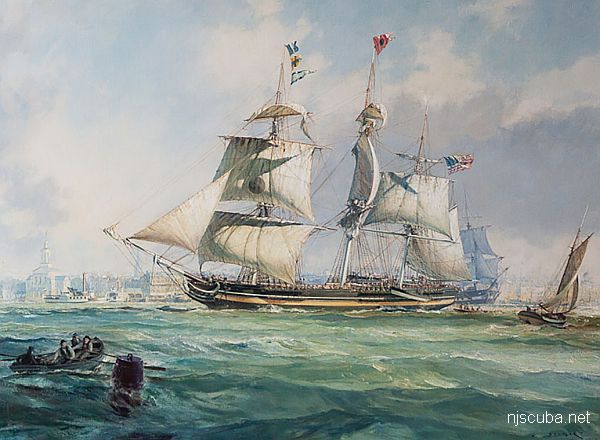
A packet ship of the early 1800s. Of note is the way the sails on the mainmast are set backward, against the sails on the fore- and mizzen- masts. Known as "backing", this was how a square-rigged ship "put on the brakes" to slow or stop without actually furling the sails.
Wind power has been used by mankind for millennia. Almost every human culture has constructed sailing vessels of some kind, from crude log or reed rafts to the highly developed wind-jammers of the early twentieth century. Many of these vessels were the most complex and technologically advanced machines of their time - equivalent to our jet airliners.
More: Sailing Ships ...
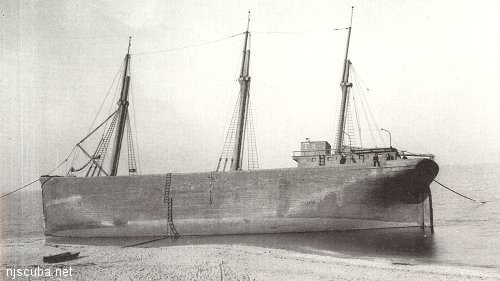
The schooner barge was the final development of the working sailing ship. The design originally evolved in the 1870s on the Great Lakes, where it was found that sailing ships could be more profitably towed from place to place than sailed. No longer subject to the vagaries of the wind, such trips could be made on a scheduled basis, and with reduced labor costs. The idea spread into general use, resulting in the conversion of many sailing ships into barges. Ironically, most of the vessels that were converted to schooner barges were not actually schooners, but square-rigged ships. Square-riggers, with their large and expensive crews of skilled sailors, became uneconomical to operate in the face of ever-improving steam power, while more efficient schooners managed to compete for a few years longer.
More: Schooner Barge ...
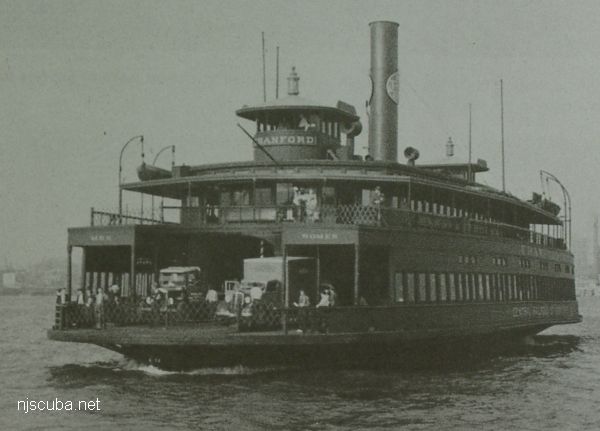
A ferry is a ship designed to transport people or vehicles across the water on a regular schedule. Ferries generally cover only short distances in protected areas and are not designed for the open sea. The distinction between a ferry and a steamer is a blurred one, though, especially in the waters around New York City, where the same company might operate a cross-river vehicle and passenger ferries, and cross-bay passenger steamers, all for the same commuter service. Some ferries even carried rail cars.
More: Ferry ...