Collecting Mussels
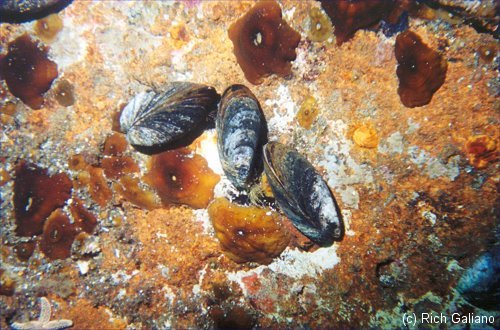
Mussels are easy. they grow almost everywhere - on any hard surface. They are the lawn grass of the sea. All you have to do is pluck them and put them in your bag. Don't waste a lot of time selecting them individually underwater. Just grab big clumps as fast as you can, and stuff them in your bag. Sort them out topside later, when your nitrogen clock isn't running. Take more than you think you'll want because you will end up discarding a lot of what you take this way.
A big bag of mussels can be quite heavy and require a lot of air in your BC to lift, so make sure that you ascend the anchor line when returning to the boat. Barring that, shoot the mussels to the surface with a lift bag to avoid making an especially risky free ascent.
Try to collect mussels only from the higher parts of a wreck, away from the bottom. Mussels collected from low down are more likely to contain sand and mud. Offshore mussels are generally cleaner than inshore, except in the Mud Hole, where everything is filthy. I've never taken mussels from an inlet jetty, but I wouldn't be surprised if they tasted like gasoline!
The quantity of mussels on our wrecks varies. Often-hit wrecks such as the Spartan and Stolt Dagali are often picked clean by divers. One of the best mussel wrecks in the area is now the Beth Dee Bob, where they grow almost a foot deep in spots, and as clean as a whistle. Inshore, the Dykes is not a bad place to get them, although they are a little dirty.
Back in the boat, it's now time to clean your mussels. Take the clumps out, and pull the individual mussels apart. Each mussel is attached by a tuft of tough fibers known as a "beard". It is important to not pull the beard out of the animal at this point, otherwise, it will die prematurely and spoil. The best size is 1 1/2 " - 2 1/2 ". Bigger ones are impressive, but not as good. Separate out the keepers, and throw the rest overboard, where they will feed the fish.
Keep a sharp eye for other creatures while you work on your mussels. You will find many things, such as tiny starfish and crabs, clam worms, and other miniature residents of the mussel patch that you would otherwise never see. Throw them all overboard. Finally, put the separated mussels in a mesh catch bag. Tie a rope around the bag and thread it through the handle. Don't tie the rope directly to the handle of the bag, as it will rip off eventually from this. When the boat is underway, toss the bag out and tow it behind in the wake for 5-10 minutes.
When you haul them back in, they will be bright and shiny. Don't overload the bag or leave it out for too long, as this will result in pulverized mussels and eventually a torn or even lost bag. And don't forget to take the bag back in before you get to port, otherwise, the boat may back over it, and you will have no mussels, no bag, and a very angry captain to deal with.
Put the clean mussels on ice in a cooler. They will keep alive in your refrigerator for several days. You can also freeze them alive and they will keep for a very long time. There are many mussel recipes that can be found with a quick search.
Something almost anyone can catch is shellfish. They really don't put up much of a fight or try to escape, so even a beginning diver can take something home for the dinner table.
More: Collecting Shellfish ...
Mussels are found everywhere, attached to any solid substrate. Mussels are to the sea what grass is to suburbia. Mussels lack the muscular foot of clams or the large hinge muscle of scallops. Instead, they have a "beard" of tough fibers near the hinge with which they attach themselves.
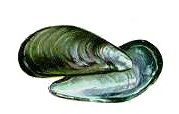
The Blue Mussel Mytilus edulis, to 4" is the edible mussel. The similar Horse Mussel Modiolus modiolus grows to 6", and is considered inedible. Both types are found from the intertidal zone down to the depths. See entry on barnacles.
More: Mussels ...
Fish
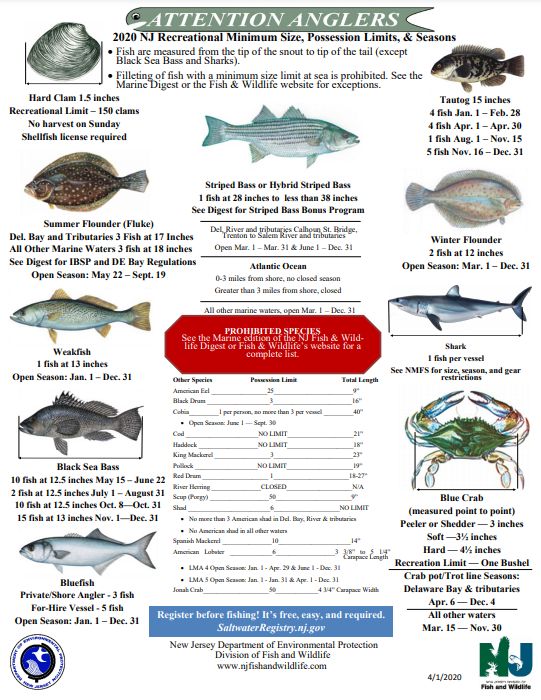
New Jersey now requires registration for saltwater fishing, including lobsters. Registration is free and can be done online at nj.gov/dep/saltwaterregistry.
This listing is for New Jersey waters only - if you cross into New York or Delaware, or Federal waters ( more than 3 miles offshore, ) you are subject to their regulations. Federal regulations supersede state regulations whenever stricter.
Lobster
More: Fishing Regulations ...