Lightship
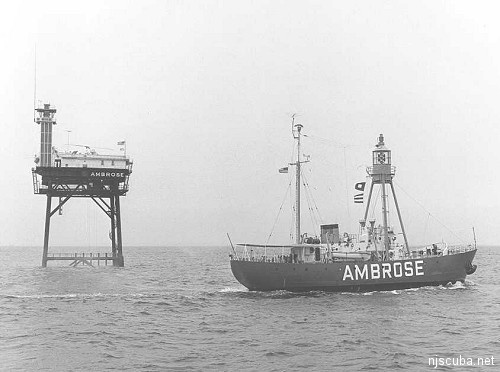
A lightship is a small vessel with minimal engine power and a stout stable hull, designed to act as an anchored long-term floating lighthouse outside of a harbor. They were generally painted in bright red or orange anti-collision colors. Not that it helped much.
Nowadays, lightships have been largely replaced by offshore towers and more modern methods of radio navigation. Very close to the final resting place of the Relief is its modern counterpart, the Ambrose Tower. The lightship Ambrose is a virtual twin to the Relief and may be toured at the South Street Seaport in New York City. The old Boston Lightship was sunk as an artificial reef off Atlantic City in 1994.
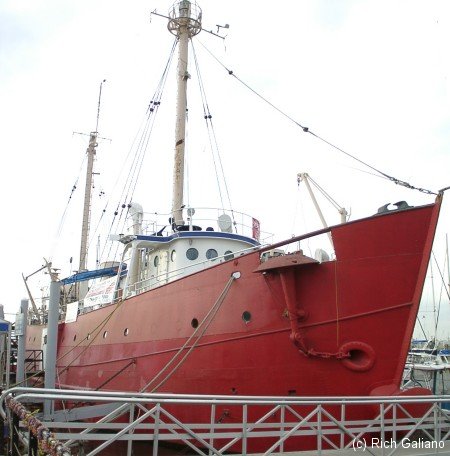
The lightship Winter Quarter LV-107 / WAL-529, built in 1923, and now used as floating office space in the marina adjoining Liberty State Park in Jersey City. While not a museum, you can still go aboard and tour the decks and open spaces. Note the massive mushroom anchors on the bow.
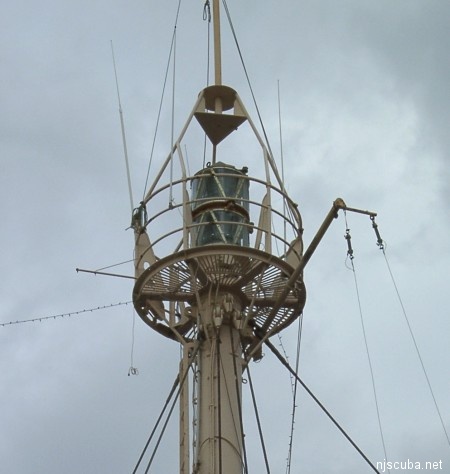
As an aside, a few years ago the Ambrose Tower was rammed by one of the very ships it was meant to guide. The collision tore off one of the tower's four legs, and in the process, it settled a long-standing question. Many people doubted that the tower would stand on only three legs, with one leg gone, although it was designed for just such an accident. The engineers were right, the tower did survive, and it was soon repaired.
Lightships
THE MARITIME HERITAGE OF THE UNITED STATES
NATIONAL HISTORIC LANDMARK THEME STUDY
PART ONE: LARGE PRESERVED HISTORIC VESSELS: LIGHTSHIPS
JAMES P. DELGADO
MARITIME HISTORIAN
(JUNE 1989)
THE DEVELOPMENT OF THE AMERICAN LIGHTSHIP
Lightships were essential partners with America's lighthouses as part of the federal government's commitment to safe navigation on the nation's coasts and on the Great Lakes. While the first American lighthouse dates to the colonial era, the use of lightships is a more recent 19th-century phenomenon in the United States, though employed earlier in Europe. Moored over treacherous reefs, or marking the narrow approaches to a channel or harbor entrance where lighthouses could not be built or placed in areas too far offshore for a shoreside lighthouse's lens to reach, lightships were fewer in number than the estimated 1,500 lighthouses built in the United States. In all, 179 lightships were built between 1820 and 1952. In 1909, the heyday of the United States Lighthouse Service, there were 51 lightships (46 on the eastern seaboard and five on the Pacific Coast) on station in the United States.
Between 1820 and 1983, the U.S. government established 116 lightship stations on three coasts and on the Great Lakes. Among the more famous and significant lightship stations were "Ambrose, " marking the southern entrance into New York harbor along the New Jersey coast; "Nantucket, " marking not only the entrance to Boston harbor but also the American end of the transatlantic route; "Chesapeake, " marking the entrance into the Chesapeake Bay, "Diamond Shoals" off the Outer Banks of North Carolina, which marked a dangerous spot along the coastal ocean highway by way of the Gulf Stream; and "San Francisco" on the bar three miles out from the Golden Gate. These were among the better-known stations; others, less known to the public, were as important if not more significant, such as the Huron station on Lake Huron, which safely guided a major proportion of the nation's maritime traffic across the Great Lakes.
The first lightship was a small wooden schooner moored on the Chesapeake Bay. From this pioneer, the lightship type developed through the 19th century from sail to steam, from wood to iron to steel hulls, and to more powerful optics. The development of the lightship was also marked by changes in hull design, the development of direct diesel and diesel-electric propulsion, changes in sound signals, and the development of the radio beacon in the 1930s, which revolutionized the navigational potential of lightships by providing a non-visual long-distance bearing to the lightship station. Officially designated by numbers after 1867 (such as Lightship No.112), the lightships were often referred to by the name of the station on which they served, such as "Nantucket." Because of this, an individual lightship in the course of her career was often known by more than one station name. Serving under the Fifth Auditor of the Treasury, the United States Lighthouse Board, the United States Lighthouse Service, and finally the United States Coast Guard, lightships like lighthouses remained at a constant location, with new vessels replacing the old. Thus there were more than one "Nantucket, " "Ambrose, " "Chesapeake, " "Diamond Shoals, " and "San Francisco, " as well as others, on the various stations through the years. Lightships, also referred to as light vessels, retained their lighthouse service numbers until 1947, when the U.S. Coast Guard designated some of them "WAL" and assigned a new number (such as WAL-534). After 1965, all lightships were redesignated "WLV" (such as WLV-534).
FIRST GENERATION:
WOODEN-HULLED LIGHTSHIPS
The first American lightships were built with wooden hulls. They replaced the early beacon boats, small, undecked craft apparently built for sheltered waters. Joseph Hill, the probable builder of the sloop Discovery, originally a beacon boat, described her in 1821 as a 26.2 by 9.8 by 3.9-foot, 8-16/95-ton vessel with a square stern, built around 1791. In 1821, Hill noted that the vessel was fitted with a single mast and deck, apparently installed after she was sold by the government, "condemned as not fit for service." the beacon boats were unmanned, securely moored vessels that served as large buoys. The first manned lightship was authorized by Congress in 1819 and built in 1820 by John Pool in Hampton, Virginia. The specifications called for a 70-ton vessel, copper fastened and sheathed, with berths for four men, a galley, a capstan belfry, spars, and a yawl boat with davits. A more detailed description of an early wood lightship is found in an 1823 contract between Jonathan Thompson, Superintendent of Lighthouses in New York, and New York shipbuilder Henry Eckford. The contract calls for three lightships, each built with white oak frames and live oak planks, and pine decks. The ships were to be iron and cooper fastened and copper sheathed. The two masts would mount copper lanterns, supplied from oil rooms lined with tin in the hold. On deck, "cabooses" or cabins for sleeping 6 to 8 men were to be built. The ships would be ballasted with kentledge (iron pigs), and anchored with iron chain and cast-iron mushroom anchors. One vessel, slated for Cape Hatteras, was to be approximately 300 tons burthen. The other two, for Delaware Bay, were to be approximately 100 tons. Eckford built the latter two 106-3/95-ton vessels. They were 72 feet long, with a 20-foot beam and 8.4- foot depth of hold.
The hull design of these early vessels did not differ from that of standard merchant vessels. The lines of Eckford's 1823 lightships show a round-bottom hull with a bluff bow and somewhat sharper stern. This translated into a rough time in heavy seas. Many early lightships were not stable when anchored. In 1851, the captain of the Sandy Hook lightship complained that "The model of the present ship and her bottom, is similar to a barrel; she is constantly in motion, and when it is any ways rough she rolls and labors to such a degree as to heave the glass out of the lantern, the beds out of the berths, tearing out the chainplates, etc., rendering her unsafe and uncomfortable." This problem would not be rectified until after 1856 when experiments led to the development of bilge keels to retard rolling.
In response to Congressional concern and criticisms of the nation's aids to navigation, the Secretary of the Treasury appointed a Lighthouse Board. Manned by naval and army officers and civilian scientists, the board's duty was to "inquire into the condition of the light-house establishment" under provision of an Act of Congress of March 3, 1851. The Lighthouse Board found the lightships "in bad order, badly attended, and all with ... insufficient illuminating apparatus. Many of them are not moored, but anchored by a single chain and anchor, with a long scope of cable; the vessel consequently describes a large circle around the anchor, destroying, in some degree, her usefulness as a range, and is in danger of fouling" the board found many vessels lit with lamps that ranged from pans of oil with wicks floating in them to lamps set into gimballed platforms that were suspended from the masts; these lights were not visible far out to sea. The board also criticized the fact that the various vessels, much like lighthouses up to that time, were built to various plans and designs with no standardization. Since the wooden lightships lasted only five to ten years because of decay, the Lighthouse Board recommended that iron vessels be substituted; "The advantages of iron over wood for the construction of light-vessels are self-evident. Durability, buoyancy, and economy of first cost, are the advantages, without any conceivable disadvantages " the board also recommended that the vessels follow the model of British lightships, which were iron vessels fitted with 21-inch parabolic Reflectors and Argand lamps.
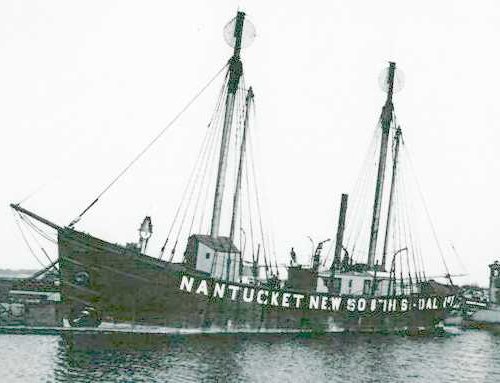
Lightships were fitted with better lamps and reflectors by the Lighthouse Board, but iron hulls were not built for decades. Instead, the board ordered a wooden vessel, later numbered as Lightship No. 1, in 1855. Built at Kittery, Maine, at the Portsmouth Navy Yard, the 275-ton oak vessel was 103 by 24 feet and carried two lamps atop each mast. Most wooden lightships built afterwards generally followed her lines and design, establishing the first "standard" for American lightships. Rigged as a schooner, the staunchly built vessel lasted on the rugged Nantucket station from 1856 until 1892, last serving off Savannah, Georgia until 1930. Sold to the Groveton, Massachusetts, Sea Scouts, the former lightship was grounded in a 1936 flood and stripped. In 1986, the 130-year-old hulk remained visible on the bank of the Merrimack River.
In 1891, journalist Gustav Kobbe visited No. 1 on the Nantucket Station. He described how the space between the outer hull planks and ceiling planks was filled with salt "to keep her sweet, " but devoted much of his attention to the particulars of the lights:
The lanterns are octagons of glass in copper frames five feet in diameter, four feet nine inches high, with the masts as centers; there are eight lamps, burning a fixed white light, with parabolic reflectors in each lantern, which weighs, all told, about a ton. About nine hundred gallons of oil are taken aboard for service during the year. The lanterns are lowered into houses built around the masts. The house around the main lantern-mast stands directly on the deck, while the foremast lantern-house is a heavily timbered frame three feet high. This is to prevent its being washed away. When the lamps have been lighted and the roofs of the lantern-houses opened, - they work on hinges and are raised by tackle, - the lanterns are hoisted by means of winches to a point about twenty-five feet from the deck. Were they hoisted higher they would make the ship top-heavy.
Not all of the early lightships were built as such. Some were former merchant vessels purchased by the government and modified, such as Lightship No. 8, built in 1853 as the brig Thomas J. Haight or No.10, a scow built as a stone barge, used to build the Stannard Rock Lighthouse, and then converted to a lightship on Lake St. Clair in 1882. It was in this fashion that the first iron-hulled lightships were acquired.
TRANSITIONAL GENERATION:
COMPOSITE AND IRON AND STEEL HULLED LIGHTSHIPS
The first iron-hulled lightships were two former U.S. Revenue Marine steam cutters, Spencer and Legare, both of which were converted to lightships in 1847 during the Mexican War. Spencer marked Willoughby Spit in Virginia until retired in August 1867; Legare marked Merrills Shell Bank, Mississippi, until sunk by Confederate forces. The next iron lightship was the former Confederate gunboat Lady Davis, first built in 1858 as the tugboat James Gray. The Confederates, as part of their effort to defend the port of Charleston, removed Lady Davis' engines for the ironclad ram Palmetto State in 1862. Following the fall of Charleston, the U.S. acquired the former gunboat for use as a lightship. Equipped "using materials collected from Charleston and Port Royal," including 8 tons of old shells as ballast, the vessel was moved in 1865 to mark the wreck of the monitor Weehawken. Designated No. 31 in 1867, the lightship was withdrawn in 1871 and sold.
Before building iron or steel lightships, the Lighthouse Board briefly experimented with composite construction in the 1880s. In 1881, Lightship No. 43 was built at Wilmington, Delaware, by Pusey and Jones with an iron hull sheathed in yellow pine. Other lightships built to the same design were numbers 45 and 46. Ten years later, the first composite lightship built with steel frames and a wood hull, No. 47, was launched at South Boston by Harrison and Loring. these composite vessels were described in 1890 by Arnold Burges Johnson, Chief Clerk of the U.S. Lighthouse Board; "They are intended to be the most powerful and complete light-vessels ever built." the next three lightships, numbers 48-50, as well as No. 66 (1896) and No. 67 (1897), were also built as composites. The last composite lightships, numbers 66-71, were built with steel frames, stem, stern, and keel, a bilge strake, and topside plating, while the bottom, from the line of the main deck down, was planked with white oak and sheathed with Muntz metal.
Despite these experiments, the development of metal hulled lightships lagged behind the adoption of iron and steel hulls in commercial and military vessels in the United States, in large part due to timber dependent United States shipbuilders' initial reluctance to build ships of metal, and the belief by the Lighthouse Board that wood hulls better withstood heavy seas and collisions than "brittle" iron. The rusting of iron hulls also encouraged fears of frequent maintenance. The operational experiences of the composite lightships in time would counter these beliefs. The board nonetheless was willing to experiment, though, and in 1882, one year after the first composite lightship was built, the first iron-hulled lightship designed and built as such, No. 44, was laid down by Pusey and Jones. The vessel carried steam auxiliary machinery, as did her contemporary composite and wooden sisters. Steam was used for the sound signal alone since light vessels were either towed or sailed out to station.
There were only three other iron-hulled lightships, numbers 52, 53, and 54, all built at West Bay City, Michigan, in 1892. At the same place, in 1891, No. 51, the first steel-hulled lightship, was built. This vessel was also the first to receive an electric illuminating apparatus, rated at 4000-candlepower. Other steel-hulled lightships followed, and after 1902 all lightships were built of steel. In 1904, Lightship No. 78 was built by the New York Shipbuilding Co. at Camden, New Jersey. No. 78's specifications called for a 129 foot long, 28.6-foot beam, 668-ton displacement steel-hulled vessel with a compound marine steam engine driving a single screw. Two masts mounted lanterns that were raised from steel houses to the masthead. Numbers 79, 80, 81, and 83 were viewed by the Lighthouse Board as prototypes. In 1907, the subsequent specifications for Lightships No. 84-88 were adopted as "The standard specification for light vessels."
By the end of the 19th century, hard-learned lessons had resulted in a standardization of lightship form and design, starting with a flat bottom, a rounded bow, and bilge keels to reduce rolling. The use of heavily constructed steel hulls, moored with massive mushroom anchors attached with strongly forged huge cables; decks designed to let the water run off; and a dual mast system to always keep a light lit characterized the typical lightship in the United States after 1904. Different classes of lightships were built, first with riveted, and finally with welded steel hulls, the principal distinction being the length of the hull and the power plants. These vessels were externally much the same, with the exception of Great Lakes lightships, which were built differently for lake sailing conditions. Great Lakes lightships were sharper and shorter to better cope with the short wave intervals on the lakes and icing.
After 1891-1902, changes in lightships centered on the changes in propulsion and shipboard power systems and the development of the optics and sound signals aboard the lightships, including submarine bells, oscillators, and finally the radio beacon.
THE SECOND GENERATION:
STEAM-POWERED AND PROPELLED LIGHTSHIPS
Most lightships were towed to station by lighthouse tenders, though many of the early vessels carried a fore-and-aft rig. Ironically, several former steamers were converted into lightships after their steam machinery was removed. Steam machinery was introduced for the first time when Lightship No. 39 was built in 1875. Two boilers powered a steam pump and the 12- inch fog whistle. No. 40 was similarly equipped, but Lightships No.41 and No. 42, built respectively in 1876 and 1877, were outfitted with John Ericsson's hot air caloric engine, which compressed air into a "Brown's Fog Siren." All subsequent lightships carried auxiliary steam for the fog signals and pump, and, beginning with No. 47, for the windlass.
The Lighthouse Board's specifications for the composite lightships No. 47, No. 48, and No. 49 provide a detailed picture of the first steam machinery for lightship use. The board specified two cylindrical water-tube boilers of the "return-tubular" form, 6.6 by 7.3 feet, capable of reaching a working pressure of 100 pounds per square inch. The boilers powered a small, horizontal non-condensing steam engine "at least 5-inches in diameter with a 6-inch stroke, " fitted with a Pickering governor, and capable of 120 revolutions per minute. The engine was connected to a shaft with a worm-wheel:
On the same shaft which carries the worm-wheel will be a cast-iron cam-wheel about 20 inches diameter, upon which brass cams of proper length are to be fastened. These cams work against a small composition roller, which is fastened in the middle of the length of a wrought-iron lever about 32 inches long. One end of this lever is stationary as a fulcrum and at the other end is attached a rod half an inch in diameter, connected at the upper end to the bell-crank which operates the whistle valve.
The whistle was a 12-inch diameter brass casting with a double-seat steam valve.
The first steam-propelled lightships, numbers 55, 56, and 57, were steel vessels built in 1891. However, like the introduction of iron and steel hulls, this innovation was not universally adopted at first. Lightships were built without steam propulsion for several years, reflecting the same slow adoption of the new technology that is seen in the late (1902) construction of the last wooden-hulled lightship, No. 74. the early steam-propelled lightships often did not rely on their engines for navigation and were also towed to the station, using the steam plant for the auxiliary machinery and fog signal and occasionally running the engine to keep headway in heavy seas. Early 20th century steel-hulled, steam-propelled lightships also carried riding sails on spencer masts; these were intended to steady the lightship. For the most part, though, the development of propulsion plants meant the diminishing use of the masts to carry any sort of sail.
Additionally, the development of steam, and later Diesel plants, introduced electricity aboard the lightships. No. 51 was equipped with electric incandescent lamps in 1892, the first to be so fitted. By 1917, older oil lamps were being replaced with electric lights, which no longer required lowering to the deck for cleaning and refueling. That year nine electric lights were aboard lightships, a number that substantially jumped within the next decade. the electric lantern and the introduction of Fourth Order Fresnel lenses at the masthead was another major change in the lightship brought about by the development of shipboard power plants.
When Lightship No. 55 was built in 1891, the vessel was outfitted, as were her two sisters, with a single-cylinder, non-condensing 100 HP marine steam engine with a 14-inch bore and a 16-inch stroke. The engine drove a single screw, and the vessel was capable of 8 knots speed. In 1896, when Lightship No. 66 was built by the Bath Iron Works at Bath, Maine, she was fitted with a single-cylinder 350 HP condensing engine with a 20-inch bore and a 22-inch stroke that drove a 4-bladed propeller. Bath Iron Works installed the same engine in Lightships No. 68, 69, and 71. The first compound steam engine in a lightship was a 380 HP engine installed aboard No. 76 in 1904, followed the same year by a 325 HP vertical, surface condensing compound engine with 16- and 31-inch bores and a 24-inch stroke in Lightship No. 78.
The vertical, surface condensing compound engine became the standard for steam lightships, and compound engines with near-identical cylinder dimensions, strokes, and horsepower were employed on nearly all lightships that were built after 1904. Steam engines were installed through 1923; after that date, only Diesel and Diesel-electric systems were installed in new lightships (with the exception of No. 112, built in 1936 with a compound reciprocating engine, which was the last steam-propelled lightship). The introduction of steam moved the lightships into a new generation of development, and in 1922, the U.S. Lighthouse Service (a Government agency that assumed control from the Lighthouse Board in 1910) had 61 lightships in commission, of which 38 were self-propelled, all but three by steam.
THE THIRD GENERATION:
DIESEL AND DIESEL-ELECTRIC LIGHTSHIPS
The installation of diesel-electric plants in lightships was considered by marine engineers as early as 1913 when G. H. Blaker and George Crouse Cook discussed the matter, Blaker proposed two 150 HP engines "direct-connected to direct-current generators, these engines to be connected at the switchboard so that they could be operated in parallel." the system would power the engines, windlass, and lights, and would obviate the necessity of carrying steam, at working pressure, 24 hours per day, seven days a week. It would obviate the carrying of much coal, as for the same horse-power the oil would weigh half; therefore, double the amount of energy could be stored upon the same ship in the same space, the electrically-driven propeller would make the outfit as flexible as any steam plant, and probably more flexible, and would be directly under the control of the operator in the pilothouse so that instant action could be had at any time. With the installation of two sets, it would obviate almost entirely the possibility of a break-down.
In 1915, Lightship No. 98 was built with a 4-cylinder Mietz & Weiss kerosene engine; the following year, No. 101 and 102 were built with similar engines. This initial venture into internal combustion engines did not result in the large-scale adoption of gasoline or kerosene engines for lightships, however. Within a decade, the first diesel engines were being installed in lightships, heralding the next major stage in lightship development. The first lightship built with full diesel propulsion was No. 111, constructed by Bath Iron Works in 1927. The 132.4-foot vessel was equipped with an 8-cylinder diesel engine, direct-reversing with compressed air, with auxiliary generators, electrically-driven pump motors, and a small low-pressure steam boiler for heating.
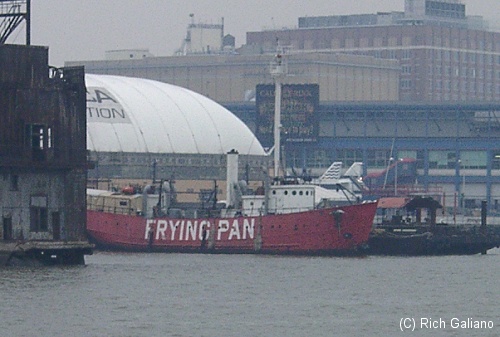
Tied up in the East River along the Brooklyn waterfront.
Beginning in 1926, the last group of lightships built by the U.S. Lighthouse Service were laid down. These 133-foot class lightships, numbering from 113 to 117, were followed by the 114-foot No. 118. These "modern" lightships, built between 1926 and 1938, embodied the changes wrought by direct diesel and diesel-electric technology. Older lightships were modified with diesel and diesel-electric engines and more modern electrical systems, but at the same time, a number of ships were built with the new technology. Thus the first class of lightships built in the 20th century with riveted steel hulls and massive steam engines were eventually all re-engined save one (Lightship No. 83) or replaced by lightships such as the Pacific Coast's No. 100, with diesel-electric propulsion, diaphone air horns, 1,000-watt electric lights in 375-mm lenses, and a reduced tonnage (with the installation of less heavy diesels) meaning less resistance to the sea and hence less battering.
THE FOURTH GENERATION:
COAST GUARD-BUILT LIGHTSHIPS
In 1939, the Lighthouse Service was made part of the reorganized United States Coast Guard. The Coast Guard inherited the lightships at a time when the need for the vessels was diminishing. The same year, the Lighthouse Service noted that the number of floating aids to navigation had decreased since 1880. Automation of lights, the radio beacon, and the development of large navigational buoys played a major role in lightship decommissioning. Not surprisingly, in 1949-1950, the Coast Guard modified Lightship No. 99 to an unmanned, experimental radio-controlled vessel named Exp or Exp-99. According to Popular Science, the vessel was to have a "crew" of electronic devices operating automatically or controlled by radio from shore. Each of its signals --marker light, foghorn, radio beacon, and bell -- is either duplicated or otherwise arranged to defy failure. If either main light fails, the other keeps operating; if both fail, there's still an emergency battery light. Three diesel generators work in rotation to supply power. If one quits, another automatically takes over. The cost of the new ship is $375,000 --just half of a manned lightship. An annual saving of $59,000 in maintenance and personnel is also anticipated.
The vessel was moved to the Coast Guard's Third District headquarters at Staten Island, New York, in May 1950, for a three-month experimental trial run at the Ambrose station. However, the experiment was postponed indefinitely and the lightship's disposition is unknown. Despite this, a portent of the future end of the lightship was at hand. In just 33 years, the last lightship left her station.
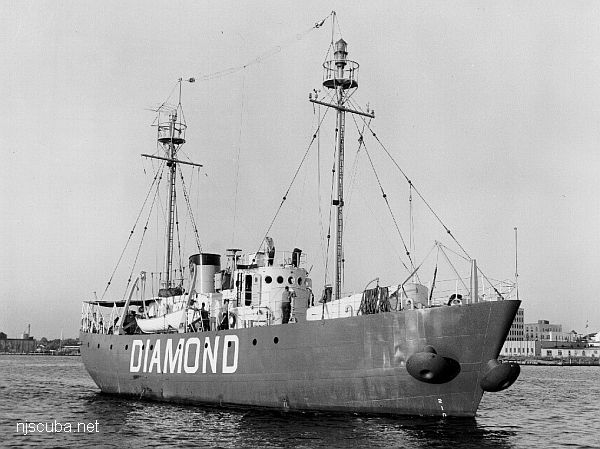
The Coast Guard built six lightships. The first two, WAL- (later WLV-) 189 and 196, were built at Bay City, Michigan, in 1946. Somewhat similar in appearance to the 1930s lightships, the Coast Guard lightships, WLV-189 and 196, as well as the four lightships that followed them were the only completely welded lightships, built with a high degree of structural integrity and transverse bulkheads. These vessels were also the only lightships built with alternating current electrical systems throughout. They were direct diesel propelled, reflecting improvements made in high-compression diesel engines since the 1930s.
In 1950, two additional lightships, built to the same general plan of 189 and 196, and with the same features, were launched from the Rice Brothers shipyard at East Boothbay, Maine. WAL-604 and 605 were the last lightships built under contract for the government. In the same year, the Coast Guard built at its Curtis Bay, Maryland, yard Lightship WAL-612, another sister ship to 189 and 196. The last lightship was also built at Curtis Bay. Constructed in 1952, WAL-613, like her five preceding sisters, was a 128-foot welded steel vessel. However, the lightship mounted a single tripod mast of British design with the light on top. the Coast Guard-built lightships were the last in service, as all others were gradually retired. Technology brought an end to manned lightships about the same time manned lighthouses were being considered for automation. Large navigational buoys, 40 feet in diameter and 42 feet high, painted lightship red with automatic lights, fog signals, and radio beacons began to replace lightships in 1967. In 1983 the last two lightships, marking the Nantucket station, retired, ending a 150-year lightship tradition in the United States.
SURVIVING LIGHTSHIPS IN THE UNITED STATES
There are 22 surviving lightships in the United States. There may be as many as five former U.S. lightships surviving abroad in Canada, Surinam, Vietnam, and Uruguay. When lightships were decommissioned, either by the Fifth Auditor, the Lighthouse Board, the Lighthouse Service, or the Coast Guard, they were as a general rule stripped of their equipment and sold. Some, mostly wooden-hulled vessels, were scrapped by the government. As a result, only a small number of lightships survive today, and all date to no earlier than 1902. Outside of wrecks, or hulks like the stripped hull of Lightship No. 1 on the Merrimack River, no first-generation wooden lightships survive. Likewise, none of the composite or early iron or steel-hulled lightships of the 1890s survive.
One of the steam-powered, but not steam-propelled lightships survives. Lightship No. 75, an 83.9-foot steel scow lightship, was built at Ferrysburg, Michigan, in 1902 for Great Lakes service. Sold in 1939, the vessel was converted into the power lighter St. Clair on New York harbor. In service and homeported at Staten Island, the former lightship has been greatly modified, including the installation of engines and an additional mast.
Eight of the second-generation steam-propelled lightships survive. They are numbers 79 (1904); 83 (1904); 84 (1907); 85 (1907); 87 (1907); 103 (1920); and 107 (1923). One other steam-propelled second-generation lightship, No. 112 (1936), was specially designed and built after the heyday of the steam lightships and belongs in a class by herself.
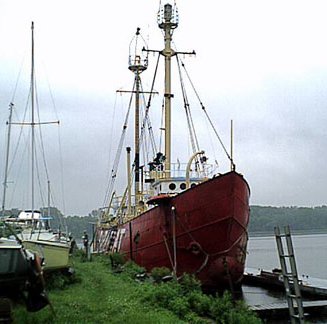
No. 79, also known as "Barnegat" ( right ) is a museum vessel being restored by the Philadelphia Ship Preservation Guild. She is listed in the National Register of Historic Places. No. 83, also known as " Relief, " is a museum vessel at Northwest Seaport, Inc. in Seattle, Washington. Listed in the National Register of Historic Places, No. 83 was designated a National Historic Landmark on April 11, 1989.
No. 84, also known as "Relief, " was substantially modified for use as a display vessel by the Harry Lundeberg School of Seamanship. Recently sold for conversion into a restaurant, the lightship, missing much of her superstructure and with a gutted main deck, is moored off Brooklyn, New York. Discussions are underway for the possible return of the lightship to Jacksonville, Florida, where she would be extensively restored and placed on display. No. 84 served near there as "St. John's River" from 1929 to 1954. No. 85, decommissioned in 1962, was sold to Oceanology International and converted into the research vessel Recoverer, homeported in Chicago. No. 87, also known as "Ambrose, " is a museum vessel displayed at South Street Seaport, in New York City. Listed in the National Register, No. 87 was also designated an NHL on April 11, 1989.
No. 103, also known as "Huron, " is a dry-berth exhibit owned by the City of Port Huron, Michigan, and displayed on the banks of the St. Clair River. No. 103 is listed in the National Register. No. 107, last known as "Relief, " is a hulk at the North American Metals shipbreaking yard in Bordentown, New Jersey. No. 112, also known as "Nantucket, " is a museum vessel owned and operated by Nantucket Lightship Preservation, Inc., which is currently negotiating to homeport the vessel in Portland, Maine. Of all these vessels, only No. 83 retains her original steam engine.
Two of the kerosene engine-propelled lightships survive; No. 101, also known as "Portsmouth, " is a dry-berth museum vessel owned and displayed by the City of Portsmouth, Virginia. Listed in the National Register, No. 101 was designated an NHL on May 5, 1989. No. 102, repowered with a diesel engine in 1944, was sold in 1965, converted into a crab processing ship, and in 1970 was the fishing vessel Big Dipper, homeported in Ketchikan, Alaska. Neither of these vessels retains their original kerosene engine.
Five of the third-generation diesel and diesel-electric lightships survive. They are Nos. 111, 114, 115, 116, and 118. No. 111, last known as "Portland, " is a hulk at the North American Metals shipbreaking yard in Bordentown, New Jersey. No. 114, also last officially designated as "Portland, " is now known by the pseudo-designation "New Bedford." there was no such station, but the vessel is owned by the City of New Bedford, which is in the process of deciding the lightship's future as a display vessel. No. 115, also known as "Frying Pan Shoal, " is a grounded hulk on the Chesapeake Bay. She is in poor condition, missing the mainmast and original engine, and recently suffered a major engine room fire in 1988. No. 116, also known as "Chesapeake, " is a floating museum vessel owned by the National Park Service and on 25-year loan to the Baltimore Maritime Museum. The lightship is open to the public on the waterfront of Baltimore's Inner Harbor. No. 116 is listed in the National Register. No. 118, also known as "Overfalls, " (though never assigned to this station) is a floating museum vessel owned by the Lewes Historical Society that is displayed on the waterfront of Lewes, Delaware. No. 118 was recently listed in the National Register of Historic Places.
All six of the Coast Guard-built lightships survive. WLV-189 is a display vessel moored at Atlantic City, New Jersey. WLV-196, laid up as an accommodation ship at Seattle, Washington, was recently sold for conversion into a fishing vessel to operate out of Ketchikan. WLV-604, also known as "Columbia, " is a floating, operational museum vessel owned by the Columbia River Maritime Museum and displayed on the waterfront of Astoria, Oregon. WLV-605, also known as "Relief, " is an operational museum vessel. Owned by the United States Lighthouse Society of San Francisco, WLV-605 is currently berthed in Oakland, California. Negotiations for a permanent homeport for the vessel in the San Francisco Bay Area are underway. WLV-612, also known as "Nantucket I, " is berthed at Charlestown Navy Yard, Boston, Massachusetts. Owned by the Boston Metropolitan District Commission, the vessel is slated for display as a museum ship. WLV-613, also known as "Nantucket II, " is berthed near 612 and is owned by New England Historic Seaport, which intends to restore the vessel as a floating headquarters for their sailing ship Spirit of Massachusetts.
LIGHTSHIPS SELECTED FOR STUDY
Eight of the surviving 22 lightships were selected for study as potential National Historic Landmarks. The criteria for selection included 1) representation of a specific type (generation) of lightship; 2) integrity of original design; 3) historic significance of the vessel; and 4) the national significance of the stations on which she served. The eight lightships studied were:
- Lightship No. 83, "Relief, " Seattle, WA
- Lightship No. 87, "Ambrose, " New York, NY
- Lightship No. 101, "Portsmouth, " Portsmouth, VA
- Lightship No. 103, "Huron, " Port Huron, MI
- Lightship No. 112, "Nantucket, " Portland, ME
- Lightship No. 116, "Chesapeake, " Baltimore, MD
- Lightship WLV-604, "Columbia, " Astoria, OR
- Lightship WLV-605, "Relief, " Oakland, CA
Lightship No. 83 was selected as the best example of the second-generation, steam-propelled lightships. She alone retains her original compound steam engine and served as the first lightship on the significant Blunts Reef Station. Lightship No. 87, also a second-generation steam-propelled vessel, was re-engined in 1932. However, she retains excellent integrity of design in every other area, was the first lightship in the United States equipped with a radio beacon, and served with distinction on the nationally significant Ambrose Station, marking the entrance to New York harbor, the nation's principal port. Lightship No. 101 was selected because, despite her re-engining in 1944, she retains excellent integrity of design in all other areas and is the only lightship remaining with the single tubular mast for the light that characterized the lightships of the 1920s. Her station assignments, at Cape Charles, Virginia, Overfalls, and Stonehorse Shoal, marked the entrance to the important ports of Chesapeake Bay, Delaware Bay, and warned mariners away from a dangerous shoal off Cape Cod.
Lightship No. 103 was selected for study because she is the sole surviving Great Lakes lightship, designed and built specially for the lakes, serving on several stations as a relief lightship and finally serving at "Lake Huron, " a nationally significant station on the major water highway of the Great Lakes. No. 112 was selected because she is a unique lightship built specially for the nationally significant Nantucket Station, one of the earliest stations in the United States, the farthest offshore, and the first beacon to welcome transatlantic vessels sailing to the United States. Serving solely on the Nantucket station, she is the oldest vessel associated with it. Lightship No. 116 was selected for study because she retains the highest level of integrity of the five surviving, third-generation Diesel and Diesel-electric lightships. She also served on the nationally significant "Chesapeake" station (formerly "Cape Charles") which marked the entrance to the ports of Chesapeake Bay, including Newport News, Hampton Roads, Norfolk, Richmond, and Baltimore.
Two of the six surviving Coast Guard-built lightships were selected for study. These vessels represent the fourth and last generation of American lightships. WLV-604 and 605 both possess the highest level of integrity and are in the best condition of the group, being operational. 604 served a more significant station, Columbia River, and was the last vessel stationed there. However, 605 was the last vessel stationed at Blunts Reef and also served as relief lightship for the entire west coast of the United States until retired in 1975.
Nearly all of the other surviving lightships are historic vessels of considerable significance. The integrity of those in shipbreaker's yards or converted to other uses might preclude listing in the National Register, but individual assessments are needed and restoration of some might result in listing. A review of the National Register eligibility for three lightships not already listed, namely lightships No. 114, WLV-612, and WLV-613, is strongly recommended.
ACKNOWLEDGEMENTS:
The advice and assistance of Willard Flint of Rockville, Maryland, the preeminent lightship historian in the United States, is gratefully acknowledged. Without Mr. Flint's research and assistance, as the footnotes readily indicate, this study could not have been completed. Similarly, the assistance of Dr. Robert L. Scheina, Historian, U.S. Coast Guard, Washington, D.C., and lighthouse historian F. Ross Holland is also acknowledged. Wayne Wheeler, Executive Director of the U.S. Lighthouse Society, San Francisco, was also helpful. Ken Black, Director of the Shore Village Museum in Rockland, Maine, graciously shared information and provided helpful advice. I would also like to thank the owners, operators, and crew of the various lightships visited and studied, for their gracious hospitality and sharing of research materials and photographs. The J. Porter Shaw Library at San Francisco Maritime National Historical Park served as the primary source of many of the sources consulted in the study, as did the research library of the U.S. Lighthouse Society.
-- from National Parks Service
A ship is a large watercraft that travels the world's oceans and other sufficiently deep waterways, carrying goods or passengers, or in support of specialized missions, such as defense, research, and fishing. Ships are generally distinguished from boats, based on size, shape, load capacity, and tradition.
More: Gallery of Ships ...
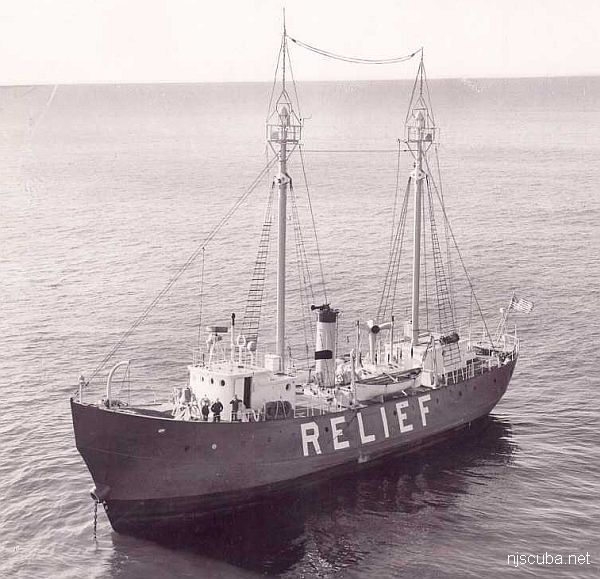
- Type:
- shipwreck, lightship, USCG
- Name:
- Named for its job - as the "relief ship" for the other regular lightships along the eastern seaboard.
- Built:
- 1904, New York Shipbuilding, Camden NJ USA
- Specs:
- ( 129 x 28 ft ) 631 gross tons, 9 crew
- Sunk:
- Friday June 24, 1960
collision with freighter Green Bay - no casualties - GPS:
- 40°27.144' -73°49.070' (AWOIS 2003)
- Depth:
- 105 ft, main deck at 90
More: Relief Lightship WAL-505 ...
- Type:
- artificial reef, lightship, USA
- Name:
- Named for the harbor that it served as marker for during its long active career.
- Built:
- 1946, Devoe Shipbuilding, Bay City MI USA
- Specs:
- ( 128 x 30 ft ) 630 tons
- Sponsor:
- Atlantic County, Trump Casino, Atlantic City Seafood Festival, Artificial Reef Association, Atlantic County Party & Charter Boat Association
- Sunk:
- Friday January 28, 1994 - Atlantic City Artificial Reef
- GPS:
- 39°15.444' -74°14.004'
- Depth:
- 85 ft
More: Boston Lightship WLV-189 ...