
Horned Salp
Thalia democratica
Although they may superficially resemble swimming siphonophores, salps are actually free-living tunicates. There are 6 genera of salps and all are transparent.
Tunicates are much more advanced in the evolutionary scheme of things than jellyfishes, having, for example, a circulatory system. The larvae actually even have several features in common with vertebrates, including the precursor of a spinal cord, but these are lost in the sac-like adults. Salps do not sting.
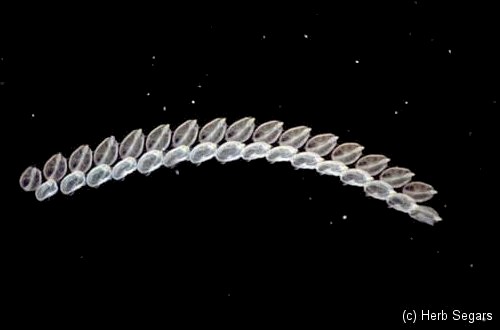
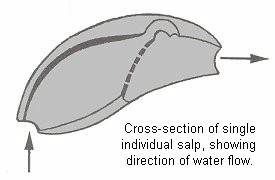
These animals pump water through their body for respiration, feeding, and locomotion. They feed near the surface. Salps secrete a mucous film that runs along the body wall to the mouth, collecting particles from the surrounding water to feed on. Individual animals range in size from under an inch up to 8 inches, depending on the species. Salps often form long chains ( up to 90' ) of connected individuals. A common predator of salps that is often seen in local waters is the Sunfish, Mola mola.

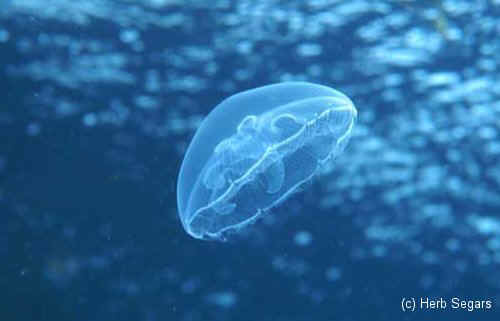
The many creatures on this page are lumped together for the one trait they all have in common - they are all "jelly-like" - soft, gelatinous, and more-or-less transparent. Other than that, they are for the most part completely unrelated. True Jellyfishes, Hydromedusae, and Siphonophores are in the phylum Cnidaria, related to bottom-dwelling Hydroids, Sea Anemones, and corals. Comb Jellies are in the phylum Ctenophora, and are completely unrelated to jellyfishes, as are Sea Butterflies and Corollas, which are mollusks. Salps are free-swimming tunicates, more closely related to us than to any of these other creatures.
More: Jellyfishes ...