
Navigational Aids
Here are a few pieces of gear to help you find your way around in the deep blue, or green, brown, or black, as the case may be. When diving, it is important to remember that you need to navigate both horizontally, and vertically. The vertical component is usually taken care of by the dive boat anchor, but emergencies do occur, and you should be prepared.
2016 Update
Nothing much has changed in twenty years. The Tektite strobe is exactly the same, and you can still get good big dive reels, although enclosed models have disappeared. Compasses still point north, and flags are still a bother.
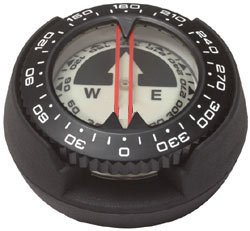
A compass is the most basic and inexpensive piece of navigational equipment and should be bought at the same time as the rest of your gauges.
In a beach or inlet dive your compass is your single most important tool - it tells you which direction is the shore. When wreck diving, a compass is useless if you don't look at it until you're lost. Take a bearing as soon as you hit the bottom, just in case. In a boat dive, directions such as "turn right from the anchor" can often steer you in the opposite direction, if the current reverses and pulls the boat around to the other side. Compass bearings are much more reliable.
More: Compass ...
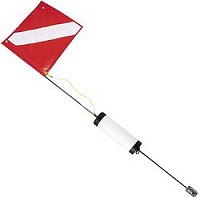
All divers are required to show a flag when in the water. When boat diving, the boat will fly the flag for you, but when shore diving you must take care of this yourself. All dive shops sell flag/floats and lines. The simple fiberglass pole type is inexpensive and works fine; there is no need to buy anything extravagant - it will only get beat-up. If you plan to stay in one place, you can tether the flag to an extra weight on the bottom, or even just prop it up at the shore. If you plan to move around, then you should drag it behind you.
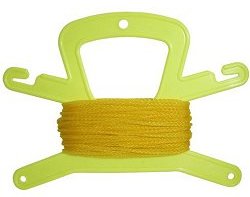
Use only polypropylene for a flag line, never nylon. Polypropylene floats, so when it goes slack it will float up away from you, instead of sinking down in coils around you, like nylon. The big yellow spools that dive shops sell work very well. Although they look clumsy, their size makes them easier to handle in the water. With experience, you will learn to gauge the amount of line necessary to keep the flag from being pulled under, without letting out a huge excess to get tangled up in. Add a brass snap to clip it off for hands-free use. Once you get used to it, dragging a flag is really no trouble at all.
More: Dive Flag ...
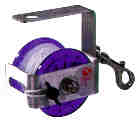
A wreck reel should be considered standard equipment on all but the easiest open ocean dives. Even if you aren't into wreck penetration, you can use the reel as a foolproof way of always knowing how to get home. Just clip it on, and off you go. This is much easier and more reliable than any other means of navigation, and is useful in many situations, especially in poor visibility. Among other things, a wreck reel will allow you to make explorations over featureless sand areas, and in confusing debris fields, like the Mohawk, as well as conduct organized searches, etc. In open water, a wreck reel is often more useful than a compass, although you should always carry one of those as well. On the other hand, there is no real use for a wreck reel in a typical inlet or jetty dive, whereas your compass will be extremely useful.

More: Wreck Reel ...


Lift bags are commonly used for recovering heavy objects from the bottom. The bag is simply tied on, inflated from a regulator, and shot to the surface. An often-overlooked use for a lift bag is to get yourself to the surface in a safe manner when you have become lost and can't find the anchor, or if the anchor has pulled out of the wreck. Using your reel as described above, you can shoot a bag directly to the surface and then ascend on the line.
However, under such circumstances, I prefer to get myself off the bottom and up to my decompression or safety stop depth as quickly as possible, and then deploy a bag to the surface using a short length of line attached to the bag for just that purpose. Either way, the bag marks your position for the crew of the dive boat. You should write your name in bold letters on your bag, so you can be identified before you surface. The bag will also keep you from being sucked down to the bottom if there is a strong current. Most lift bags have open bottoms. A bag like this can hit the surface, tip over, and deflate. For self-rescue, as described, you should use a bag with a self-closing bottom.
More: Lift Bag ...
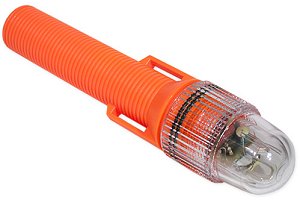
Day or night, an inexpensive flashing strobe light hanging from the anchor chain will guide you home. At night, it may be the only thing that leads you back to the up-line, and even during the day, it is reassuring to look up and see it blinking in the distance. Under some conditions, it can relieve you of the need to use a wreck reel, something that any spearfisherman would appreciate.
In fact, the more strobe lights there are hanging from the anchor line, the better. The presence of your strobe light signals to other divers that you are still down. Don't get one of the miniature AA-powered models, get a big bright one that you can see from a distance through murky water. The tektite Strobe 300 (pictured) is the biggest and brightest model available, and probably the best for use in our murky waters.
More: Strobe Light ...
There are on the market today portable underwater direction-finding units that home in on each other by sound. These provide similar functionality to a strobe light, but with ( theoretically ) longer range, and are ( theoretically ) unaffected by water conditions and visibility. They are also very expensive, and prone to failure when a large object or wall gets between the two units. A number of times I have seen people get lost because they counted on one of these gadgets, and it didn't work.
Perhaps the most disturbing thing about these devices is that their users seem to be mostly beginners who place unfounded faith in them, probably because they paid so much for it at the dive shop. They seem to hit the water in "brain-off" mode, counting on their expensive gadgets to get them home, and making little or no effort at other forms of navigation. Unfortunately, these people are probably the least able to cope with the emergency situation that arises when they find out just how reliable their little sonar toy isn't. Learn to use a wreck reel instead.
More: Sonar ...
Top wreck divers offer their opinions on how to deal with low visibility. Using navigation skills and avoiding panic are the keys to coping with this problem.
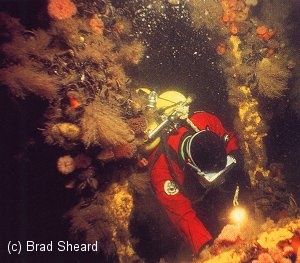
Diving Blind
YOU'RE INSIDE A WRECK, and either through your own fault or an environmental change, the visibility drops to zero. How do you manage it?
We asked two of the Northeast's top tech divers for their opinions on managing low- or no- vis overhead environment situations.
Dan Crowell is captain of the Brielle, New Jersey-based dive boat SEEKER. He is a tech diving instructor, as well as a commercial diver who has made more than 130 dives on the Andrea Doria. He has also been a member of expeditions to the USS Monitor and the Britannic, among others.
John Chatterton also is a commercial diver, tech instructor, and boat captain. Among his dive accomplishments are the first Trimix dive on the Lusitania and the first rebreather dive on the Britannic. He did his 100th dive on the Doria in 1996. Both men are also accomplished underwater videographers and members of the prestigious Explorers Club.
"I always plan on encountering zero visibility, " said Chatterton. "If I don't, great. If I do, it poses two specific problems: One, it's as intimidating as hell, and two, it poses terrific navigation problems. Preparation is the key defense."
Crowell says divers are responsible for creating most visibility problems. Ninety percent of the time, it'll clear if you just stop moving, maintain contact with the wreck and wait."
As with any difficult environment or situation, panic is the killer in zero vis, he says. Relax, take a few breaths and analyze what is occurring. Maintain your original position vis-a-vis contact with your surroundings and think before reacting. If there is a current, it will eventually clear your position.
Crowell says one simple means of avoiding visibility problems when digging or moving wreckage is to orient yourself toward the exit before you begin to dig and to excavate into the current, not with it.
NAVIGATION
Both divers consider navigational skills to be the key to low visibility diving. "No method of navigation is failure proof", said Chatterton. "In my opinion, successful navigation is using multiple methods simultaneously as conditions dictate. Navigation doesn't happen by itself. It takes effort, but it can enable you to do things that otherwise would be extremely foolhardy."
Simple Navigation
Commercial diver John Chatterton uses the following tips to keep navigation simple:
STROBE LIGHTS or Cyalume sticks at critical navigation points.
IDENTIFICATION of specific locales within the ship. This comes from experience of intimate knowledge of the wreck.
MAGNETIC COMPASS: Know the lay of the wreck and the direction you're traveling.
PENETRATION LINE: (a "pen line").
LINES OF the WRECK: Follow naturally occurring lines like a seam between a deck and a wall, a pipe or a cable.
EXACT DEPTH: Know the exact depth of landmarks, exits, tie-ins and other key navigational points.
"At any given time, I will have, at the very least, two methods employed, " he says.
Crowell adds personality to Chatterton's description: "It's analogous to going shopping at a mall. Some people drive, park their cars, go shopping, go back to their cars and leave, never having to stop and think where they are. Others have to remember what row and section they parked in, which entrance they used, etc. The number of navigational methods you use depends on what you're comfortable with."
REELS
"I hardly ever dive with a reel, " said Crowell, "but I only go as far as I'm comfortable. If you don't feel comfortable, you shouldn't be where you are. Pen (penetration) lines are fine if you know how to use them and lay them out. There's also a time factor involved on each end of the dive - laying the line going in and removing the line coming out. A reel is a secondary piece of equipment. Don't use it as a crutch nor expect it to be there when you need it."
"A pen line can break or be cut on just about anything", noted Chatterton. "Then what? In my opinion, penetrating with only a reel is foolish and dangerous. And using a pen line is much slower than swimming without one.
PROGRESSIVE PENETRATION
"As I understand it, Gary Gentile coined the phrase 'progressive penetration' to describe penetration without a reel, instead relying on multiple dives to learn a specific area and progressing incrementally each dive", said Chatterton. "I'd describe this as experience, but it's come to describe any non-reel penetration."
"Knowledge and experience go a long way", agreed Crowell. "Don't go beyond your comfort zone. Get deck plans and study the layout of the wreck. Count portholes or doorways on the way in. And start practicing progressive penetration on wrecks with lots of ambient light. One thing I still do is take my light and place it in my stomach, then sit and wait for my eyes to become accustomed to the dark. You'd be surprised at how they pick up the ambient light."
"Panic will kill you", said Crowell. "It reverts right back to your open water training. Assess the situation, stop and take three breaths, but don't panic." the name of the game is survival, which is as much an attitude as an action.

SURVIVAL
More often than not, it is the perception of a problem, rather than the problem itself, that leads to an accident. Don't freeze, and don't focus on what you did wrong - there's plenty of time for recriminations later. Instead, concentrate on getting your breathing, emotions, and actions under control. Think about where you are and how you will exit the wreck, then devote your attention to retracing your route at a calm, steady pace.
reprinted from Sport Diver magazine, May / June 2000