
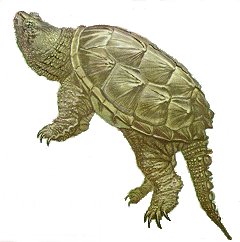
Snapping Turtle

Snapping Turtle

Chelydra serpentina

Size: to 15" (body)

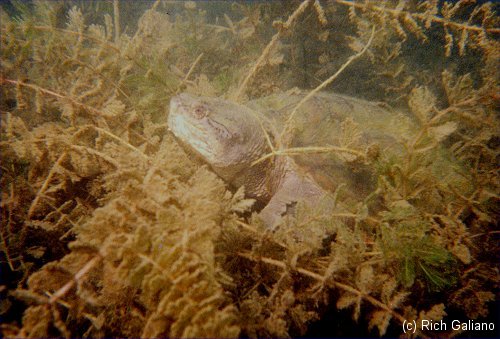
Habitat: hides on the bottom in any type of water

Notes: Generally docile and easily approached in the water, but should be treated with respect for its powerful bite. This turtle can easily amputate a finger or toe and becomes pugnacious when landed. If you have the patience, try to see how long this turtle can go between breaths. A lot longer than you or me, that's for sure.
Snapping Turtle
In the water, these turtles are inoffensive, but don't tempt fate!
Snapping Turtle

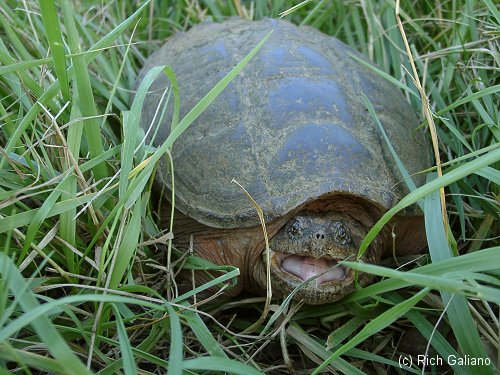
On land is a different story. I pulled over and used a stick to push this nasty little guy off the highway. He was not the least bit appreciative, and snapped at me repeatedly - the long neck gives this turtle a very quick snake-like motion. Spring seems to be the season for Snapping Turtle wanderlust, and they turn up in the darndest places.


Human Vision Underwater

When light travels from a less-dense medium like air to a more-dense medium like water, the rays are refracted or bent towards the normal or perpendicular of the surface between the two mediums. In crude terms, light going from air to water will tend to be straightened, while light going from water to air will tend to be ... um ... crookeded. Confused yet? Take a look at the figure below.

refraction
( Tautogolabrus adspesus )

In this figure, you can see the light rays traveling from an object in the water to your eyes, neglecting the effect of the flat glass lens of your mask. The blue lines trace the actual path of the light rays through the water and into the air, or conversely, through the air into the water - the direction really doesn't matter. As you can see, the rays are bent toward the perpendicular of the surface on the water side, and away from it on the air side.