Sharks - Dogfishes
from us than we are from them.
Real sharks are ashamed of them.
"Dogfish" is a generic name for a large number of small, generally harmless, and unaggressive sharks, not all of which are very closely related. Smooth Dogfishes are related to Tiger, Bull, and other Requiem Sharks, while Spiny Dogfishes are in a completely different group, more closely related to Angel Sharks. Compare these with the unrelated Chain Dogfish, a "Cat" shark. Sandbar sharks have nothing in common with the others here, except their small size. None of these little sharks is really dangerous, although any of them could give a good bite if provoked. Generally, they will avoid you.
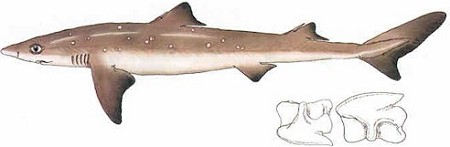
Spiny Dogfish
Squalus acanthias
Size:
to 3ft (male)
to 4 ft (female)
Habitat:
cool coastal waters, midwater, and bottom, but seldom at the surface
Notes:
The Spiny Dogfish has two distinguishing features: rows of small white dots that run along its sides, and a sharp spine that is found in front of each of its two dorsal fins. The spines of the Spiny Dogfish are formed from material much like that of our teeth. Other distinguishing features include the lack of an anal fin, and the rounded, un-notched tail, unlike the Smooth Dogfish. In the water, the white spots are the thing most likely to jump out at you for identification, although they fade away in some older individuals.
More: Spiny Dogfish ...
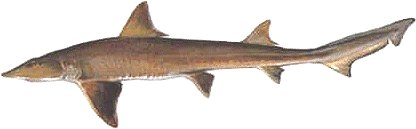
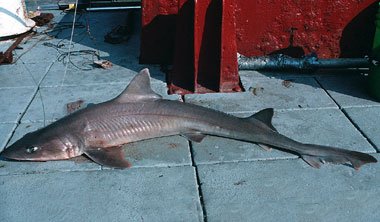
Smooth Dogfish
Mustelus canis
Size:
to 4ft (male)
to 5 ft (female)
Habitat:
shallow coastal waters, in depths 30 ft and below.
Notes:
Smooth Dogfish are tannish-gray, slate-gray, or brown above. The lower sides and belly are white, grayish-white, or yellow. A sooty spot is often found near the tip of the upper lobe of the caudal fin. The species is distributed from New Brunswick, Canada, to Uruguay, and inhabits the bottoms of estuaries and coastal waters out to a depth of about 650 feet. During the spring and summer, most of the sharks are found in waters less than 60 feet deep.
More: Smooth Dogfish ...
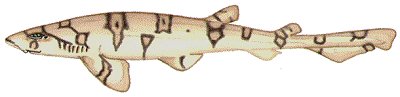
Scyliorhinus retifer
Size:
to 18"
Habitat:
open ocean bottoms, deep
Notes:
This is a harmless little Cat shark that is found on deep wrecks beyond 130 ft.
More: Chain Dogfish ...
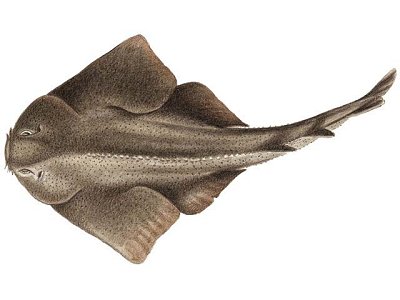
Squatina dumerili
Size: to 5 ft
Habitat: shallow coastal waters to extreme depths
Notes:
Angel Sharks are ambush predators, much like Goosefish. They are generally passive creatures but can bite viciously if provoked. They seem to be intermediate between sharks and rays, and are actually more closely related to Spiny Dogfish than anything else, despite appearances.
More: Atlantic Angel Shark ...
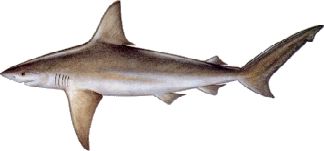
Carcharhinus plumbeus
Size:
to 6 ft
The Sandbar Shark is the commonest inshore shark in New Jersey waters.
Most people are familiar with Peter Benchley's thrilling novel Jaws or one of the movies it has inspired. The image of a giant shark terrorizing a small resort community is hard to forget. After all, the idea of predators ( in this case, people ) becoming prey realizes one of our most primal fears. It also makes for exciting reading or viewing.
More: Sandbar (Brown) Shark ...
- Sea Basses & Porgies ...
- Blackfish & Cunner ...
- Cods & Allies ...
- Triggers, Puffers, & Sunfish ...
- Flounders ...
- Drums ...
- Ocean Bottom ...
- Baitfishes ...
- River & Inlet ...
- Pelagics ...
- Tropical Fishes ...
- Sharks - Inshore ...
- Sharks - Offshore ...
- Sharks - Dogfishes ...
- Skates & Rays ...
More: Marine Fishes ...
Fish
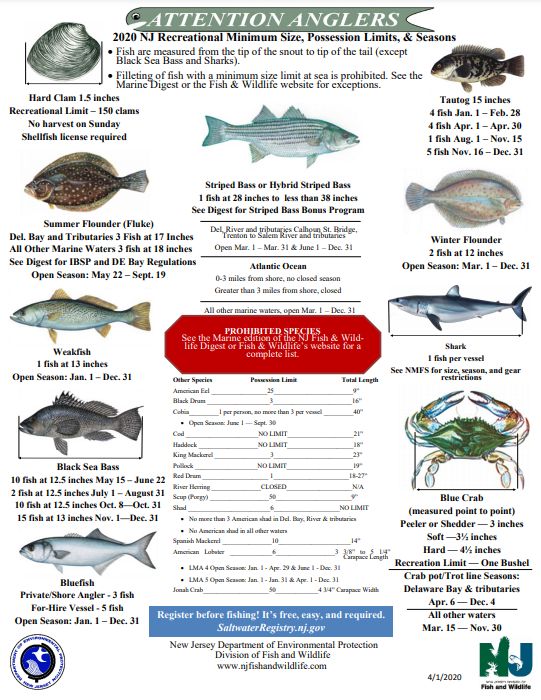
New Jersey now requires registration for saltwater fishing, including lobsters. Registration is free and can be done online at nj.gov/dep/saltwaterregistry.
This listing is for New Jersey waters only - if you cross into New York or Delaware, or Federal waters ( more than 3 miles offshore, ) you are subject to their regulations. Federal regulations supersede state regulations whenever stricter.
Lobster
More: Fishing Regulations ...