Blue-Green Algae
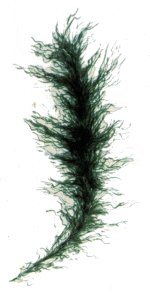
Most blue-green algae are inconspicuous, forming slimes or velvety coverings on any available surface. Some blue-green algae, not all of which are blue-green in color, are capable of surviving in extreme conditions that kill most other forms of life. Some give off toxins that are harmful or fatal to other forms.
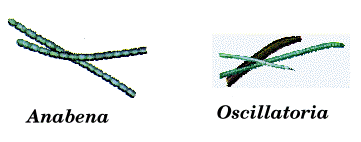
Although it may seem a minor difference between green and blue-green, the names belie a tremendous difference in biology - these are actually photosynthetic Bacteria.
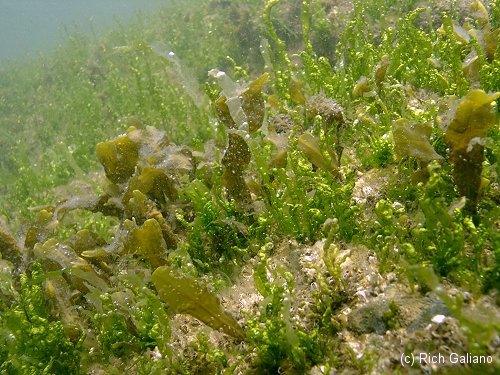
In our waters, plants and algae are found only in shallow water where sufficient light can penetrate for photosynthesis. It would be unusual to find algae below 10-20 ft, so our wrecks and reefs, despite the profusion of attached organisms, are actually devoid of plant life! Of course, that is completely neglecting the microscopic algal plankton that is so profuse in our waters and so lacking in the clear water of the tropics.
More: Algae & Seaweeds ...