
June 1, 2018
Clinging Jellyfish - 2018
June 1, 2018
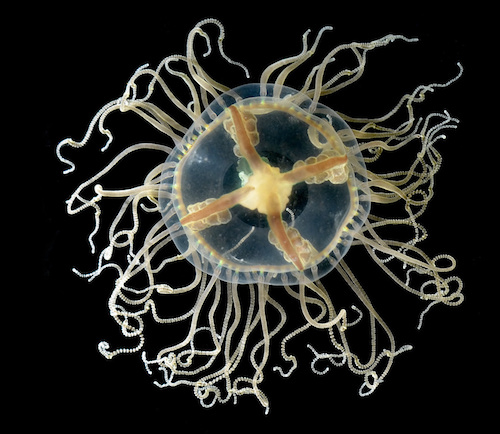
very dangerous
This is a Pacific coast jellyfish that has been spotted along the East Coast for many years, but until recently has been uncommon. It is slightly larger than a quarter, about one inch in diameter. The sting of this jellyfish will send you to the hospital, not just people that are especially sensitive, but anyone. It is found in bays and inlets where it clings to seagrasses, it is not normally found in the open ocean. Your best protection against jellyfish stings is an exposure suit; even a lycra skin is thick enough to block the microscopic stingers.
- Clinging Jellyfish Fact Sheet
Biology, 06/1/18
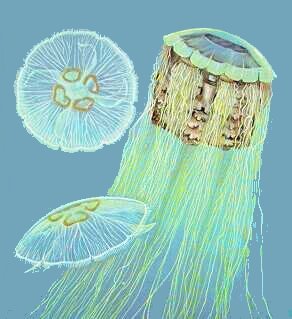
Red Jelly Cyanea capillata (right)
Jellyfishes are free-swimming relatives of corals, anemones, and hydroids. In fact, in many cases, they are the same species, just in a different stage of life! Not all medusas ( as jellyfishes are called ) have a corresponding polyp stage, and likewise, not all polyps have a corresponding medusa stage, but most alternate generations in each form. Small jellies ( up to 1" across ) are most likely the medusa stage of some hydroid, while large jellies are usually the dominant stage of a species in which the polyp stage is almost absent. Even anemones have a periodic medusa stage, although it is infrequently observed.
Although jellyfish can swim slowly, they are largely at the mercy of the tides and currents, and at times large numbers are concentrated into bays and may be stranded on beaches.
More: True Jellyfishes ...
« » Hello World! »