
Goosefish
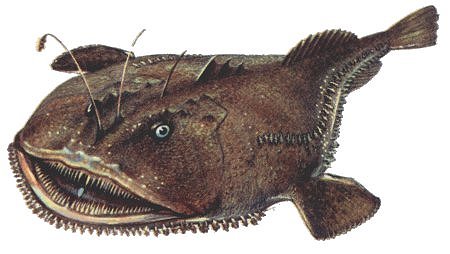
Lophius americanus
Size
to 48" and 50 lbs.
Description:
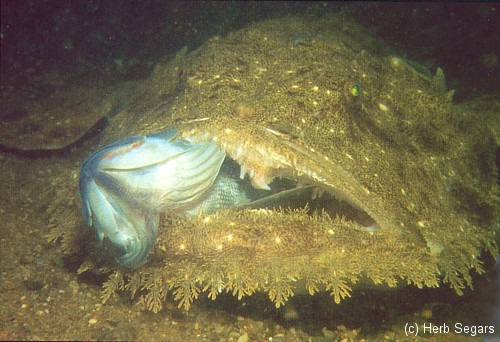
Also known as Headfish, these are a living nightmare in appearance, although they are actually rather docile, provided you don't get too close to the hungry end. Like alligators, they will snap at anything that comes within range, which makes for a number of hair-raising but amusing stories. The tails of these toothy monstrosities are excellent eating and are served in restaurants as "Monkfish" ( also known as "Headfish" and "All-mouth". ) They are extremely slimy. Females are larger than males. A related species in Europe grows to 100 lbs!
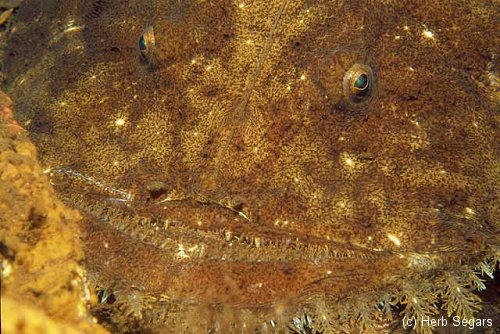
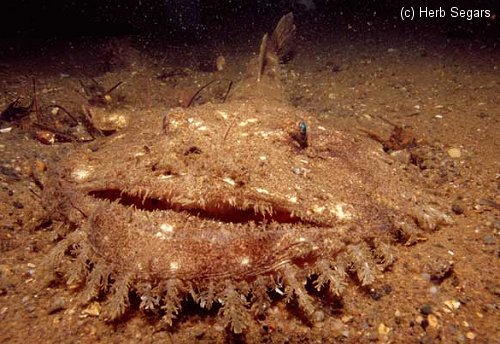
The family Lophiidae includes large, flat-headed fishes with enormous mouths and tapering bodies. They are unlike any other fish in the region, and it would be difficult to confuse them with other species. Also referred to as Monkfish, All-mouth, and Anglerfish, Goosefish have their first dorsal spine modified for a special purpose. The spine possesses a flap of skin at its tip which acts to lure prey when it is wiggled back and forth like a worm on the end of a slender reed. Behind its head, the Goosefish has a group of short dorsal spines that are connected by a black membrane. Another, more southerly species, the Blackfin Goosefish, Lophius gastrophysus, lacks the interspinous membrane and has longer dorsal spines. The Goosefish is dark chocolate brown above, sometimes mottled, and light tan below. It is a benthic species occurring in coastal waters and out to depths of at least 1,500 feet from New Brunswick, Canada, to northern Florida. Goosefish inhabit sand, mud, and broken shell bottoms in waters ranging from about 32 to 75°F.
Spawning occurs offshore from spring to early fall, depending on the latitude. Reproductive activity commences as early as March off North Carolina and as late as September off New England. The pelagic eggs are deposited in huge gelatinous masses. These ribbon-like egg veils are seasonally observed by sea-going fishermen, for they may be 20 to 36 feet long and 2 to 3 feet wide. The purplish-brown eggs, numbering 1 to 2 million, are clustered in small groups of several ova, each in compartments within the floating mass. Hatching takes place in continental shelf waters that are 41 to 65°F.
Goosefish are among the most gluttonous of all fishes. Not only do they ambush small prey, aided by their fishing appendage, but they also engulf large food items. Foods identified from Goosefish stomachs include Spiny Dogfish, skates, eels, herrings, Weakfish, Tautog, Butterfish, puffers, Cod, Haddock, flounders, sea birds (loons, seagulls, scoters, and mergansers), lobsters, crabs, worms, shellfish, sand dollars, and starfish. One Goosefish contained 21 commercial-size flounders and a Spiny Dogfish; another had eaten 75 herrings, and a third consumed 7 wild ducks.
Goosefish are good eating, but more like lobster than fish. Not good fried, better stewed, or almost any recipe where you would use lobster.

These fishes are most likely to be found on or near the bottom out at sea, either resting or swimming around. In addition, many of the types more often found in the rivers and inlets may be found out at sea.
Many of the types presented here are representative of entire families of similar related species. While some are closely related, others are not. These particular species are the most common in our area.
More: Ocean Bottom ...
Most folks catch fish with hook and line. A successful fisherman combines skill, knowledge, and experience with a good deal of luck to essentially trick a fish into catching itself. If the fish won't bite, you go home empty-handed. However, scuba divers have a much more dynamic method available to them - spearfishing. Spearfishing is more akin to hunting than to hook and line fishing: rather than relying on a convincingly presented bait or lure, the spearfisherman enters the environment of his quarry and pursues it on its own terms.
More: Spearfishing ...