Photography - Well-lit Situations
Close-up & Flash
By well-lit, what I mean is situations that fall within the normal range of your camera's exposure program. This is a combination of ISO (film) speed, shutter speed, and aperture which will result in capturing a desired image. On land, such situations occur all day long, but underwater they are rare. Clear shallow water with a bright sun shining overhead is the only environment in which your camera is likely to work unaided, as it would topside.
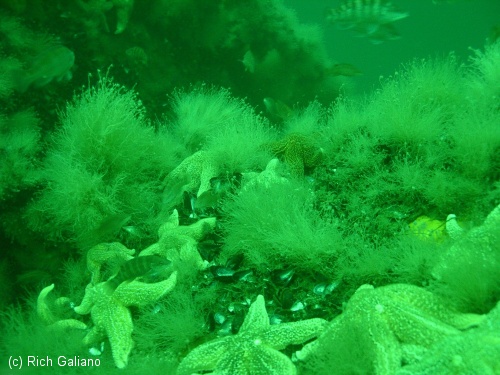
An unremarkable ambient light test shot, at a depth of about 100 ft. Note the loss of colors, even close-up. Flash would bring out all the hidden colors.
In deeper water or under less-bright conditions, ambient light may be augmented with flash. Flash has a number of drawbacks when used with auto-programmed exposure. Most cameras have a fixed flash sync shutter speed of around 1/90 second in any automatic exposure mode. This is very fast for underwater shooting and will cause the camera to capture little if any of the available ambient light. Hence, any distant background will be extremely dark or even black, although the subject should be properly lit by the flash.
An indirect problem with flash photography under such circumstances is focus. Unfortunately, auto-focus does not work nearly as well in a housing behind a port underwater as it does up above in air. If your camera has a fast lens ( f/2.8 or better ) the auto-exposure program will naturally make use of it, and open up to the maximum aperture. Such wide apertures have very little depth-of-field, and thus any error in focus is likely to ruin the shot. Compounding this, there is often little in an underwater scene for an autofocus system to "latch on to", and focus errors are common.

To increase your likelihood of success, use aperture-priority mode to manually stop down the lens to f/4.0 or so, and increase the ISO speed to 200-400 to compensate. Remember - it is possible and even easy to salvage a poorly exposed digital photo by "pushing" or "pulling" the exposure after the fact, but if the focus is off, there is no way to fix it! Ironically, cheaper cameras with small-aperture lenses may be saved from these focus problems by depth-of-field.
Underwater strobe lights have a very limited effective range, four to eight feet at the outside. This limits you to shooting only subjects that are within flash range. Large subjects are typically not possible, owing to the restricted underwater field-of-view at the short distances involved.
Sand is tricky stuff to shoot at with a flash, because it is usually so reflective that all you get in your picture is glare, especially at close range. Try turning the strobes slightly away from the subject, so the light falls indirectly, and use a diffuser.