
Dive Training
So you’re thinking about trying scuba diving, but you’re not sure where to start. It is actually not difficult to get your entry-level certification to dive, easier than getting a driver’s license. Look in the Yellow Pages or in the Directories section of this website for a shop near you, or inquire at the local college, university, or YMCA, which may run classes that are open to the public.
- Gear Contents ...
- Dive Training ...
- Dive Gear ...
- Diving Activities ...
- Gas Calculators
- DPlan ...
Moving on to the professional level, the lowest professional rating is Divemaster. I would hardly recommend doing this unless you are really interested in turning Pro - Divemaster is the longest and most arduous rating of all to get. The Divemaster course is like graduate school - a year or more of indentured servitude. On the other hand, pitching in with classes and other activities can be a lot of fun. Divemasters are the sergeants and mules of the diving world and carry out much of the tour-guiding, tank-filling, and grunt work at resorts and on dive boats. Beyond Divemaster, there is Assistant Instructor, which is basically gold-plated Divemaster, and then increasing levels of Instructor.
More: Dive Training - Advanced ...

You would have to be crazy to dive in the North Atlantic ( or anywhere ) and not protect yourself with inexpensive accident insurance coverage available from DAN - Diver's Alert Network. Check your existing health insurance policy, and you will most certainly find that accidents involving scuba diving are excluded ( skydiving too ).
DAN offers various packages, tailored to everyone from the most occasional Caribbean diver to the hard-core Andrea Doria techie. Coverage includes recompression chambers, transport, and other costs, both in and out of the country. The yearly fee for all this is not much more than the cost of a mask, or a single day's boat diving, and also includes membership in the organization and a subscription to their excellent safety-oriented magazine Alert Diver.
More: Insurance & Emergencies ...
From way back when in 1996 ...


by Dr. Jolie Bookspan, author of Diving Physiology in Plain English
Myth 1 - The Dive Reflex Protects You

In the dive reflex, heart rate and limb blood flow decrease. Careful science ( that means we didn't accidentally step on the thermisters ) shows time and again that the dive reflex does not reduce the need for oxygen underwater as it does in marine mammals. Field studies ( where you're allowed to step on the thermisters ) indicate that the dive reflex does not extend breath-holding time. Occasional cases of human survival after very cold water near-drowning are not due to the dive reflex. Cold is the likely mechanism behind the reduced metabolism that permits survival.
More: Diving Myths ...
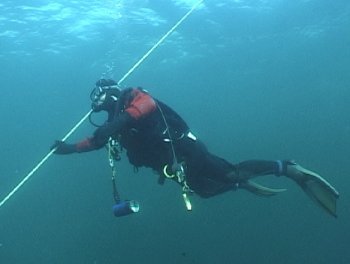
Here is a description of recreational dive planning. The purpose here is to demonstrate basic dive planning and use of Dive Tables for non-divers who are interested in becoming certified but are worried about the complexities and math involved. Learning to use dive tables is usually the single most daunting classroom task for a student diver. It's really not all that hard.
The purpose of dive planning is to manage the Nitrogen gas that is absorbed into the tissues of your body while breathing air at higher-than-normal pressures underwater. If you absorb too much Nitrogen at depth and then ascend to normal atmospheric pressure, the gas will form bubbles in your blood and tissues. This is called Decompression Sickness, commonly known as "the bends." Decompression Sickness can vary in severity from barely noticeable to fatal, depending on your dive profile and other factors. The goal of no-decompression dive planning is to plan your dives in advance so that under no circumstances* can ascending to the surface result in Decompression Sickness.
More: Dive Planning ...
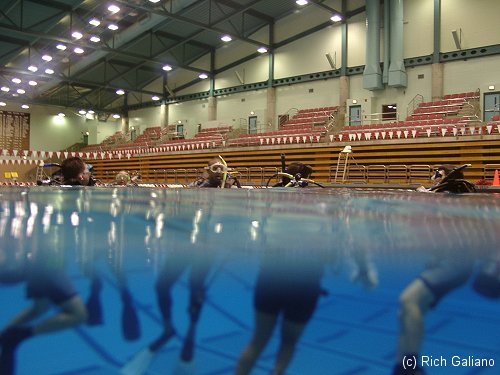
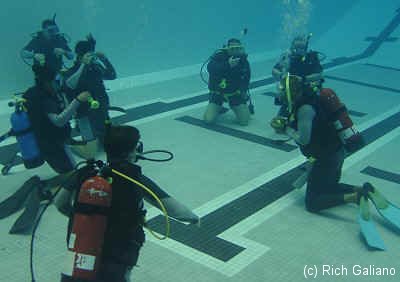
Scuba diving in the United States is by and large not regulated by the government ( as opposed to Australia and other places, where it is. ) This remarkable fact is the result of the scuba industry's so-far successful efforts to head off government meddling by putting forth their own standards for training, equipment, and other specifics. In fact, all the major diving certification organizations and manufacturers actually got together and agreed on a basic set of requirements for the industry, and even have an ISO-9000 certification for it.
More: Dive Training - Getting Started ...
Beneath the Waves
By Steve Nagiewicz & Herb Segars
Photography by Herb Segars
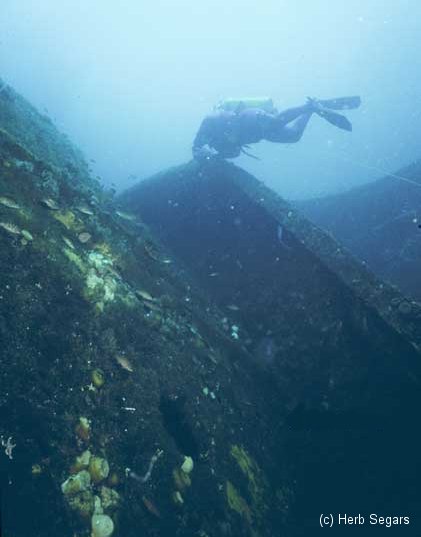
We have all watched television and marveled at the presentations of renowned underwater explorer Jacques Cousteau, or the movie fiction of Peter Benchley's "Jaws" or "The Deep." they have given us a glimpse into the strange underwater world that few of us get to explore. Yet how many of us have sat along the water's edge and wondered what mysteries must lie beneath the waves?
More: Why Dive in New Jersey? ...
- Home ...
- Dive Sites ...
- Artificial Reefs ...
- Marine Biology ...
More important than gear is training, and more important than training is experience. You can buy gear and training, but there is only one way to get experience.
In aviation there is a saying: "You start out with a full bag of luck, and an empty bag of experience. The trick is to fill up the bag of experience before the bag of luck runs out." The same is true for diving. Take it slow. As one of my instructors said: "There are old divers, and there are bold divers, but there are no old bold divers."
When you start out in this sport, buying your first set of dive gear can be bewildering, not to mention expensive. The sad truth is that as a newly-certified diver, the equipment you have seen and used so far is not what you should be buying for real-world use. Almost all of it - jacket-style BC, weight belt, light, snorkel, etc - is more suited to floating students in a swimming pool or quarry than real-world diving. Most scuba gear is designed for the mass market of easy, infrequent, warm water diving, and is inadequate and/or inappropriate for diving around here. With so many different models and variations of everything - how do you select the best equipment for you? In the absence of any other guide, your first impulse may be to go out and buy just the same gear you were trained in - which is almost certainly an expensive mistake.
More: Scuba Gear & Training ...