
Smooth Dogfish
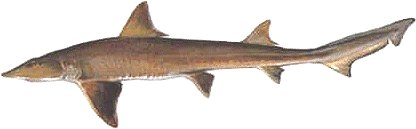
Smooth Dogfish
Mustelus canis
Size:
to 4ft (male)
to 5 ft (female)
Habitat:
shallow coastal waters, in depths 30 ft and below.
Notes:
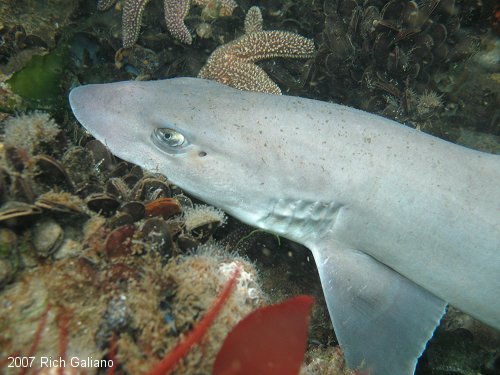
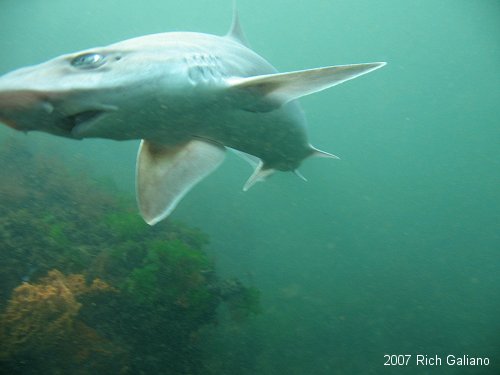
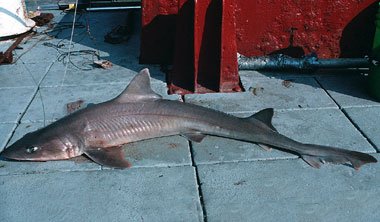
Smooth Dogfish are tannish-gray, slate-gray, or brown above. The lower sides and belly are white, grayish-white, or yellow. A sooty spot is often found near the tip of the upper lobe of the caudal fin. The species is distributed from New Brunswick, Canada, to Uruguay, and inhabits the bottoms of estuaries and coastal waters out to a depth of about 650 feet. During the spring and summer, most of the sharks are found in waters less than 60 feet deep.
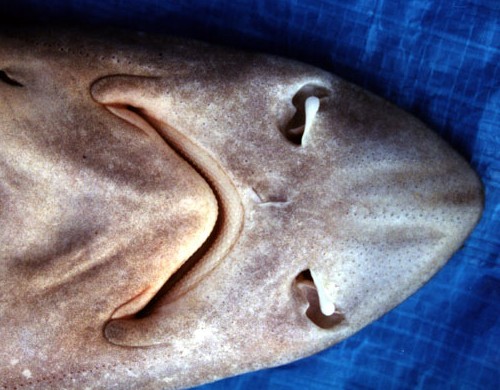
The Smooth Dogfish Mustelus canis is one of the most common sharks along the Atlantic coast of the United States. The small gray-brown shark discarded on a pier or beach in the spring of the year is probably a Smooth Dogfish or "Smoothhound". It is a medium-sized shark reaching a maximum length of about 5 feet, although fish in the 1- to 3-foot class are more common. The species has a slender body with two dorsal fins nearly equal in size. The second dorsal fin is positioned slightly ahead of the anal fin. Other distinguishing characteristics are the narrow, catlike eyes, the large spiracle behind each eye, and the caudal fin, which has a small lower lobe.
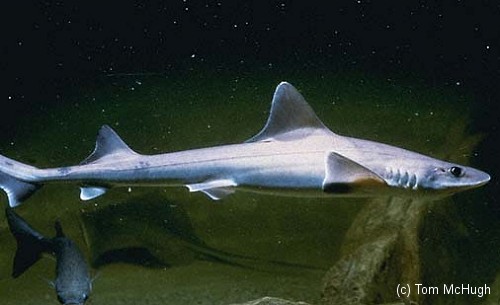
Spawning occurs in coastal waters from May through July over most of the range. Males are sexually mature when they are 1 to 2 years old, females when they are 2 or 3. Fertilization is internal, and after a 10-month period, the female births 4 to 20 ( average 14 or 15 ) 14-inch pups. The sexes grow at different rates. Females are larger at a given age than males, and attain a larger maximum size ( 59 inches compared to 43. ) Average lengths for the sexes combined for ages 1, 5, 10, and 15 years are 16.9, 43.9, 50, and 52 inches. Smooth Dogfish use their senses of sight and smell to scavenge for prey, usually during the hours of darkness. Favorite foods are crabs, fishes, squids, clams, worms, and lobsters.
from us than we are from them.
Real sharks are ashamed of them.
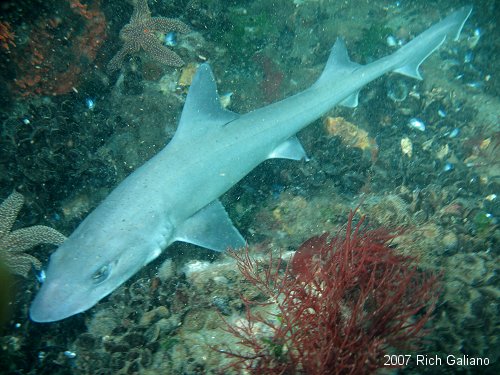
"Dogfish" is a generic name for a large number of small, generally harmless, and unaggressive sharks, not all of which are very closely related. Smooth Dogfishes are related to Tiger, Bull, and other Requiem Sharks, while Spiny Dogfishes are in a completely different group, more closely related to Angel Sharks. Compare these with the unrelated Chain Dogfish, a "Cat" shark. Sandbar sharks have nothing in common with the others here, except their small size. None of these little sharks is really dangerous, although any of them could give a good bite if provoked. Generally, they will avoid you.
More: Sharks - Dogfishes ...
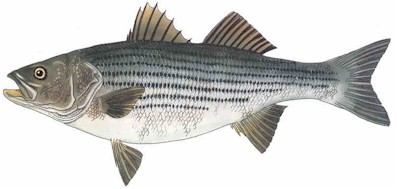
Morone saxatilis
Profile by Thomas Baum,
Senior Fisheries Biologist
Common Name:
Striped Bass, also called Rockfish, Rock, Striper, and Linesider
More: Striped Bass ...
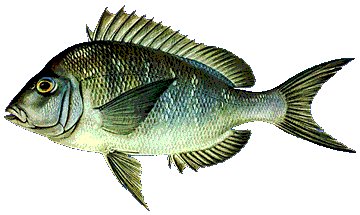
Stentotomus chrysops
Profile by Stacey Reap
Range:
Scup have been found along the Atlantic coast from the Bay of Fundy and Sable Island Bank, Canada, to as far south as Florida; however, the greatest concentrations can be found from Massachusetts to North Carolina. Depending upon the season, they can be found from coastal waters and estuaries out to depths of approximately 650 ft. along the outer continental shelf. A separate population of scup referred to as the "southern porgy" or S. aculeatus, is referenced in several South Atlantic Bight studies; however, there is no official differentiation made between the two populations by the American Fisheries Society.
More: Porgy (Scup) ...